1

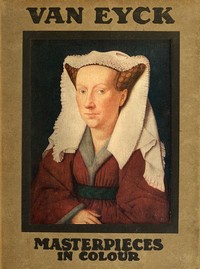
Van Eyck — A Closer Reading
(0 User reviews)
1833
Project Gutenberg
2013
Not confirmed
Eyck, Hubert van, 1366-1426; Eyck, Jan van, 1390-1440
Readers of public-domain and historical texts
Project Gutenberg digital edition
en
Edition facts
Words
14,284
Reading time
63 min
Text sections
2
The source record for Van Eyck — A Closer Reading measures this digital text at 14,284 words, 1 hr 3 min estimated reading time, and 2 detected text sections.
The text analysis averages about 32.0 words per sentence, while the detected sections provide another way to judge how the source is divided.
Project Gutenberg metadata also associates the work with “Eyck, Hubert van, 1366-1426,” connecting these edition facts with the source record’s subject description.
Source:
Project Gutenberg record #41798
This editorial note examines J. Cyril M. Weale's 1908 monograph on the Van Eyck brothers, focusing on the contrast between Hubert's shadowy legacy and John's documented career, the diplomatic mission to Portugal, and the author's reliance on inference and local attribution.
Editorial Edition Score
4.5/5
★★★★★
★★★★★
Calculated from edition completeness, EPUB availability, text structure and catalogue metadata. Not a user rating.
How this score is calculated
- Description quality20 pts
- Title & short description10 pts
- Source metadata20 pts
- Text length15 pts
- Chapters / structure15 pts
- EPUB file integrity20 pts
Total of 100 points, scaled to a 2.5-5.0 range. Editions with an empty description or a missing EPUB file are not scored.
Edition quality
Read the Text
Note: Project Gutenberg also has an HTML version of this file which includes the original illustrations. See 41798-h.htm or 41798-h.zip: (http://www.gutenberg.org/files/41798/41798-h/41798-h.htm) or (http://www.gutenberg.org/files/41798/41798-h.zip)
Images of the original pages are available through Internet Archive. See http://archive.org/details/vaneyckocad00wealuoft
MASTERPIECES IN COLOUR
Edited by T. Leman Hare
Hubert, 1365 (?)-1426 John, 1385 (?)-1441
"MASTERPIECES IN COLOUR" SERIES
BELLINI. GEORGE HAY. BOTTICELLI. HENRY B. BINNS. BOUCHER. C. HALDANE MACFALL. BURNE-JONES. A. LYS BALDRY. CARLO DOLCI. GEORGE HAY. CHARDIN. PAUL G. KONODY. CONSTABLE. C. LEWIS HIND. COROT. SIDNEY ALLNUTT. DA VINCI. M. W. BROCKWELL. DELACROIX. PAUL G. KONODY. DÜRER. H. E. A. FURST. FRA ANGELICO. JAMES MASON. FRA FILIPPO LIPPI. PAUL G. KONODY. FRAGONARD. C. HALDANE MACFALL. FRANZ HALS. EDGCUMBE STALEY. GAINSBOROUGH. MAX ROTHSCHILD. GREUZE. ALYS EYRE MACKLIN. HOGARTH. C. LEWIS HIND. HOLBEIN. S. L. BENSUSAN. HOLMAN HUNT. MARY E. COLERIDGE. INGRES. A. J. FINBERG. LAWRENCE. S. L. BENSUSAN. LE BRUN, VIGÉE. C. HALDANE MACFALL. LEIGHTON. A. LYS BALDRY. LUINI. JAMES MASON. MANTEGNA. MRS. ARTHUR BELL. MEMLINC. W. H. J. & J. C. WEALE. MILLAIS. A. LYS BALDRY. MILLET. PERCY M. TURNER. MURILLO. S. L. BENSUSAN. PERUGINO. SELWYN BRINTON. RAEBURN. JAMES L. CAW. RAPHAEL. PAUL G. KONODY. REMBRANDT. JOSEF ISRAELS. REYNOLDS. S. L. BENSUSAN. ROMNEY. C. LEWIS HIND. ROSSETTI. LUCIEN PISSARRO. RUBENS. S. L. BENSUSAN. SARGENT. T. MARTIN WOOD. TINTORETTO. S. L. BENSUSAN. TITIAN. S. L. BENSUSAN. TURNER. C. LEWIS HIND. VAN DYCK. PERCY M. TURNER. VAN EYCK. J. CYRIL M. WEALE. VELAZQUEZ. S. L. BENSUSAN. WATTEAU. C. LEWIS HIND. WATTS. W. LOFTUS HARE. WHISTLER. T. MARTIN WOOD.
_Others in Preparation._
Illustrated with Eight Reproductions in Colour
London: T. C. & E. C. Jack New York: Frederick A. Stokes Co.
IN TOKEN OF REVERENCE AND LOVE
Page I. The Advent of the Van Eycks 11
II. Hubert's Novitiate 17
III. The Great Polyptych 22
IV. In the Service of Burgundy 42
V. Period of Great Endeavour 58
VI. A Note in Conclusion 77
LIST OF ILLUSTRATIONS
Plate I. The Adoration of the Lamb, _c._ 1426 Frontispiece (By Hubert van Eyck.--The Cathedral, Ghent)
Page II. Choir of Angels, _c._ 1426 14 (By Hubert van Eyck.--Royal Gallery, Berlin)
III. Portrait of "Tymotheos," 1432 24 (By John van Eyck.--National Gallery, London, No. 290)
IV. Portrait of the Painter's Father-in-law, 1433 34 (By John van Eyck.--National Gallery, London, No. 222)
V. John Arnolfini and Joan Cenani, his Wife, 1434 40 (By John van Eyck.--National Gallery, London, No. 186)
VI. The Virgin and Child, St. Donatian and St. George, and Canon G. Van der Paele, 1436 50 (By John van Eyck.--Town Gallery, Bruges)
VII. Portrait of Margaret van Eyck, the Painter's Wife, 1439 60 (By John van Eyck.--Town Gallery, Bruges)
VIII. The Virgin and Child, and Chancellor Rolin, date uncertain 70 (By -- van Eyck.--The Louvre, Paris)
THE ADVENT OF THE VAN EYCKS
The advent of the Van Eycks is the most important landmark in the history of painting in northern Europe. With them we open an entirely new chapter, for although the value of oil in various inferior processes of the art had been ascertained and availed of at an earlier period, it was entirely due to their long and painstaking experiments that its use was perfected as the vehicle of colouring matter in picture-painting. Unfortunately, time and its worst incidentals have obliterated the evidence which would have enabled us to follow the development of this new method, just as they have robbed us of all the earlier work of its original expounders, leaving us at the same time much too inconsiderable remains for a comprehensive survey of the school of which they were the finished product. It is a disconcerting experience to encounter primarily the lifework of two such eminent painters at a stage when they were already in the plenitude of their powers, and an experience that must always tax the ingenuity of the student and critic of their art. Particularly is this the case in respect of the elder brother, for the ascertained facts of Hubert's history are restricted to the last two years of his life (1425-26), while of the masterpieces he bequeathed to posterity only one can be said to be absolutely authenticated, though of others generally ascribed to him several may safely be accepted as genuine. John's career, on the other hand, can be traced back to 1424, but the chronology from that date to his death in 1441 is fairly ample, while he has left us a rich heritage of attested paintings to exemplify the varying aspects of his remarkable genius.
Weale's study of Hubert and Jan van Eyck, part of the 'Masterpieces in Colour' series, opens with a striking asymmetry: Hubert, the elder brother, is granted only a tentative birth year ('1365 (?)') and a single completed work—the Ghent Altarpiece—while Jan's life is traced through court records, diplomatic missions, and dated paintings. The book's structure mirrors this imbalance, devoting three chapters to Hubert's novitiate and the polyptych, then pivoting to Jan's service under Philip the Good of Burgundy. Weale's tone is that of a cautious connoisseur, weaving archival evidence with local traditions, but he repeatedly flags the limits of documentation, especially for Hubert.
Hubert's Shadowy Presence
Weale introduces Hubert van Eyck almost apologetically, noting that 'the advent of the Van Eycks' is obscured by 'the scantiness of authentic records.' The chapter on Hubert's novitiate relies heavily on inference: his training is assumed from stylistic analysis, and his sole securely attributed work is the Ghent Polyptych, completed 'in or before 1426.' Weale describes the polyptych's centrepiece, 'The Adoration of the Lamb,' but offers no detailed description of its composition or colour—a curious omission for a volume in a colour-plate series. Instead, he focuses on the panel's provenance and the difficulty of separating Hubert's hand from Jan's. The reader is left with a portrait of an artist defined by absence, his biography stitched together from a single masterpiece and the silence of contemporary records.
Jan's Portuguese Embassy and Lost Portraits
One of the most vivid passages recounts Jan van Eyck's journey to Portugal in 1428–29 as part of a Burgundian embassy to negotiate the marriage of Duke Philip to Isabella of Portugal. Weale details the mission's itinerary—from Estremóz to Arrayollos, Aviz, and finally audience with the king on 13 January—and notes that Jan 'was at his easel painting the Infanta's portrait.' Two copies were made and dispatched by separate routes to ensure delivery. Weale laments that both portraits are 'lost certain treasures of his art,' a phrase that underscores the fragility of early Netherlandish painting. The narrative then digresses into a catalogue of works in Portugal 'locally claimed for Van Eyck,' including the 'Fons Vitae' at Oporto and paintings in Évora and Thomar. Weale is sceptical, noting that the quantity 'vastly too great' for Jan's brief stay, yet he cannot resist speculating that the master's reputation 'was already one to conjure with in these distant realms.'
The Author's Method: Inference and Attribution
Throughout the text, Weale oscillates between archival precision and speculative attribution. He cites documents—the Duke's letters, the marriage contract signed 29 July, the fleet's dispersal by storm—but when evidence runs thin, he falls back on phrases like 'traditionally ascribed' or 'locally claimed.' The chapter on the polyptych, for instance, offers no technical analysis of the painting's oil technique or iconography, despite these being hallmarks of Van Eyck scholarship. Instead, Weale treats the work as a biographical anchor. This approach reflects the book's origin as a popular introduction: it prioritises narrative over analysis. Readers expecting a deep dive into style or symbolism will find instead a chronicle of what can be known—and what must be guessed—about two painters who transformed Flemish art.
Weale's Van Eyck is best read as a period piece of art-historical writing, one that reveals as much about early twentieth-century connoisseurship as about its subjects. The book's value lies not in its conclusions—many have been superseded—but in its documentation of the evidentiary gaps that still surround Hubert van Eyck and the Portuguese sojourn of Jan. Readers should approach the attributions with caution, noting where Weale relies on local tradition rather than documentary proof. The colour plates, though not described in the text, offer a visual counterpoint to the author's cautious prose.
Reading Weale’s careful guesswork about Hubert and John, all that quiet sifting of attributions, left me feeling oddly tender toward the shadows in art history. It reminded me of how we treat the Pre-Raphaelites—less documented, more felt. I drifted to Dante Rossetti and the Pre-Raphaelite movement — Context and Discussion, where the mystery isn’t solved, just cherished. Some artists remain half-lit, and that’s enough.
There are no reviews for this eBook.
There are no comments for this eBook.
Reader reflection
Take a moment to reflect on this book
Create a short personal record of your experience with this book.
Your progress
0
/
10
2
How much did you enjoy the reading experience?
3
Would you recommend this book to another reader?
4
How demanding did the text feel?
5
Was the book moving at the right speed?
6
What did you appreciate most?
7
How original did the book feel?
8
Did you gain anything practical from the text?
9
What changed or sharpened your thinking?
10