1


Fra Angelico: A Sketch — A Reader’s Guide
(0 User reviews)
278
Project Gutenberg
2010
Not confirmed
Painters -- Italy; Angelico, fra, approximately 1400-1455
Readers of public-domain and historical texts
Project Gutenberg digital edition
en
Edition facts
Words
9,725
Reading time
43 min
Text sections
2
The catalog record for Fra Angelico: A Sketch — A Reader’s Guide provides practical reading context through 9,725 words, 43 min estimated reading time, and 2 detected text sections.
The text analysis averages about 23.7 words per sentence, while the detected sections provide another way to judge how the source is divided.
Project Gutenberg metadata also associates the work with “Painters -- Italy,” connecting these edition facts with the source record’s subject description.
Source:
Project Gutenberg record #34372
This editorial note examines Jennie Ellis Keysor's 1900 biography of Fra Angelico, focusing on how the catalog subjects (painter, religion) align with the text's actual content: a blend of devotional description, historical setting, and anecdotal narrative rather than critical art analysis.
Editorial Edition Score
4.5/5
★★★★★
★★★★★
Calculated from edition completeness, EPUB availability, text structure and catalogue metadata. Not a user rating.
How this score is calculated
- Description quality20 pts
- Title & short description10 pts
- Source metadata20 pts
- Text length15 pts
- Chapters / structure15 pts
- EPUB file integrity20 pts
Total of 100 points, scaled to a 2.5-5.0 range. Editions with an empty description or a missing EPUB file are not scored.
Edition quality
Read the Text
Faith was still so real and living a thing that men and women shut themselves up from the world in order to live holy lives and devote themselves entirely to the service of God.
It is a body of such men on the heights of Fiesole that interests us. They are Dominican monks, of the order of great preachers, founded long ago by St. Dominic. Over long white robes the brothers, or frates, as they are called, wear black capes and back from their tonsured heads fall hoods, which protect them in inclement weather. It is a prosperous monastery surrounded by goodly fields. In some, the olive groves blossom in the spring-like snow, or wear foliage of richest green as the season advances. In others, the yellowing grain waves in the upland summer breeze. The monks are busy people, many without in the fields tilling the fruitful soil or gathering in the abundant harvest.
Indoors there is the silence which attends toil, intense and absorbing. The cellar and kitchen are in perfect order and in the refectory, or dining room, the table is spread for the next frugal meal. In the scriptorium, or writing room, several monks are busy copying ancient manuscripts on parchment. One does this work, using the most exquisite lettering, while another indites the hymns long loved by the church. This other, bending over his task, from a rich palette makes the vine to run, the dragon to coil, the angel head to shine, the tropic bird to fly from out the lettering of his book or, more ambitious still, he decorates a broad margin with an elaborate design. Mayhap he devotes an entire page to the deliniation of some favorite saint.--
"What joy it is to labor so, To see the long-tressed angels grow Beneath the cunning of his hand, Vignette and tail-piece subtly wrought!"
Here in the walk of the cloisters, his pallid face lit up by fiery eyes, strolls another, the preacher of the monastery. To-night he will electrify his audience with the eloquence of his sermon that shall tell of the curse of evil, of the saving power of love.
Yonder, with the face and attitude of one who prays, painting a lovely angel with flame upon her forehead, with stars upon her robe and with a golden trumpet in her hand, is a man whose fancy has outgrown the margin, the full page even, of the beloved parchment book, and so he fills a whole wall with his vision from Paradise. Little need is there to name this painter-monk. It is Fra Angelico, the "Angelical Painter," _Il Beato_, "The Blessed."
To this man, who prays as he paints and who paints as he prays, we are to give our attention for a time. It is particularly delightful to find such a character in a time when holy men and women sometimes forgot their religious vows and ordinary citizens, in their scramble for place, lost sight of the laws of honor and manhood. In a time of greed it pleases us to find a man, who, though his art was the fashion of his period, would take no money for his pictures; in a time of ambition for place, to find one who could refuse an elevated position because he did not think himself fitted to fill it; to find a man so simple and yet so wise that he knew the work allotted to him in life and had the devotion to stick to it in spite of inducements to give it up.
Such a man was Fra Angelico, the sweet character, the beautiful artist of heavenly visions, the man to whom Ruskin goes back as the embodiment of correct principles in art, even beyond Raphael, the idol of the ages. Fra Angelico is the last figure of the old simple time in art when the spirit counted for most. He lingered long on the threshold of that later time, when men forgot the spirit in their enthusiasm for copying the real thing as it presents itself in nature.
Now that we know what the prosaic artists of that prosaic time taught, namely to draw correctly, we go back to the visions of the angelical painter and hug them to us as a rich bequest, a glimpse, as it were, of that paradise closed to mortal eyes. Along other lines too, it is good for us to study the men and women who were great enough to be simple, to be devoted. In art it is quite as good and equally delightful.
Jennie Ellis Keysor's Fra Angelico: A Sketch (1900) opens not with the painter himself but with a panoramic view of a Dominican monastery near Florence, situating the reader in a specific time—'when the Renaissance is virgin new to the world.' The catalog subjects list 'Painters -- Italy' and 'Angelico, fra, approximately 1400-1455,' yet the excerpts reveal a text more concerned with the monk's pious environment and personality than with systematic art criticism. Keysor describes the monastery's olive groves, grain fields, and the silent toil of monks copying manuscripts, establishing a devotional atmosphere before Angelico appears. This approach suggests the sketch is as much a spiritual portrait as a biographical one.
Devotional Setting Over Artistic Analysis
The excerpts devote considerable space to the monastery's daily life—the black capes, tonsured heads, and orderly refectory—before discussing any painting. Keysor writes that the monks 'shut themselves up from the world in order to live holy lives,' framing Angelico's art as an extension of that piety. When she finally addresses his work, she relies on quoted authorities like John Ruskin, who calls Angelico's paintings 'so many huge pieces of opal among common marbles,' and Paul de St. Victor, who claims 'the light of his studio came from Paradise.' These borrowed descriptions emphasize transcendent beauty over technical analysis. The catalog subject 'religion-theology' thus proves more accurate to the text's tone than 'Architecture,' which appears only in the category field. Keysor's narrative treats Angelico's art as a manifestation of faith, not a subject for formal critique.
Anecdotal Biography and Moral Exemplarity
Keysor structures the sketch around key episodes that illustrate Angelico's character. When Pope Eugenius offers him the archbishopric of Florence, Angelico responds with characteristic humility: 'I can paint pictures but I cannot rule men.' This anecdote, drawn from the excerpts, serves to present the painter as a model of virtue rather than a complex historical figure. Keysor further notes that Angelico 'never took an order without first consulting his prior' and that payment for his pictures 'went to swell the income of the convent.' Such details align with the catalog's religious framing but offer little about Angelico's artistic techniques or influences. The biography reads as a hagiography, emphasizing obedience, generosity, and devotion over aesthetic innovation. The reader seeking analysis of Angelico's use of gold leaf or perspective will find instead a moral portrait.
The Limits of the Sketch: What the Excerpts Omit
Despite the catalog subject 'Architecture,' the excerpts contain no sustained discussion of buildings or architectural principles. The term appears only in the metadata, not in the text itself. Similarly, the excerpts mention specific paintings—'The Coronation of the Virgin' in the Louvre, scenes from the lives of St. Lawrence and St. Stephen in the Vatican—but provide no detailed description of their composition or style. Keysor's account of Angelico's journey to Rome focuses on his stops at convents, where he 'probably left pictures and certainly the memory of a charming personality.' The text's word count of 9,725 suggests a brief overview, and the excerpts confirm that the sketch prioritizes narrative accessibility over scholarly depth. Readers should expect a devotional introduction rather than a critical study, and the catalog subjects should be interpreted as broad thematic tags, not precise content descriptors.
Keysor's Fra Angelico: A Sketch offers a window into early twentieth-century popular biography, where moral instruction and aesthetic appreciation intertwine. The text's reliance on quoted authorities and anecdotal episodes reflects its era's approach to art writing. For contemporary readers, the sketch serves as a historical document of how Angelico was received in 1900—as a saintly artist whose life exemplified piety. Those seeking technical analysis or architectural context should look elsewhere, but those interested in the cultural framing of Renaissance art will find this sketch a revealing artifact.
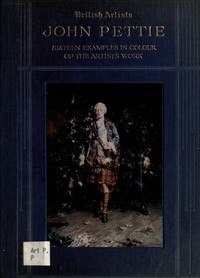
Reading this gentle guide to Fra Angelico, I remembered sitting with my grandmother's old art books, how the paintings felt less like analysis and more like quiet prayer. That same hush came back with John Pettie, R.A., H.R.S.A. Sixteen examples in colour of the artist's work — Context and Discussion, where the anecdotes linger longer than any critique. Both feel like someone showing you a beloved thing, not explaining it.
There are no reviews for this eBook.
There are no comments for this eBook.
Reader reflection
Your personal reading reflection
Build a private reading journal entry for this title.
Your progress
0
/
10
2
How did the book work for you overall?
3
How likely are you to recommend this book?
4
How easy was the book to follow?
5
Would a second reading be valuable?
6
Was the book what you thought it would be?
7
How strong was your personal connection to the text?
8
How useful were the ideas in this book?
9
In one sentence, what did you learn?
10