1

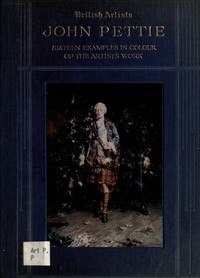
John Pettie, R.A., H.R.S.A. Sixteen examples in colour of the artist's work — Context and Discussion
(0 User reviews)
1044
Project Gutenberg
2011
Not confirmed
Pettie, John, 1839-1893
Readers of public-domain and historical texts
Project Gutenberg digital edition
en
Edition facts
Words
6,122
Reading time
27 min
Text sections
1
For John Pettie, R.A., H.R.S.A. Sixteen examples in colour of the artist's work — Context and Discussion, the stored edition analysis reports 6,122 words, 27 min estimated reading time, and 1 detected text section.
The text analysis averages about 22.4 words per sentence, while the detected sections provide another way to judge how the source is divided.
Project Gutenberg metadata also associates the work with “Pettie, John, 1839-1893,” connecting these edition facts with the source record’s subject description.
Source:
Project Gutenberg record #37088
Martin Hardie's introduction to John Pettie's work examines the painter's early determination, the critical reception of his narrative subjects, and the technical admiration his colour and brushwork commanded among fellow artists.
Editorial Edition Score
4.4/5
★★★★★
★★★★★
Calculated from edition completeness, EPUB availability, text structure and catalogue metadata. Not a user rating.
How this score is calculated
- Description quality20 pts
- Title & short description10 pts
- Source metadata20 pts
- Text length15 pts
- Chapters / structure15 pts
- EPUB file integrity20 pts
Total of 100 points, scaled to a 2.5-5.0 range. Editions with an empty description or a missing EPUB file are not scored.
Edition quality
Read the Text
They were destined to form a School which breathed new life into Scottish art and inaugurated a fresh epoch. All of them gave free expression to their own personality, but one and all made beautiful colour their highest ideal.
In 1858 Pettie exhibited his first picture at the Royal Scottish Academy; and in 1860 made his first venture at the Royal Academy in London with "The Armourers," which was hung on the line. It was followed in 1861 by "What d' ye lack, madam?" a picture of the saucy 'prentice in Scott's "Fortunes of Nigel." With the exhibition of this picture his success was assured, and the encouragement he received led him to leave the North and seek his future in the greater world of London.
In 1862 we find Pettie sharing a studio in Pimlico with Orchardson and Tom Graham. A year later, taking C. E. Johnson in their company, they moved to 37, Fitzroy Square, a house afterwards tenanted by Ford Madox Brown. I have before me a solemn agreement dated September 18, 1863: "We, W. Q. Orchardson, J. Pettie, and T. Graham, agree to each other that we shall pay the following proportions of rent for house, No. 37, Fitzroy Square (W. Q. Orchardson, L66 13s.; John Pettie, L56 13s.; T. Graham, L41 13s.), or in these proportions whether of increase or reduction." Here they lived a happy Bohemian existence, with guinea-pigs running about the studio floor; their cash-box an open drawer where bank-notes, gold and silver were mixed in cheerful confusion with bottles of varnish and tubes of colour; their general factotum one Joe Wall, a retired prize-fighter, who had been model to Landseer and Frith.
To the two years spent in Fitzroy Square, and to the ten years following, belong several of Pettie's finest works. His keen perception of dramatic incident, his fine sense of colour, and his brilliance of craftsmanship, soon drew the attention they deserved. In 1865 his "Drum-head Court-Martial" was one of the pictures before which visitors clustered daily when it hung on the Academy walls. It is a dashing picture, full of spirit in idea and design; and the artist seldom painted anything better, or more full of character, than the heads of those commanders sitting in judgment.
In the following year, at the early age of twenty-seven, he was elected an Associate of the Royal Academy, winning the coveted honour eighteen months before his friend and companion, Orchardson. With "Treason," exhibited in 1867, he burst into a triumph of dramatic intensity and glowing colour. The picture has a grip and unity of conception that places it on a higher level than any of his previous works. To the three following years belong such fine subjects as "The Sally" and "The Flag of Truce," which, with "Treason," are now in the Mappin Art Gallery, Sheffield; the "Tussle with a Highland Smuggler"; and "Touchstone and Audrey." "Rejected Addresses," exhibited in 1870, has all Pettie's charm of colour and fluent brushwork.
Among other comedies in little, touched with light fancy and the joy of life, are "A Storm in a Teacup" and "Two Strings to Her Bow." The latter is one of Pettie's happiest pieces of pure sentiment, persuasive in its natural charm and its touch of romance. Light-hearted gaiety and the ecstasy of existence sing in rippling music from lines and colours vibrant with joy.
In 1874 Pettie was elected a Royal Academician, filling the vacancy caused by the death of Sir Edwin Landseer. His first exhibits were two of his finest works, "A State Secret," and "Ho! Ho! Old Noll!" The scene in the latter is a tennis-court where two cavaliers are looking on with a chuckle of amusement at the spirited caricature which a third has made upon the wall. "Ho! Ho! Old Noll" is the work of a master draughtsman. The light pose and easy grace of the cavalier who makes the sketch, the foreshortening of his arm, the hand that holds the chalk--so lightly that it seems to move--are all superbly rendered. Two years later, in 1876, he exhibited "The Step," a picture of a little girl with golden hair, in a pale blue dress, dancing before her grandmother. The same old lady, with spinning-wheel and high-backed chair, formed the subject of a picture titled "Grandmother's Memories."
Martin Hardie opens this volume not with a sweeping claim about John Pettie's place in art history, but with a specific anecdote: as a boy, Pettie was found drawing on a box lid or cask top, oblivious to errands. The story establishes a pattern of single-mindedness that Hardie traces through Pettie's career. The text is as much about the painter's character as his canvases, drawing on reminiscences from friends and fellow artists to build a portrait of a man 'pure and honest through and through.' Hardie's own voice is measured, occasionally defensive, as he acknowledges that some critics have 'abused Pettie's work' while insisting that painters themselves are 'always enthusiastic in their homage to his colour and workmanship.'
A Painter's Early Determination
Hardie recounts Pettie's path to art against family resistance. His father wanted him in business; a local critic called the boy's drawing of a carrier and donkey 'uncanny.' When Pettie's mother brought his drawings to James Drummond of the Royal Scottish Academy, Drummond initially advised to 'make him stick to business,' but after seeing the work, he changed his mind: 'Well, madam, you can put that boy to what you like, but he'll die an artist!' The anecdote does more than show early promise—it reveals a pattern of judgment based on evidence rather than expectation, a theme Hardie returns to when discussing Pettie's later critics.
The Stumbling Block of Narrative
Hardie identifies a persistent point of contention: 'the storied idea' in Pettie's work. Some critics, he writes, have made this their 'stumbling-block,' objecting to the narrative or anecdotal element in paintings like A Drum-head Court-Martial or Treason. Hardie does not dismiss these objections, but he reframes the debate by noting that painters whose own art is 'at the opposite pole to Pettie's in aim and method' still praise his colour and workmanship. The implication is that technical mastery can transcend subject matter, and that Pettie's true strength lies in execution rather than story.
Colour and Workmanship as Common Ground
Hardie repeatedly steers attention to Pettie's handling of paint. He cites a friend's description of Pettie's self-portrait in the Aberdeen Gallery as 'all pure and luminous, all rich coral and amber and gold.' The same friend insists that Pettie's nature was 'all amber and gold,' blurring the line between the man and his medium. Hardie himself ventures that 'no painter, however modern, and no critic, however biassed, could stand in front of that little portrait head in the Tate Gallery and honestly refrain from admiration and respect.' The claim is specific and testable, grounded in a particular work rather than general praise.
The Artist's Own Words on Integrity
Hardie includes a passage from a letter by Pettie, in which the painter states: 'it is a matter of the highest importance that my pictures should be as good as I can make them, and thoroughly well studied. I should be unworthy indeed if money influenced me in the smallest degree as regards the quality of my work.' The quotation, though brief, aligns with the portrait Hardie builds of a principled craftsman. Pettie expresses confidence that 'being consciously true to my art I need not fear in the long run to receive my due.' Hardie lets the painter's own words stand as evidence, reinforcing his argument that Pettie's reputation rests on integrity of practice.
Hardie's introduction is not a comprehensive biography but a focused argument for Pettie's technical merit, supported by anecdote, critical response, and the painter's own correspondence. Readers approaching the sixteen colour plates will find the text a useful counterweight to any lingering bias against narrative painting. Hardie's insistence on separating the story from the handling invites a closer look at Pettie's brushwork and colour, qualities that may not reproduce fully in these plates but are worth seeking out in the originals he names.
There's something about Pettie's fierce early resolve that lingers—the way a painter's certainty can outlast fashion. It made me think of another quiet devotion to craft, the slow building of light in pigment, as in The brothers Van Eyck — Inside the Classic. Both feel like conversations held across centuries, waiting for someone to sit with them a while.
There are no reviews for this eBook.
There are no comments for this eBook.
Reader reflection
How will you remember this book?
Save your reaction, strongest insight, and memorable passage.
Your progress
0
/
10
2
Was reading this book enjoyable?
3
Is this a title you would suggest to others?
4
How demanding did the text feel?
5
How well did it match your expectations?
6
Could you follow the author’s main argument?
7
How would you describe its reading pace?
8
Would this book work well in a reading group?
9
What is the main idea you are taking away?
10