1

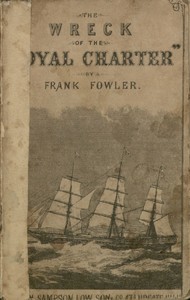
The Wreck of the "Royal Charter" Compiled from Authentic Sources, with Some Original Matter — Inside the Classic
(0 User reviews)
359
Project Gutenberg
2018
Not confirmed
Royal Charter (Ship); Shipwrecks -- Wales -- Anglesey
Readers of public-domain and historical texts
Project Gutenberg digital edition
en
Edition facts
Words
35,819
Reading time
156 min
Text sections
8
This digital edition of The Wreck of the "Royal Charter" Compiled from Authentic Sources, with Some Original Matter — Inside the Classic is described by source-level measurements including 35,819 words, 2 hr 36 min estimated reading time, and 8 detected text sections.
The text analysis averages about 21.1 words per sentence, while the detected sections provide another way to judge how the source is divided.
Project Gutenberg metadata also associates the work with “Royal Charter (Ship),” connecting these edition facts with the source record’s subject description.
Source:
Project Gutenberg record #58364
Frank Fowler's 1859 compilation on the Royal Charter shipwreck, blending telegraphic news, eyewitness accounts, and technical analysis of the auxiliary screw's role in the disaster.
Editorial Edition Score
4.6/5
★★★★★
★★★★★
Calculated from edition completeness, EPUB availability, text structure and catalogue metadata. Not a user rating.
How this score is calculated
- Description quality20 pts
- Title & short description10 pts
- Source metadata20 pts
- Text length15 pts
- Chapters / structure15 pts
- EPUB file integrity20 pts
Total of 100 points, scaled to a 2.5-5.0 range. Editions with an empty description or a missing EPUB file are not scored.
Edition quality
Read the Text
There was an element of uncertainty in the disaster which added to its painful and prostrating effect upon the public mind. The ship had brought eleven days' later news; there was no list of its passengers to be had in England; and who could tell but that his friends or kinsmen were on board? We all knew here the splendid qualities of the vessel: we all knew how high her colours stood in the colony. _I_ knew I had travelled the six hundred miles of dangerous sea between Sydney and Melbourne to make my journey home in her. Who then that had a relative or connection in the colony could--or _can_ to this hour--help the bleak conviction that in this vessel, which the cruel rocks have battered, and the remorseless waves have beaten to fragments, he or she was making a visit to the mother country? There were many of course that Thursday morning at Lloyd's, and the colonial coffee-houses, who by the last mail had received letters from friends intimating their intention of coming home by the 'Charter.' To them the intelligence of the wreck had terrible interest. Hour after hour they hung about the City, and when, just before closing, a 'List of the Saved' was received at Lloyd's, it was with difficulty the clerk was enabled to keep them from tearing the document from his hands and post it upon the walls. One gentleman, white-headed and bent with age, who, I subsequently found, had a son on board, swooned the moment he saw the list. _His boy was saved._
I endeavour to be brief in these introductory remarks; but somehow the atmosphere of dejection which has rested upon us all since the evil tidings first met us, reproduces itself as I write, and I find myself calling up with mournful minuteness the earlier passages in the History I have been requested to prepare. To that task let me now compel myself.
While the news of the wreck was still being bandied from mouth to mouth, I, who knew the ill-fated craft, and thought, without taking upon myself to suggest a reason for the disaster, I could yet set down many things which might enable others to do so, wrote the following article for one of the newspapers:--
'The finest ship that ever left the port of Liverpool has gone down with five hundred lives on board. I knew the ship--unhappily I knew some of those who have perished. I purpose to tell my impressions of the vessel, of the captain--everything I know that is likely to be read with interest by the dread light of the calamity.
Frank Fowler's account of the Royal Charter wreck opens not with a narrative of the storm but with the jarring contrast between two telegrams: one announcing the ship's expected arrival, the other its loss. This structural choice immediately foregrounds the shock and disbelief that greeted the news in October 1859. The book's preface reveals it was written under severe time pressure—'saving the Mail which leaves England on the 12th'—which may explain its hybrid form: part compiled report, part editorial commentary.
The excerpts show Fowler weaving together official telegrams, press reactions, and his own analysis of the ship's design. He questions the wisdom of the 'auxiliary screw' in iron clippers, arguing that the engine's dead weight and tendency to foul may have contributed to the disaster. This technical critique, set against the human tragedy, gives the work a distinctive forensic quality uncommon in contemporary shipwreck literature.
The Telegram and the Silence
The book's opening hinges on a temporal gap: the cheerful telegram of October 25, and the devastating news two days later. Fowler notes that only The Times carried the initial report, creating 'a gleam of hope' that was quickly extinguished. This pattern—good news followed by catastrophe—structures the early chapters and mirrors the experience of families awaiting word.
Fowler's language is restrained but pointed: 'Men passed the news from one to another in whispers.' He does not dramatize the scene but lets the understatement carry the weight. The contrast between the ship's expected arrival and its destruction is a recurring motif, and readers should note how Fowler uses the timeline of telegraphic communication to build tension even in a known outcome.
The Auxiliary Screw Controversy
A central argument in the excerpts concerns the Royal Charter's design as an 'auxiliary' screw steamer—an iron ship originally intended for sail but fitted with a 300-horsepower engine. Fowler contends that this hybrid arrangement was 'problematical' at best, and 'disastrous' when working off a lee shore. He points to the screw fouling when spars were cut away, and the engine's failure to ease the cables as the ship dragged anchor.
Fowler asks pointed questions: would the ship have hugged a lee shore at night without steam power? Would her officers have consulted the weather-glasses more anxiously? He does not answer these questions but presents them 'deferentially, sorrowfully.' This section is notable for its technical specificity—tonnage, horsepower, the mechanics of anchoring—and for its implicit critique of maritime engineering trends in the 1850s.
The Press and the Inquest
The book's structure includes a section titled 'The Press on the Catastrophe' and later 'The Adjourned Inquest' and 'The Verdict.' This suggests Fowler saw the media and legal responses as integral to the story. The excerpts show him quoting and analyzing newspaper accounts, treating the press as both a source and a subject.
Readers should note how Fowler interweaves his own voice with quoted material. He reproduces a long passage from what appears to be a newspaper editorial, which describes the ship 'split amidships' and 'letting her engines and passengers through.' This blending of voices—compiler, journalist, coroner—creates a layered narrative. The inquest section likely offers official testimony, but the excerpts do not reveal its conclusions; Fowler's own analysis remains the dominant thread.
The Human Toll in Lists and Details
Among the book's appendices is a 'List of Steerage Passengers'—a stark reminder that the disaster involved real individuals. Fowler also includes a note on the Reverend Charles Vere Hodge, suggesting personal memorials alongside the technical report. The excerpts do not describe the deaths in detail, but the inclusion of passenger lists and a clergyman's name points to a documentary impulse.
Fowler's closing lines in the excerpted portion invoke 'the poet of "The Shipwreck"' to underscore the unimaginable horror, but he quickly pivots to praise Captain Taylor's 'stedfast devotedness.' This balance—between statistical record and moral tribute—characterizes the work. Readers should watch for how Fowler handles the tension between the ship's gold (mentioned in passing) and the human cost.
Fowler's book is best approached as a contemporary document rather than a polished history. Its rushed composition, evident in the preface, gives it a raw, immediate quality. Readers interested in Victorian shipwreck literature, the history of marine engineering, or the role of the press in disaster coverage will find specific material here. The technical arguments about screw propulsion are worth attending to, as they reflect debates that would shape ship design for decades. Treat the book as a primary source—flawed, opinionated, and revealing.
Reading Frank Fowler’s account of the Royal Charter, I kept thinking how a single, violent morning can redraw the map of memory. That same quiet shock returned while turning pages in The Night the Mountain Fell: The Story of the Montana-Yellowstone Earthquake — Story, Setting & Ideas, where the earth simply let go. Different elements, but the same small human hush left behind.
There are no reviews for this eBook.
There are no comments for this eBook.
Reader reflection
Before you leave, reflect on the book
Use these questions to collect your thoughts before moving on.
Your progress
0
/
10
2
Did this book hold your interest?
3
Would you recommend this book to another reader?
4
How demanding did the text feel?
5
Would you start a conversation about this book?
6
Did this book create an emotional response?
7
Is this a title worth rereading?
8
Did the book meet your expectations?
9
What changed or sharpened your thinking?
10