1

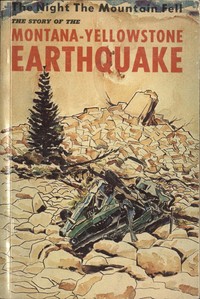
The Night the Mountain Fell: The Story of the Montana-Yellowstone Earthquake — Story, Setting & Ideas
(0 User reviews)
2681
Project Gutenberg
2018
Not confirmed
Earthquakes -- Montana; Earthquakes -- Yellowstone National Park
Readers of public-domain and historical texts
Project Gutenberg digital edition
en
Edition facts
Words
21,733
Reading time
95 min
Text sections
4
This digital edition of The Night the Mountain Fell: The Story of the Montana-Yellowstone Earthquake — Story, Setting & Ideas is described by source-level measurements including 21,733 words, 1 hr 35 min estimated reading time, and 4 detected text sections.
The text analysis averages about 18.7 words per sentence, while the detected sections provide another way to judge how the source is divided.
Project Gutenberg metadata also associates the work with “Earthquakes -- Montana,” connecting these edition facts with the source record’s subject description.
Source:
Project Gutenberg record #56850
Edmund Christopherson's account of the 1959 Montana-Yellowstone earthquake blends geological description with firsthand survivor narratives, focusing on the Hebgen Lake area and the massive Madison Canyon landslide.
Editorial Edition Score
4.6/5
★★★★★
★★★★★
Calculated from edition completeness, EPUB availability, text structure and catalogue metadata. Not a user rating.
How this score is calculated
- Description quality20 pts
- Title & short description10 pts
- Source metadata20 pts
- Text length15 pts
- Chapters / structure15 pts
- EPUB file integrity20 pts
Total of 100 points, scaled to a 2.5-5.0 range. Editions with an empty description or a missing EPUB file are not scored.
Edition quality
Read the Text
one!” Mrs. Ost was screaming in half-wakened terror as Rev. Ost emerged from the tent.
The sky was clear, the moon bright, as Rev. Ost looked up and to the west. There were no clouds or wind.
But terror ran through the whole party as they saw tents swaying, trees shaking as though torn in a violent wind. Then the Osts’ 1950 Buick began to rock from front to rear as if men were jumping energetically on the bumpers. The brake lights went on as one of the gals jumped on the brake.
Then came a tremendous roar, like several express trains passing right through the camp. The trees shut off their view of the huge, 7,600 ft. mountain falling, of the huge boulders, big as houses, hurtling down one side of the canyon and up the other side, a mile away, throwing sparks and dust as they fell. Rev. Ost sensed the rushing of the wind and water trapped by the avalanching mountain, and thrown back at the dazed campers—at tornado speeds—from under the slide. “Hang onto a tree!” he shouted. Mrs. Ost ran for the car as she saw the wave of water coming. Larry was caught in the tent when the wall of water, mud, and trees hit them with such violence that it crumpled trailers and hurled the Osts’ 4,000 pound car thirty feet and smashed it against a row of trees. Although Mrs. Ost was holding onto the steering wheel, the violence of the surging water threw her against the side of the car so violently that it made a pulp out of the right side of her face. In the midst of the mud, water, and floating and flying debris, Larry managed to tear his way out of the tent.
Dust from the slide obscured the moon and heightened the sense of tragedy and terror.
The tent was gone. The deluge of water had jammed cars and trailers together. The rocks had covered the site of a trailer where a family had been playing earlier in the day.
The night rang out with the bewildered crying out for lost relatives. Stunned like the others, Rev. Ost shouted for “Fran.” After hitting the brake pedal she’d jumped out of the car and scampered, like a deer, to higher ground.
He found Gerry, unharmed, except for being wet and an injury to her hand. Sloshing through water to his knees, he found Ruth still in the car. After several minutes hunting and shouting “Larry” he found his son, soaked, clad only in shorts.
The screams of the lost and losing continued. A woman handed a baby to Melva Fredericks, saying, “Comfort him.” One dazed man walked around crying out for his missing wife. From the wet and dark came the cry of another woman calling out, “It’s safe here!”—hoping to attract someone to help or keep her company.
The Ost women and Mrs. Fredericks struggled to higher, safer ground. When the Fredericks men didn’t show up, Ost left the women praying while he went to look for them. He heard Mr. Fredericks call for help for his son, Paul. With a flashlight he borrowed, he was able to see the difficulty. The surge of water and trees had caught 15-year-old Paul and pinioned him in a sitting position in the water, with one log across the small of his back and another across his lap. The ends of the log were jammed between a smashed trailer and the Ost car, so solidly they wouldn’t budge.
Paul cried out with pain as the two men tried to pull him loose. The water kept rising as the men tried to pry the logs apart with sticks. A 2 × 12 plank, ten feet long, even though full of spikes, seemed a promising tool to pry with, but with it they were only able to gain an inch or so further separation of the logs that held Paul prisoner.
The men felt Paul’s and their own helpless panic as the water swelled up to his chest, his neck, his chin. Raised in a soundly religious family, Paul bravely faced the realization that he was gasps from death. In desperation, Ost called on Mel Fredericks to pull as hard as he could, not to care if Paul cried, or if they pulled his arms or legs out of joint. In this last, desperate straining try they found that miraculously they could raise him six inches. The rising water had buoyed the trailer. In their next few feverish tries they were able to pull him loose and helped him to walk to high, dry ground.
Edmund Christopherson's account of the 1959 Montana-Yellowstone earthquake opens not with the tremor itself but with a geographical and geological orientation: West Yellowstone, Montana, is described as a 'mountain vacation area' where 'enormous forces are still thrusting up mountains.' This framing immediately positions the earthquake as part of ongoing natural processes, not a singular catastrophe. The narrative then shifts to the precise moment—11:37 P.M. on August 17, 1959—and details the immediate physical effects: a tidal wave over Hebgen Dam and a massive rock slide from a 7,600-foot mountain. The catalog subjects list 'Earthquakes -- Montana' and 'Earthquakes -- Yellowstone National Park,' but the excerpts reveal a book that is as much about human response as geological event.
Geological Setting and Human Geography
The opening pages establish a dual focus: the region's volcanic and seismic activity is described in plain terms—'volcanic craters still exist,' 'heat of the earth still spouts its imprisoned fury'—while the human geography is equally specific: West Yellowstone, Virginia City, Madison Canyon, Gallatin National Forest, and the three-state junction of Montana, Wyoming, and Idaho. This is not a generic disaster narrative; Christopherson grounds the event in a particular place where vacationers, dude ranches, and Forest Service campgrounds coexist with active geology. The catalog subject 'Earthquakes -- Yellowstone National Park' is accurate, but the excerpts show the book's scope extends beyond the park to include the surrounding national forest and communities.
Survivor Testimony and Narrative Texture
The excerpts include extended passages from survivors, such as Mrs. Fredericks, whose quoted speech—'We’d lost our money, our cars, our clothes' and 'I’m damned if I’m going to be caught in my pajamas again'—gives the account a colloquial, immediate voice. Christopherson also recounts the story of Reverend Ost, who received a dropped message from a plane that turned out to be a two-year-old fire instruction. Ost later remarked, 'Doesn’t it strike you as almost planned?' These details, traceable to the excerpts, show the book's interest in coincidence and human perception under stress. The narrative does not simply list events; it weaves in the confusion, fear, and dark humor of those who lived through the night.
Structure and the Role of the Author
The table of contents lists chapter titles like 'Real Shook,' 'Trapped,' 'Outside World,' and 'CD’s Puzzle'—abbreviated, colloquial headings that suggest a journalistic or popular-science approach. The author, Edmund Christopherson, appears as a compiler of testimony and eyewitness accounts rather than a scientific expert. The excerpts include no geological analysis beyond basic descriptions; instead, the focus is on the sequence of events and the experiences of individuals. The catalog subject 'Earthquakes -- Montana' is thus represented through human stories, not seismology. The book's structure—moving from the quake's onset through rescue and aftermath—follows a chronological arc, but the excerpts show that the author prioritizes anecdote over technical explanation.
Readers should approach this book as a documentary account rooted in the voices of survivors and the author's on-the-ground observations. The catalog subjects accurately point to the earthquake's location, but the text itself is less concerned with geological mechanisms than with the human experience of disaster. The excerpts suggest a work that values immediacy and personal testimony over scientific analysis, making it a useful primary source for understanding how the 1959 earthquake was perceived and remembered by those who lived through it.
After the quake, Edmund Christopherson describes how the mountain’s roar became silence, and that stillness felt familiar. It’s like sitting with a ruined fly pattern, wondering what the trout sees. That patience with destruction, the quiet attention to what remains—I found the same in Blacker's art of fly making, &c. — Key Ideas to Explore. Both books ask me to look closer at what breaks, then shape something from the pieces.
There are no reviews for this eBook.
There are no comments for this eBook.
Reader reflection
Before you leave, reflect on the book
Use these questions to collect your thoughts before moving on.
Your progress
0
/
10
2
Did this book hold your interest?
3
Would you encourage someone else to read it?
4
How easy was the book to follow?
5
Was the book easy to understand?
6
How did the pace of the book feel?
7
Would you like to discuss this book with someone?
8
Which element worked best for you?
9
In one sentence, what did you learn?
10