1

The prisoners' memoirs, or, Dartmoor prison — Themes and Context
(0 User reviews)
93
Project Gutenberg
2023
Not confirmed
Dartmoor Prison; United States -- History -- War of 1812 -- Prisoners and prisons
Readers of public-domain and historical texts
Project Gutenberg digital edition
en
Edition facts
Words
62,376
Reading time
272 min
Text sections
12
The prisoners' memoirs, or, Dartmoor prison — Themes and Context can be approached with a clearer sense of reading commitment from its source measurements: 62,376 words, 4 hr 32 min estimated reading time, and 12 detected text sections.
The text analysis averages about 23.6 words per sentence, while the detected sections provide another way to judge how the source is divided.
Project Gutenberg metadata also associates the work with “Dartmoor Prison,” connecting these edition facts with the source record’s subject description.
Source:
Project Gutenberg record #71090
A first-hand account of American prisoners of war held at Dartmoor Prison during the War of 1812, compiled by a survivor. The narrative details daily hardships, the notorious April 1815 massacre, and the prisoners' resistance, based on a journal kept by Charles Andrews and certified by fellow captives.
Editorial Edition Score
4.8/5
★★★★★
★★★★★
Calculated from edition completeness, EPUB availability, text structure and catalogue metadata. Not a user rating.
How this score is calculated
- Description quality20 pts
- Title & short description10 pts
- Source metadata20 pts
- Text length15 pts
- Chapters / structure15 pts
- EPUB file integrity20 pts
Total of 100 points, scaled to a 2.5-5.0 range. Editions with an empty description or a missing EPUB file are not scored.
Edition quality
Read the Text
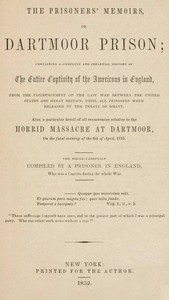
Who was a Captive during the whole War.
----_Quæque ipse miserrima vidi, Et quorum pars magna fui; quis talia fando, Temperet a lacrymis?_ Virg. I., ii., v. 5.
“These sufferings I myself have seen, and to the greater part of which I was a principal party. Who can relate such woes without a tear?”
NEW YORK: PRINTED FOR THE AUTHOR.
The following pages are presented to the public by one of the survivors of this worst of prisons, believing it will be read with deep interest by every American, and by every relative and friend of those who happened to be one of the unfortunate inmates of the Dartmoor Prison.
If any part of the work should be found languid and tedious, it must be wholly attributed to the suffering situation of the author; the vigor and vivacity of whose mind was greatly affected by those of the body. If misery is less interesting collectively in groups than when viewed individually, let the reader single out one, and view him, separately, through the iron grating, and see him, pale and feeble, etching upon a stick, with a rusty nail, another notch, which adds to his calender another of those dismal days and nights he had spent in confinement; he may view him till he sees the iron enter his soul before he turns from him, and then say--it was my son, my brother, or my friend!--he will then have a picture interesting enough to his feelings.
We, the undersigned, late prisoners of war, having been confined the greater part of the last war between the United States of America and Great Britain, and having carefully perused and examined the following Manuscript Journal, kept by Charles Andrews, our fellow-prisoner at Dartmoor, in the County of Devon, in the kingdom of Great Britain, do solemnly declare, that all matter and occurences herein contained, are just and true, to the best of our knowledge and belief; and that this is the only Journal kept at Dartmoor.
Capt. Joshua Wait, New-York. Capt. Samuel H. Ginnodo, Newport, R. I. Capt. Frederick H. Coffin, Hudson, N. Y. Mr. Joseph C. Morgan, Newport, R. I. Lieut. Homer Hull, ---- Conn. Mr. Jacob Evans, Baltimore, Md. Capt. Benjamin F. Chesebrough, ---- Conn. Mr. Luther S. Dunbar, Boston, Mass. Capt. Richard Longly, Portland, D. M. Mr. Ephraim Abbott, Boston, Mass. Mr. Fenton Conner, Charleston, S. C. Mr. Joseph Conner, Newbern, N. C. Mr. David Morrison, ---- Pennsylvania. Mr. Caleb Coffin, Nantucket, Mass. Mr. John Merrill, Portland, Maine. Capt. Charles Bennet, Hudson, N. Y. Mr. William Griffin, Salem, Mass. Mr. James Bowie, do. do. Mr. John F. Foster, Gloucester, Mass. Mr. Joseph Clark, Cape-Elizabeth, do. Mr. John Stafford, Boston, Mass. Mr. Charles Whitewood, New-York. Mr. Reuben Bunn, do. Mr. Samuel Rossett, do. Mr. Jacob F. Taylor, Philadelphia. Mr. William Conklin, New-York. Mr. Samuel S. Brush, do. Capt. John C. Rowles, Baltimore, Md. Mr. John Meigh, Boston, Mass. Mr. Edward Shaw, Baltimore, Md. Lieut. S. S. Fitch, ---- Connecticut. Mr. Samuel Correy, ---- Vermont. Mr. Samuel Howard, Baltimore, Md. Mr. William Clark, Boston, Mass. Mr. Joseph Fosdick, do. Mr. Samuel Morrison, New-York. Mr. William Hull, do. Mr. William Atkins, ---- Connecticut. Mr. Daniel Hotchkins, Salem, Mass. Mr. Thomas Carlton, Boston, do. Mr. John Migat, Warren, R. I. Mr. Cornelius Hoy, Baltimore, Md. Capt. Jesse S. Smith, Stonington, Conn. Mr. James Sproson, New-York. Mr. Benjamin Wheeler, Baltimore, Md. Mr. George Scott, ----, ----. Capt. Matthew S. Steel, Philadelphia, Penn. Mr. W. P. Sevear, Baltimore, Md. Capt. James McQuilter, do. do. Mr. John S. Miller, do. do. Mr. Thomas Bailey, Salem, Mass. Mr. Warren Humphrey, ---- Connecticut. Mr. William Rea, Boston, Mass. Capt. Thomas Hussey Hudson, N. Y. Capt. James Boggs, Philadelphia, Penn. Capt. James Gays, ---- Virginia. Capt. Thomas Mumford, Newport, R. I. Mr. Isaac Dowel, Baltimore, Md. Mr. Frederick G. Low, Cape-Ann. Mr. Henry Bull, ---- Connecticut. Doct. Benjamin Mercer, New-York. Mr. Reuben Sherman, ---- Mass.
N. B.--Out of the above list there are, at this time, only nine survivors, as far as can be ascertained.
THE PRISONERS’ MEMOIRS,
The preface immediately establishes the author as a survivor, one who endured the entire war as a prisoner. He invites the reader to single out an individual prisoner, viewing him through the iron grating, pale and feeble, etching notches on a stick with a rusty nail to mark the passing days. This vivid, intimate image sets the tone for a work that balances collective history with personal suffering. The author acknowledges that the narrative may sometimes be languid, attributing this to his own physical and mental exhaustion, a candid admission that grounds the text in the reality of its composition.
A Journal Certified by Fellow Prisoners
The book opens with a certificate signed by former prisoners who declare that they have carefully perused and examined the manuscript journal kept by Charles Andrews and that all matters and occurrences herein contained are just and true to the best of their knowledge and belief. This collaborative endorsement frames the work not as a solitary memoir but as a communal testimony. The author, identified only as a prisoner in England who was a captive during the whole war, relies on this collective verification to bolster the account's credibility. Readers should note that the narrative is presented as a compilation, drawing on a journal maintained in real time, which lends a diaristic immediacy to the events described.
Daily Life and the Calculus of Suffering
The excerpts reveal a meticulous attention to the material conditions of captivity. The author records the temperature inside the prison, noting that it was twenty-five degrees warmer than outside due solely to the heat of 1,200 human bodies, as no fires were kept. He tracks the arrival of clothing from Mr. Beasley, remarking with bitter irony that the agent seemed to think one suit would last a prisoner a lifetime, while the oldest prisoners had not received any for ten months. The contractor, seeing that peace was near, reduced rations, a cruelty the author compares to a simpleton teaching his horse to live without eating. These details build a cumulative portrait of neglect and bureaucratic indifference.
Confrontation and Collective Resistance
A key episode in the excerpts describes the prisoners' refusal to return a man who had escaped from the cachot (the punishment cell). Captain Shortland ordered the market closed and privileges revoked, then entered the yard with two hundred soldiers bearing fixed bayonets. The prisoners, having previously agreed to stand by each other, surrounded the soldiers and advised them to retire. The soldiers prudently withdrew, leaving the man they sought. The author notes that Shortland still harbored rancor, setting the stage for further conflict. This incident illustrates the prisoners' capacity for organized defiance and foreshadows the violence that would erupt on April 6, 1815.
The Promise and Limits of the Narrative
The excerpts cover only a portion of the work, ending before the detailed account of the massacre promised in the title. The author's stated aim is to provide a complete and impartial history of the entire captivity, from the war's commencement to the release by the Treaty of Ghent. However, the reader should be aware that the narrative is shaped by the author's perspective as a participant and by the constraints of his suffering. The certificate from fellow prisoners suggests a collaborative effort to ensure accuracy, but the work remains a personal testimony, not an official record. The excerpts hint at a structure that moves between chronological journal entries and thematic reflections on hardship.
Readers approaching this work should attend to the interplay between the journal's chronological entries and the author's retrospective commentary. The certificate and preface establish a framework of communal witness, while the body of the text offers a ground-level view of prison life. The excerpts suggest that the narrative is richest in its concrete details of daily struggle and collective action. The promised account of the massacre will likely test the author's claim to impartiality, making it essential to read that section with attention to his stated position as a survivor and compiler.
Tucked among those harrowing pages of Dartmoor’s prison yard, I often recall the strange patience of men who mended their own small tools. There is a quiet kinship there—in Blacker's art of fly making, &c. — Key Ideas to Explore—where hardship and craft share the same slow, careful hands. Both books keep a certain stillness, a craftsman’s pause before the next knot or next dawn.
There are no reviews for this eBook.
There are no comments for this eBook.
Reader reflection
Record your reading impressions
A brief reflection can help important ideas stay with you longer.
Your progress
0
/
10
2
What was your overall reaction to the book?
3
Is this a title you would suggest to others?
4
How much effort did this book require?
5
How strong was your personal connection to the text?
6
How well did it match your expectations?
7
Could you apply anything you learned?
8
Which part made the strongest impression?
9
What did this book teach you most?
10