1

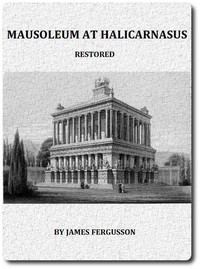
The Mausoleum at Halicarnassus Restored in Conformity With the Recently Discovered Remains — A Reader’s Guide
(0 User reviews)
877
Project Gutenberg
2016
Not confirmed
Mausoleum (Halicarnassus); Halicarnassus (Extinct city)
Readers of public-domain and historical texts
Project Gutenberg digital edition
en
Edition facts
Words
22,797
Reading time
100 min
Text sections
3
This digital edition of The Mausoleum at Halicarnassus Restored in Conformity With the Recently Discovered Remains — A Reader’s Guide is described by source-level measurements including 22,797 words, 1 hr 40 min estimated reading time, and 3 detected text sections.
The text analysis averages about 26.1 words per sentence, while the detected sections provide another way to judge how the source is divided.
Project Gutenberg metadata also associates the work with “Mausoleum (Halicarnassus),” connecting these edition facts with the source record’s subject description.
Source:
Project Gutenberg record #53578
James Fergusson's 1862 architectural treatise reconstructs the Mausoleum at Halicarnassus using recently excavated fragments, arguing for specific design solutions through comparative analysis of Greek and Roman tombs, while openly acknowledging the limits of available evidence.
Editorial Edition Score
4.6/5
★★★★★
★★★★★
Calculated from edition completeness, EPUB availability, text structure and catalogue metadata. Not a user rating.
How this score is calculated
- Description quality20 pts
- Title & short description10 pts
- Source metadata20 pts
- Text length15 pts
- Chapters / structure15 pts
- EPUB file integrity20 pts
Total of 100 points, scaled to a 2.5-5.0 range. Editions with an empty description or a missing EPUB file are not scored.
Edition quality
Read the Text
ARCHITECTURAL ORDINANCE 33
SCULPTURE AND PEDESTALS 38
1. LION TOMB, CNIDUS 14
3. TOMB AT MYLASSA 16
5. SECTION OF CYMATIUM AND OF BASE OF PYRAMID 29
6. PEDESTAL OF MONTE CAVALLO GROUP 41
Place _Plates_ I., II., and III. at the end of the work.
MAUSOLEUM AT HALICARNASSUS.
Of all the examples of the wonderful arts of the Greeks, the remains or the memories of which have come down to us, no one has excited such curiosity as the far-famed Mausoleum at Halicarnassus, or such regret that no fragments of it should have existed in our own days. All we knew of it, till very recently, was that the ancients themselves were inclined to look upon it as the very best specimen of architectural art which they possessed. For not only did they rank it as among the seven wonders of the world, but assigned it that pre-eminence—not because of its size or durability, but because of the intrinsic beauty of its design, and the mode in which it was ornamented.
The Pyramids of Egypt and Walls of Babylon were wonders only because of their mass or their durability. The Palace of Cyrus or the Hanging Gardens of Babylon may have been rich in colour and barbaric splendour, but we know enough of Assyrian and of Persian art to feel convinced that the taste in which they were designed must at least have been very questionable. The Colossus at Rhodes, and the Statue of Jupiter at Elis, whatever their merits,—and of one, at least, of them we can believe anything,—did not belong to architectural art. The Temple of Ephesus may have been beautiful in itself, but it became a wonder only from its size, as the largest of Greek temples. But the Mausoleum, which covered not more than one-sixth or one-seventh of its area, could have been remarkable only because it was beautiful, or in consequence of the elaboration and taste displayed in its ornamentation.
All that was known of this once celebrated building, till the recent explorations, was to be gathered from a few laudatory paragraphs in Pausanias, Strabo, Vitruvius, and other authors of that age; and a description in Pliny’s Natural History, which we are now justified in assuming to have been abstracted from a work written by the architects who originally designed the Mausoleum itself. Probably there were no diagrams or illustrations with their book, and we may suspect that Pliny himself did not understand the building he undertook to describe. At all events, it is certain that he stated its peculiarities in such a manner as to be utterly unintelligible to future generations.
Still there were so many facts in his statements, and the building was so celebrated, that few architects have escaped the temptation of trying to restore it. What the squaring of the circle is to the young mathematician, or the perpetual motion to the young mechanician, the Mausoleum at Halicarnassus was to the young architect; and with the data at his disposal this problem seemed as insoluble as the other two.
Some forty or fifty of these restorations have been published, and a strange and amusing collection they are. Some are round, some octagonal, some cruciform, some oblong or square in plan, some are squat, some tall.[1] Every dimension found in Pliny was applied to every part in succession, but in vain. All these designs had only one thing in common;—that they were all wrong,—some more, some less so, but none seizing what now turn out to be the main features of the design.
In 1846, Lord Stratford de Redcliffe, who was then all-powerful as our ambassador at Constantinople, obtained from the Porte a firman for the removal of certain bassi-rilievi which had been built into the walls of the Castle of Budrum, the ancient Halicarnassus. These arrived in England in due course, and were at once admitted to be fragments of the sculpture of the Mausoleum, as it had been previously assumed that they were. But their beauty only served further to increase the regret that all traces of the building to which they once belonged should have been, as it then appeared, for ever lost.
While things were in this very unsatisfactory position, the public heard with no small degree of interest that Mr. Charles Newton, formerly one of the officers of the British Museum, and then Vice-Consul at Mitylene, had not only discovered the true site of the Mausoleum on a spot formerly indicated by Professor Donaldson, but had found considerable remains of the long-lost building.
James Fergusson opens his 1862 restoration of the Mausoleum at Halicarnassus by acknowledging that the essay 'has no pretension to being a complete account.' Instead, he aims to 'recapitulate and explain the various data which have recently been brought to light' and to show how these can be applied to solve what he calls 'the riddle which has so long perplexed the student of classical architecture.' The work is thus framed as an interim report, not a definitive monograph, and Fergusson repeatedly flags where his inferences are tentative or where further evidence is needed.
The text is structured around four Latin headings—Scripta, Reliquiæ, Exempla, Rationes—which signal a methodical approach: first reviewing ancient literary sources, then the physical remains, then comparative examples, and finally the reasoning behind his own reconstruction. This framework, combined with frequent references to Pliny's dimensions and to other tomb structures such as the Lion Tomb at Cnidus, gives the essay a forensic, evidence-based character.
Reconstructing from Fragments
Fergusson's method relies heavily on comparative architecture. He draws on the Lion Tomb at Cnidus (Woodcut No. 1) and the Tomb at Dugga (Woodcut No. 2) to infer missing elements of the Mausoleum. For instance, when discussing the pyramid steps, he notes that 'the authority for this is, of course, the Lion Tomb' to justify making the lowest visible step twice as high as the others. He also uses the Tomb at Mylassa (Woodcut No. 3) to support his proportional choices.
The author is candid about the limits of his data. Regarding the height of the pyramid steps, he writes: 'What its height really was, can only be ascertained when some system of definite proportions for the vertical heights of the building shall have been satisfactorily settled.' He acknowledges that the steps' height is 'not of the smallest consequence' for matching Pliny's dimensions, because any addition to the pyramid must be subtracted from the meta (pedestal of the quadriga), and vice versa. This honest admission of uncertainty is characteristic of the essay's tone.
Fergusson also engages with the work of Mr. Pullan, a contemporary excavator, sometimes agreeing and sometimes differing. For example, he disputes Pullan's placement of two unusually wide steps at the top of the pyramid, suggesting instead that they were 'the lowest steps of all.' Such specific disagreements show the essay as a live scholarly debate rather than a settled reconstruction.
The Problem of the Quadriga Group
Fergusson devotes considerable attention to the sculptural group of the quadriga (four-horse chariot) that once crowned the Mausoleum. He considers two possible orientations: one facing the longer sides of the building (as shown in Plate II) and another facing the shorter sides. He leans toward the latter, writing: 'my own feeling is strongly in favour of the last hypothesis. It seems more in accordance with what we know of Greek art, and artistically I cannot help fancying it would look better from every point of view.'
He qualifies this as 'more a sculptor’s question than an architect’s,' indicating the interdisciplinary nature of the restoration. He also speculates about the horses' poses: the recovered horses might be the central ones 'in comparative repose,' while the outer ones 'would be in more violent action, and spread wider.' This is presented as a plausible inference, not a certainty.
The discussion of the quadriga reveals how Fergusson balances archaeological evidence with aesthetic judgment. He does not claim to have definitive proof, but rather offers a reasoned preference based on artistic principles and the fragmentary remains.
Reconciling with Pliny's Dimensions
A central task of the essay is to make the reconstructed Mausoleum conform to the dimensions given by Pliny the Elder. Fergusson shows that by assigning 25 Greek cubits (37 ft. 6 in.) to both the pyramid and the pteron (the colonnade), and by estimating the quadriga at 13 ft. 9 in., the total height comes to exactly 140 Greek feet—matching Pliny's figure. He calls this 'so clear and so satisfactory, that there the matter might rest.'
Yet he immediately adds: 'There is no real necessity to look further, were it not that one or two peculiarities come out in the investigation which seem worthy of being noted.' This reflects his scholarly rigor: even when a solution fits the ancient source, he continues to examine details that might refine or complicate the reconstruction.
Fergusson also addresses the basement's entablature, which he restores 'of such proportions as seemed to me most appropriate.' He does not claim this is the only possible arrangement, but presents it as a reasoned choice within the constraints of the evidence. The essay thus models how to work with incomplete data: propose a coherent scheme, test it against known measurements, and flag where further evidence could change the result.
Fergusson's essay is best read as a working document of architectural reconstruction, not a final statement. He repeatedly invites future scholars to refine his proposals, noting that a fuller treatment 'would require more leisure and better opportunities than are at present at the Author’s disposal.' Readers interested in the history of classical archaeology will find here a clear example of mid-19th-century methods: comparative typology, reliance on literary sources, and a willingness to admit uncertainty. The woodcuts and plates are integral to the argument, so consulting them alongside the text is essential.
There’s something tender about Victorian certainty—Fergusson trusting those fragments to rebuild a wonder, knowing he might be wrong. It reminds me of The Veil Lifted: Modern Developments of Spirit Photography — Text and Context, another earnest attempt to make the invisible tangible. Both feel like hands reaching through fog, hoping. I still wonder what they almost saw.
There are no reviews for this eBook.
There are no comments for this eBook.
Reader reflection
Before you leave, reflect on the book
Use these questions to collect your thoughts before moving on.
Your progress
0
/
10
2
Was reading this book enjoyable?
3
Would you recommend this book to another reader?
4
How much effort did this book require?
5
Would this book work well in a reading group?
6
How distinctive were its ideas or approach?
7
Was the book easy to understand?
8
How did the pace of the book feel?
9
Which lesson or insight stayed with you?
10