1

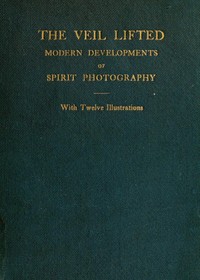
The Veil Lifted: Modern Developments of Spirit Photography — Text and Context
(0 User reviews)
1807
Project Gutenberg
2019
Not confirmed
Spiritualism; Spirit photography
Readers of public-domain and historical texts
Project Gutenberg digital edition
en
Edition facts
Words
27,809
Reading time
121 min
Text sections
4
For The Veil Lifted: Modern Developments of Spirit Photography — Text and Context, the stored edition analysis reports 27,809 words, 2 hr 1 min estimated reading time, and 4 detected text sections.
The text analysis averages about 21.6 words per sentence, while the detected sections provide another way to judge how the source is divided.
Project Gutenberg metadata also associates the work with “Spiritualism,” connecting these edition facts with the source record’s subject description.
Source:
Project Gutenberg record #59451
This 1894 collection examines spirit photography through J. Traill Taylor's experimental paper, a letter by Rev. H. R. Haweis, addresses by James Robertson, and editor Andrew Glendinning's miscellanea. The excerpts reveal a mix of technical procedure, personal testimony, and theological argument, with careful attention to photographic conditions and the elusive nature of psychic images.
Editorial Edition Score
4.6/5
★★★★★
★★★★★
Calculated from edition completeness, EPUB availability, text structure and catalogue metadata. Not a user rating.
How this score is calculated
- Description quality20 pts
- Title & short description10 pts
- Source metadata20 pts
- Text length15 pts
- Chapters / structure15 pts
- EPUB file integrity20 pts
Total of 100 points, scaled to a 2.5-5.0 range. Editions with an empty description or a missing EPUB file are not scored.
Edition quality
Read the Text
ns to Mr. Taylor on points of detail regarding his experiments, all of which he replied to frankly and explicitly. In replying to one member, Mr. Taylor stated that he had received a letter, asking him to bring a reasonable man with him _to witness_ his experiments—in fact, he said, he had the option of taking any one he chose. To another member Mr. Taylor replied that he himself placed the sitters and the camera, and also arranged the lighting of the room. Several members spoke highly of Mr. Taylor’s qualifications to conduct such experiments; but as they could not accept the spiritualistic hypothesis, and as the photographs had to them the appearance of being copied from cut-out prints, or made by “stump-work,” they concluded that therefore they could not be genuine, ignoring entirely Mr. Taylor’s emphatic statements, which he had already given in his paper, viz.:—
“_My conditions were entirely acquiesced in_”—that I “_should use my own camera and unopened packages of dry plates, purchased from dealers of repute, and that I should be excused from allowing a plate to go out of my own hand till after development_,” and that “_I should dictate all the conditions of operation_.”
As a matter of fact, everything connected with the experiments was subject to Mr. Taylor’s entire control and approval.
“SPIRIT PHOTOGRAPHY,” WITH REMARKS ON FLUORESCENCE.[3]
_By_ J. TRAILL TAYLOR.
The presence of smoke may be considered as implying the existence of flame. Spirit photography, so called, has of late been asserting its existence in such a manner and to such an extent as to warrant competent men making an investigation, conducted under stringent test conditions, into the circumstances under which such photographs are produced, and exposing the fraud, should it prove to be such, instead of pooh-poohing it as insensate because we do not understand how it can be otherwise—a position that scarcely commends itself as intelligent or philosophical. If in what follows I call it “spirit photography” instead of psychic photography, it is only in deference to a nomenclature that extensively prevails, and not as offering a surmise from any knowledge of my own as to what is matter and what spirit, or the distinction between mind, spirit, and matter, for in truth I don’t know. I approach the subject merely as a photographer.
The volume opens with J. Traill Taylor's paper describing experiments in psychic photography, a text that oscillates between the language of scientific procedure and the vocabulary of spiritual revelation. Taylor recounts repeated failures—"Again and again have we gone into the developing chamber, only to find there was but the physical sitter"—before detailing successful sittings where unseen presences appeared on the plate. The narrative voice is that of a careful investigator, noting precautions such as bringing one's own plates and ensuring they "should not pass out of his sight." Yet the same author invokes Michelangelo's poetry to describe a spirit-face as "the realisation of a high ideal of beauty, sweetness, and spirituality." This tension between empirical rigor and aesthetic wonder shapes the entire work.
The Rhetoric of Evidence
The contributors adopt markedly different strategies to establish credibility. Taylor emphasizes procedural detail: plates were taken "with the utmost care to be able to vouch for the conditions." Andrew Glendinning, as editor, frames the paper as "a matter of historical interest" for scientific men. In contrast, the Rev. H. R. Haweis and James Robertson lean on personal testimony and theological reasoning. The excerpt from "Edina"—a pseudonymous legal gentleman—offers a narrative of repeated failure: seven attempts, two in Glasgow and five in Edinburgh, yielding only "faces of persons unknown to us." This account of perseverance against disappointment lends emotional weight to the eventual success. The volume thus presents a spectrum of evidentiary styles, from the quasi-laboratory report to the confessional anecdote.
The Unseen Sitter
A recurring motif is the presence of spirit people who are sensed but not seen. Taylor writes of being "conscious of the presence of spirit people before they made their appearance on the plate." The clairvoyant sister of "Edina" sees the deceased boy "quite distinctly," yet the camera fails to capture him. This gap between human perception and photographic registration becomes a central puzzle. The text also describes a lady's face that appeared beside a sitter, "full of each charm and grace that make up the womanly character," compared to the work of Raphael. Such passages blur the line between documentary record and artistic ideal, suggesting that the photograph is not merely a mechanical reproduction but a collaboration between the seen and the unseen.
Pace and Accumulation
The book's structure mirrors the iterative process it describes. Taylor's paper moves from initial failures through repeated trials to moments of success, each effort building on the last. The editor's miscellanea collects letters, addresses, and extracts, creating a layered effect. The preface notes that Taylor's paper had already appeared in the British Journal of Photography and been reprinted in newspapers across Canada, Australia, India, and America, suggesting a widening circle of readership. Within the excerpts, the pace slows for detailed descriptions of individual photographs—the "most exquisite face of a lady"—then quickens with lists of failed attempts. This rhythm of anticipation and disappointment, of technical detail and lyrical description, gives the work a distinctive, cumulative momentum.
Theological Underpinnings
Several contributors explicitly link spirit photography to religious questions. The epigraph from W. T. Stead predicts that communication with the dead will be "established on a scientific basis." Another epigraph from The Agnostic Journal calls Spiritualism "a valuable bulwark against the inroads of Materialistic Atheism." James Robertson quotes the Rev. John Page Hopps on a future life as "persistence of life," where the spirit self remains conscious after death. The editor includes a quotation from Kant about a "world of supersensuous beings" and the possibility of communication. These theological frames do not merely accompany the photographic evidence; they provide the interpretive lens through which the images are understood as more than optical curiosities.
Readers approaching The Veil Lifted should attend to the interplay of voices: the experimenter's caution, the believer's fervor, the skeptic's demand for proof. The excerpts offer no single conclusion, only a series of attempts—some successful, many not. Pay particular attention to the moments when the text shifts from procedural detail to aesthetic or spiritual description; these transitions reveal the assumptions underlying the project. The volume is best read as a document of its time, capturing a moment when photography was still a new and mysterious technology, and when the boundaries between science, religion, and art were actively being renegotiated.
Sometimes the most fleeting ambiguities in The Veil Lifted—those photographs where a figure hovers between presence and absence—remind me of the patient quietness in Wood-Carving: Design and Workmanship — Reading Companion. Both speak of things that emerge slowly, needing the right light and a steady hand, leaving traces of something deeper than the surface shows.
There are no reviews for this eBook.
There are no comments for this eBook.
Reader reflection
Take a moment to reflect on this book
Create a short personal record of your experience with this book.
Your progress
0
/
10
2
Was reading this book enjoyable?
3
Would you recommend this book to another reader?
4
Did the language feel accessible?
5
Was the book moving at the right speed?
6
Could you apply anything you learned?
7
Did you relate to its people, ideas, or situations?
8
How did the reading compare with what you expected?
9
In one sentence, what did you learn?
10