1

Emblematic Illumination; or Forms, Colours and Emblems Suitable for Illuminating Texts of Holy Scripture in Large Style, in Oils or Water-colours. — Inside the Classic
(0 User reviews)
2981
Project Gutenberg
2015
Not confirmed
Illumination of books and manuscripts; Initials
Readers of public-domain and historical texts
Project Gutenberg digital edition
en
Edition facts
Words
14,893
Reading time
65 min
Text sections
3
The catalog record for Emblematic Illumination; or Forms, Colours and Emblems Suitable for Illuminating Texts of Holy Scripture in Large Style, in Oils or Water-colours. — Inside the Classic provides practical reading context through 14,893 words, 1 hr 5 min estimated reading time, and 3 detected text sections.
The text analysis averages about 19.0 words per sentence, while the detected sections provide another way to judge how the source is divided.
Project Gutenberg metadata also associates the work with “Illumination of books and manuscripts,” connecting these edition facts with the source record’s subject description.
Source:
Project Gutenberg record #48553
An editorial note on F. M. Redgrave's 1850s handbook for large-scale biblical illumination, focusing on its emblematic color system, practical materials list, and the editor's deliberate shift from miniature missal painting to a bolder, symbol-driven style.
Editorial Edition Score
4.5/5
★★★★★
★★★★★
Calculated from edition completeness, EPUB availability, text structure and catalogue metadata. Not a user rating.
How this score is calculated
- Description quality20 pts
- Title & short description10 pts
- Source metadata20 pts
- Text length15 pts
- Chapters / structure15 pts
- EPUB file integrity20 pts
Total of 100 points, scaled to a 2.5-5.0 range. Editions with an empty description or a missing EPUB file are not scored.
Edition quality
Read the Text
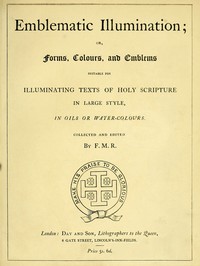
Emblematic Illumination; OR, Forms, Colours, and Emblems
SUITABLE FOR ILLUMINATING TEXTS OF HOLY SCRIPTURE IN LARGE STYLE, _IN OILS OR WATER-COLOURS_.
COLLECTED AND EDITED BY F. M. R.
_London_: DAY AND SON, _Lithographers to the Queen_, 6 GATE STREET, LINCOLN'S-INN-FIELDS.
The Editor of the following pages has no desire to offer them in competition with the numerous and useful Handbooks on Illumination already published. All those that the writer has met with--some eight or ten--have been almost exclusively directed to the study of Missal Painting and Illuminating on the most _minute_ scale. The exceptions to this rule are a few occasional remarks, merely hinting at the larger and more popular style.
The principal omission, however, which this little book is designed to supply, is the _emblematic_ branch of the subject. Amateurs most generally confine themselves to illuminating texts of Holy Scripture on a large scale, to assist in which numerous printed outlines are now published. But, from complete ignorance of the rules of ecclesiastical colouring, the amateur not only becomes hopelessly bewildered as to what colour to select for particular words, but, in falling back upon his own taste for guidance, commits errors which destroy the emblematic beauty of his work. The significance of colour is greater than is generally supposed, and will be found a subject of much interest.
Such sacred symbols as could easily be introduced into illuminated scrolls have been described, in the hope that, by their assistance, a taste for strictly appropriate ornamentation may be more largely cultivated, to the exclusion of those unmeaning and tawdry decorations which offend the eye.
Instead of furnishing copies of antique capitals, of which so many excellent collections now abound, it has been thought more useful to supply the reader with some specimens of emblematic letters (which may suggest other similar designs), suitable for particular texts, several of which are also subjoined.
The instructions for the mechanical part of the work are given on the authority of experience, while the significations of colours and emblems have been carefully collected from larger and standard publications.
_A Selected List of Requisite Materials._
_s. d._ 1 Sheet of Bristol Board, or Vellum-Paper 1 0 1 Long Wooden (flat) Ruler 0 6 1 6-inch Bone ditto 0 6 3 Pencils, F, HB, and BB 0 6 1 Cake of Lamp-Black (moist) 1 0 German Blue in Powder 0 6 "Carmine" ditto 0 6 Vermilion ditto 0 6 ½ Cake of Emerald Green (moist) 0 6 Bessemer's Gold Paint, or Winsor and Newton's Liquid Gold 1 0 Gum Arabic 0 4 2 Red Sable Brushes, 6_d._ and 8_d._ 1 2 1 Best Camel's-Hair (for Gold) 0 3 3 Saucers (2 large and 1 small) 0 3 Indian-Rubber 0 1 Spirits of Turpentine 0 3 1 Large Sheet of Millboard[A] 0 8 1 Sheet of _Transparent_ Tracing-Paper 0 3 White Tissue-Paper 0 3 ------- 10 0 -------
[A] This, divided _longwise_, serves as temporary Portfolio and Drawing-board.
_Emblematic Scrolls_; _Or, Texts in Outline, containing Capitals, &c., similar to those in our Coloured Plates_.
THE FOLLOWING ARE NOW READY:--
No. 1. "_Fear not, I will help thee._" 2. "_Look unto_ ME, _and be ye saved_." 3. "MY _Peace I give unto you_." 4. "_The_ LORD _will provide_." No. 5. "_Be clothed with humility._" 9. _In Cœlo Quies._ (In Heaven is Rest.) 13. "_Bring forth, therefore, Fruits meet for Repentance._" No. 12. "_Little Children, Love one another._" "_Speak Gently._" "_Be Patient._" 1_s. the set_.
ONE SHILLING AND SIXPENCE. (INCLUDING PHOTOGRAPH.)
No. 10. "_I am come that ye might have life._"
ONE SHILLING AND SIXPENCE EACH. (INCLUDING DIRECTIONS FOR COLOURING.)
No. 6. "HE _shall give_ HIS _Angels charge over_ THEE." No. 7. "_Unto you is born a Saviour, which is_ CHRIST _the_ LORD." No. 14. "CHRIST _is risen! Alleluia._"
TWO SHILLINGS. (INCLUDING PHOTOGRAPHS.)
No. 8. "_Glory to_ GOD _in the Highest, on Earth Peace, Good-will towards men_." No. 11. "_Be thou faithful unto Death, and I will give thee a Crown of Life._"
NOTE.--These Scrolls cannot be sent through the Post unless 1_s._ 8_d._ be added for Postage and Packing in Millboard.
[Sidenote: Eccles. ix. 10.]
To begin with the purely mechanical part of our work, let us enumerate the materials required for drawing the outlines:--
[Sidenote: Pencils.] 3 Pencils--F, HB, and BB. 2_d._ each.[1]
[1] N.B. The prices of materials vary so much, that only a general idea can be given of them, as some guide to beginners.
F. M. Redgrave's Emblematic Illumination opens by distinguishing itself from the prevailing handbooks of the 1850s, which the editor notes were 'almost exclusively directed to the study of Missal Painting and Illuminating on the most minute scale.' The book instead addresses amateurs working on a larger scale, supplying not only outlines but a systematic emblematic color code drawn from ecclesiastical and classical sources. The preface frames the work as a corrective to 'unmeaning and tawdry decorations,' proposing that color and symbol carry fixed meanings—purple for royalty and martyrdom, white for purity and forgiveness, green for hope and victory. This is not a general guide but a tightly argued manual for sacred ornamentation.
A Practical List with a Purpose
The 'Selected List of Requisite Materials' is no mere shopping list; it reveals the editor's concern with accessibility and precision. Items are priced (a sheet of Bristol Board at 1s., three pencils for 6d.) and described with care—'Bessemer's Gold Paint, or Winsor and Newton's Liquid Gold'—suggesting a reader who may be new to the craft. The inclusion of 'Gum Arabic' and 'Best Camel's-Hair (for Gold)' points to the exacting techniques required for gilding. Yet the list also hints at the book's hybrid nature: it is both a practical manual and a theological treatise. The materials are tools for executing a symbolic system, not ends in themselves. Redgrave's voice here is that of an experienced practitioner, offering advice on brushes and saucers while assuming the reader's commitment to the emblematic method.
The Grammar of Colour
The core of the book is its exposition of colour symbolism, presented as a fixed lexicon. Redgrave draws on biblical texts, patristic tradition, and classical authorities—Pliny, Suetonius, Homer—to anchor each hue. Purple, for instance, is traced from the Book of Judges through Roman sumptuary laws to its use in Spanish painting for Christ's mantle. White is linked to Revelation and Isaiah, green to 'hope in immortality, eternity, victory.' The editor is careful to note exceptions: purple is 'but little used in large illuminations' because of its difficulty in bright tints. This attention to practical limitations tempers the idealism. The section on ecclesiastical colours, citing Purchas's Directorium Anglicanum, shows how the system aligns with liturgical seasons—white from Christmas Eve to Epiphany, red at Pentecost—grounding the aesthetic in ritual practice.
Voice and Editorial Restraint
Redgrave's editorial voice is notably modest. The preface disclaims competition with existing handbooks, stating 'the Editor has no desire to offer them in competition.' The tone is instructional but not dogmatic; the colour significations are 'carefully collected from larger and standard publications.' Yet the book's structure—moving from materials to colour to emblematic letters—implies a coherent pedagogical arc. The excerpts show a writer who values clarity over ornament: sentences are direct, definitions are precise, and biblical citations are given in full. The editor's presence is felt mainly through selection and arrangement, not through personal anecdote. This restraint gives the manual an authoritative, almost liturgical quality, as if the system itself, not the editor, is the authority.
Readers approaching Emblematic Illumination should attend to the interplay between its practical instructions and its symbolic framework. The book is best used as a reference for colour choices and emblematic motifs, but its value lies in the coherence of its system. The editor's voice—learned, precise, and self-effacing—invites the reader to see illumination as a disciplined art, not a decorative whim. For those working on biblical texts in large format, this manual offers a rare combination of material guidance and theological grounding.
Reading Redgrave's insistence on bold, emblematic color rather than delicate miniature work, I found myself thinking of the sprawling, confident eccentricity of Sir Thomas Urquhart of Cromartie, Knight — Reading Companion. Both feel like a loving push outward, away from the safe and familiar. One seeks scale in paint, the other in language. There is something quietly reassuring about encountering that same brave spirit in different eras.
There are no reviews for this eBook.
There are no comments for this eBook.
Reader reflection
Before you leave, reflect on the book
Use these questions to collect your thoughts before moving on.
Your progress
0
/
10
2
How did the book work for you overall?
3
Would you pass this book on to a friend?
4
How demanding did the text feel?
5
Did the story or argument move comfortably?
6
How much did the book move you?
7
How understandable was the text?
8
What did you appreciate most?
9
What did this book teach you most?
10