1

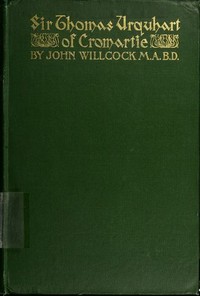
Sir Thomas Urquhart of Cromartie, Knight — Reading Companion
(0 User reviews)
772
Project Gutenberg
2012
Not confirmed
Urquhart, Thomas, 1611-1660; Crichton, James, 1560-1582
Readers of public-domain and historical texts
Project Gutenberg digital edition
en
Edition facts
Words
76,099
Reading time
331 min
Text sections
13
Sir Thomas Urquhart of Cromartie, Knight — Reading Companion can be approached with a clearer sense of reading commitment from its source measurements: 76,099 words, 5 hr 31 min estimated reading time, and 13 detected text sections.
The text analysis averages about 24.6 words per sentence, while the detected sections provide another way to judge how the source is divided.
Project Gutenberg metadata also associates the work with “Urquhart, Thomas, 1611-1660,” connecting these edition facts with the source record’s subject description.
Source:
Project Gutenberg record #38604
John Willcock's 1899 biography of Sir Thomas Urquhart examines the Scottish knight's life as translator, genealogist, and royalist, using archival materials to reconstruct his career while critically assessing his fantastical family history claims.
Editorial Edition Score
4.8/5
★★★★★
★★★★★
Calculated from edition completeness, EPUB availability, text structure and catalogue metadata. Not a user rating.
How this score is calculated
- Description quality20 pts
- Title & short description10 pts
- Source metadata20 pts
- Text length15 pts
- Chapters / structure15 pts
- EPUB file integrity20 pts
Total of 100 points, scaled to a 2.5-5.0 range. Editions with an empty description or a missing EPUB file are not scored.
Edition quality
Read the Text
is official residence as thane of the district when he was at the beginning of his ambitious career.
In the thirteenth century the family of Mouat (then _de Monte Alto_) were in possession,[3] but early in the following century the estate had accrued to King Robert the Bruce, probably because the Mounts had submitted to the English king, Edward I. King Robert granted Cromartie to Sir Hugh Ross, eldest son of William, Earl of Ross, in 1315, and by him it was afterwards, in the reign of King David Bruce (1329-70), given to an Adam of Urquhart ("de Vrquhartt"),[4] with whose descendants it remained for many generations. In 1357 he got from the Crown the hereditary sheriffdom of Cromartie, and eight years later the same Hugh Ross gave him the estate of Fisherie, in King-Edward, Aberdeenshire. This Adam is the first of the family to emerge from the darkness of antiquity into the light of history, and probably his name, as the founder of the Urquhart fortunes, suggested the still more famous progenitor to whom our Sir Thomas traced back his pedigree link by link, as our readers will afterwards hear.
Our author's father, also a Thomas, and the first of his line who was a Protestant in religion, was born in 1585. He succeeded to the property in 1603, and in 1617 was knighted by James VI. in Edinburgh. As he was left an orphan at an early age, he was brought up under the care of his grand-uncle, John Urquhart of Craigfintray, who has been commonly called from this circumstance "the Tutor of Cromartie."[5] His great-grandnephew, our Sir Thomas, has celebrated his praise in very high terms. "He was," he says, "over all Britain renowned for his deep reach of natural wit, and great dexterity in acquiring of many lands and great possessions, with all men's applause."[6]
From all accounts, it seems that the "Tutor" was faithful in the discharge of all the duties belonging to his office,[7] though he did not succeed in imparting to his pupil the secret of acquiring landed property, either with or without applause.
Sir Thomas Urquhart, senior, received his estates, we are informed, "without any burthen of debt, how little soever, or provision of brother, sister, or any other of his kindred or allyance wherewith to affect it."[8] He married Christian, the fourth daughter of Alexander, fourth Lord Elphinstone (1552-1638), and received with her a dowry of nine thousand merks Scots (_i.e._ £500 Sterling). The date of our author's birth is given by Maitland as 1605, but it is now certain that this is an error, and that the true date is 1611.[9] Sir Thomas was the eldest of the family, and he tells us that he was born five years after the marriage of his parents. He also informs us that his mother's father, Lord Elphinstone, held the office of High Treasurer in Scotland at the time of the marriage. As that nobleman was High Treasurer only from just before 19th April, 1599, till 22nd September, 1601, it would not have been unreasonable to fix the date of the marriage as probably some time in 1600, if we had no other information on the subject. But it so happens that the marriage-contract is in existence,[10] and is dated the 9th of July, 1606, and consequently Sir Thomas's birth would fall in the year 1611. Our author must therefore have been in error in describing his grandfather as being High Treasurer at the time of his daughter's marriage. He had, indeed, occupied this office some years before. Sir Thomas should have said "had been," instead of "was," but his lordly disposition of mind would probably make him contemptuous of such trifles.
In 1611, James VI. was drawing near to the end of the first period of his reign, during which he had been under the influence of the traditions of the days of Elizabeth and Burghley, and had not yet passed into his own keeping, and the hands of profligate favourites. Bacon was still in the shade of distrust, from which, however, he was soon to emerge: he was now, indeed, Solicitor-General, but his ambition was not satisfied by this post. The heir-apparent to the throne was Prince Henry, who died in the following year. Charles, his brother, was now eleven years of age. Shakespeare brought out this year his play of _The Winter's Tale_, and Ben Jonson his _Catiline_. Sir Walter Raleigh was a prisoner in the Tower, and was busily engaged in writing his _History of the World_, which he completed in the following year, though it was not published until 1614. The Authorised Version of the English Bible appeared this year. Milton was now a child of scarcely three years old, and Cromwell a boy of twelve.
John Willcock's 1899 biography of Sir Thomas Urquhart opens with a frank admission: most readers know Urquhart only as the translator of a French classic, while his original works in poetry, trigonometry, genealogy, and biography remain obscure. Willcock aims to remedy this by assembling scattered archival materials into a vivid portrait of a 'romantic, fantastical figure.' The preface reveals a biographer working at a distance from public libraries, relying on a network of correspondents—Miss Kemp, James Walter, and others—to track references across Scotland. This collaborative method shapes the book's texture, blending scholarly reconstruction with local historical detail.
The Biographer's Method and Sources
Willcock explicitly positions his work as an expansion of earlier sketches by the Maitland Club, Dr. Irving, and the Dictionary of National Biography. Where those offered 'a bare outline,' he promises to 'clothe the skeleton with sinews and flesh.' The preface lists a dozen named contributors who supplied details from King-Edward, Hatton Castle, and Aberdeen University Library. This reliance on distant collaborators shapes the book's evidentiary texture: Willcock frequently cites local traditions, such as Hugh Miller's account of a battle at 'Wallace Den,' while also reproducing Urquhart's own genealogical claims—including the assertion that an ancestor fathered twenty-five sons and eleven daughters. The biographer's tone wavers between scholarly caution and amused skepticism, as when he notes that Urquhart 'does not let us off easily' with his numerical exaggerations.
Urquhart's Genealogical Fantasies
The excerpts reveal Urquhart's genealogical writings as a central challenge for Willcock. Urquhart traces his lineage to 'the Ionian race of the Prince of Achaia' and promises future proof from 'Arabick, Greek, Latin, and other writers.' Willcock quotes Urquhart's plan for a 'great chronicle of the House of Urquhart' that would mention families in Germany, Bohemia, Italy, France, Spain, England, Scotland, Ireland, and 'several other nations of a warmer climate.' The biographer notes dryly that Urquhart's concluding paragraph promises evidence falling short of 'Holy writ or the works of Euclid.' This tension between Urquhart's grand claims and Willcock's critical framing is the book's driving dynamic: the biography becomes as much a study of Urquhart's self-mythologizing as of his actual deeds.
Local History and the Landscape of Cromarty
Willcock anchors Urquhart's narratives in specific geographical features. He describes the 'mote-hill of Cromartie' and 'Wallace Den,' a hollow where tradition holds that William Wallace's nephew killed six hundred of King Edward's forces. The biographer draws on Hugh Miller's account of English troops surprised in a ravine, then driven over 'abrupt and dizzy precipices' into the Firth. These passages show Willcock moving between Urquhart's written claims and oral tradition, weighing the 'silence' of one source against the 'many details' of another. The landscape itself becomes a character: the Sutor peninsula, the Firth, and the 'shapeless hillocks' said to mark burial sites all serve as physical evidence for contested histories. Willcock's method here is archaeological, treating place-names and topography as documents to be read alongside Urquhart's texts.
Readers approaching Willcock's biography should attend to its dual focus: the life of Urquhart and the process of reconstructing that life from fragmentary sources. The book rewards those interested in how nineteenth-century Scottish antiquarians worked, as Willcock's network of correspondents and his critical engagement with local tradition are as much the subject as Urquhart himself. The excerpts suggest a work that is both a biography and a meta-commentary on biographical method, particularly in its handling of genealogical claims that strain credibility.
Reading John Willcock’s careful portrait of Sir Thomas Urquhart, I kept thinking of how he chased grand, often impossible designs—genealogies stretching to Adam, a universal language. There is something lonely in such vast ambition. It reminded me of the quiet, patient water flowing through Rome’s old fountains, documented in Fountains of Papal Rome — Background and Themes. Strange, how both men sought permanence in stone and ink.
There are no reviews for this eBook.
There are no comments for this eBook.
Reader reflection
How did this book work for you?
Your answers remain private and are stored only in this browser.
Your progress
0
/
10
2
How did the book work for you overall?
3
How likely are you to recommend this book?
4
How much effort did this book require?
5
Was the book what you thought it would be?
6
Could you follow the author’s main argument?
7
Was the book moving at the right speed?
8
Would you read this book again?
9
What changed or sharpened your thinking?
10