1

Art and Pleasure: "Painting with Needles" New Uses of Dexter Cotton Warp — Reading Companion
(0 User reviews)
24
Project Gutenberg
2021
Not confirmed
Crocheting -- Patterns
Readers of public-domain and historical texts
Project Gutenberg digital edition
en
Edition facts
Words
13,489
Reading time
59 min
Text sections
2
For Art and Pleasure: "Painting with Needles" New Uses of Dexter Cotton Warp — Reading Companion, the stored edition analysis reports 13,489 words, 59 min estimated reading time, and 2 detected text sections.
The text analysis averages about 18.3 words per sentence, while the detected sections provide another way to judge how the source is divided.
Project Gutenberg metadata also associates the work with “Crocheting -- Patterns,” connecting these edition facts with the source record’s subject description.
Source:
Project Gutenberg record #65873
A 1949 crochet pattern booklet from Virginia Snow Studios, using Dexter Cotton Warp. The catalog subject 'Crocheting -- Patterns' accurately describes the content, but the excerpts also reveal a strong emphasis on historical design inspiration and the practical economy of home crafting.
Editorial Edition Score
4.5/5
★★★★★
★★★★★
Calculated from edition completeness, EPUB availability, text structure and catalogue metadata. Not a user rating.
How this score is calculated
- Description quality20 pts
- Title & short description10 pts
- Source metadata20 pts
- Text length15 pts
- Chapters / structure15 pts
- EPUB file integrity20 pts
Total of 100 points, scaled to a 2.5-5.0 range. Editions with an empty description or a missing EPUB file are not scored.
Edition quality
Read the Text
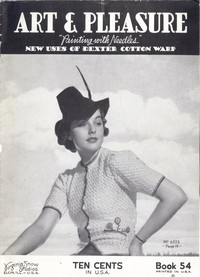
ART & PLEASURE “_Painting with Needles_” NEW USES OF DEXTER COTTON WARP
_Virginia Snow Studios_ ELGIN, ILL.—U.S.A.
TEN CENTS IN U.S.A. PRINTED IN U.S.A.
_Art and Pleasure_ “Painting With Needles”
To the Romans who cradled culture, all forms of created beauty constituted Art. Fine sewing of all kinds, they called “Painting with Needles”.
Today, centuries later, we find millions of American women, those of wealth and those of more modest means alike, also painting with needles. They are expressing the beautiful in colorful yarns, and perpetuating culture with their crocheted creations made for the comfort and pleasure of gracious living.
And it is more than art! Women have learned and are learning how to dress better for less and how to adorn their homes with practical, yet lovely, articles of usefulness.
Crocheting with Dexter Cotton Warp is, in a sense, the fair flower of an art that our great-grandmas practiced not alone for pleasure, but with an eye to the practical—the art of the weaving of rugs. Their yarns were not so fine and lovely as of today, nor so amazingly easy to work with. But then, as now, women found pride and delight in the home-arts, and now crocheting, the art of the hour, flaunts many of the exquisite designs that have survived those early rugs.
You who love to crochet seek of course the most beautiful and authentic designs, and finest materials to work with. This Book is for you. In it you will find fascinating variety, and you will meet as from the pages of history patterns originally conceived by Colonial grandames, or Spanish senoras, or Bavarian peasants—designs from all over the world. You will find the instructions simple and easy to follow. Choose, and know the thrill of superior crocheting. Save money. And feel free, please, to make us your crocheting headquarters. We shall always be glad to serve you.
_Virginia Snow_ Elgin, Illinois
A Century of Service Weaves Beauty and Long Life Into Your Crocheting!
For one hundred and twenty years women of America have used Dexter Cottons.
A hundred and twenty years ago N.G.B. Dexter dreamed of working magic with cotton, and he founded his mills in rugged New England to make that dream come true. His were the first mills in America. Crude the first cotton that came from them, of course, and yet the Dexter stamp of quality was the guarantee of American women that the yarns they wove and spun with, American-made, could not be surpassed by any product of the mills across the seas.
Today American women have that same faith and reliance in the cottons that bear the name of Dexter. Today as never before, there is fulfillment of his early dream. For women are working magic with cotton, they are creating beautiful things with soft lustrous yarns of delicious colors, sensuously lustrous, yet strong and enduring. And today, as never before, the name of Dexter on yarns carries assurance of unsurpassed quality, of almost a century and a quarter of continued integrity.
Choose Dexter cottons. They will weave into your crocheting unparalleled beauty, and retain that beauty far longer than ordinary yarns can promise....
This practical utility bag knows no age limit—it “sings with youth” yet by its very usefulness can be dignifiedly subdued. You can make it in any combination of colors getting rare effects with its diagonal stripes. And you will possess an ideal utility bag for shopping, or with sports clothes, or as a knitting bag.
Instructions on page 11
Even the laundry bag in the modern home must be expressive of beauty. Here is one that you will find easy to fashion; sturdy and enduring, it will remain always a happy spot of color through countless washings and much abuse.
Instructions on page 12
NO. 6534—SHOPPING BAG
Here, too, is a shopping or knitting bag that can be worked up in various combinations of colors, and you will find countless times when it will be “Just the bag I need”—a practical bag you will prize.
Instructions on page 12
Strongly Spanish is this striking belt, with fringe trimming—just the thing to smartly “set off” the simple sports dress, and give it tone.
Instructions on page 11
NO. 6537—ZIPPER PURSE
Crochet this zipper purse in colors to match the belt above and it, too, will be an unusual style appeal, amazingly fetching.
Instructions on page 11
NO. 6528—LACE TABLE CLOTH
Also ultra smart for distinctive service. Crocheting at its loveliest contributed to this distinctive table cloth. It completely covers the table and lends itself in generous measure to that indefinable something—that for want of a better word—designers call charm.
Instructions on page 9
NO. 6530—TUMBLER MUFFS
The catalog subject for this booklet is simply 'Crocheting -- Patterns,' and the excerpts do contain detailed instructions for items like a frilled mat and a rug. However, the opening pages also present a broader cultural argument: the author invokes Roman definitions of art, claims that crocheting with Dexter Cotton Warp continues a tradition of 'painting with needles,' and explicitly links the patterns to designs from 'Colonial grandames, or Spanish senoras, or Bavarian peasants.' The subject heading captures the practical use but omits this historical framing.
Historical Claims and Commercial Purpose
The booklet’s introduction asserts that crocheting is both art and thrift. It tells readers they can 'dress better for less' and adorn homes with 'practical, yet lovely, articles.' This dual appeal—aesthetic pleasure and economic sense—is reinforced by a company history of Dexter Cotton Warp, which traces back to N.G.B. Dexter’s mills in 'rugged New England.' The text positions the product as part of a century-long American tradition, claiming that Dexter cottons 'could not be surpassed by any product of the mills across the seas.' The historical references to Romans and colonial women are not supported by evidence in the excerpts beyond these assertions; they function as marketing rhetoric rather than documented history.
Pattern Instructions as Primary Evidence
The bulk of the excerpts consists of crochet instructions, such as for a 'Frilled Mat' described as 'a dainty design from the days of crinoline and hoop skirts.' The instructions are highly technical, specifying materials (e.g., 'Dexter Cotton Warp, Art. 380, 1 tube natural No. 100'), hook sizes, and row-by-row stitch counts. For example, the mat pattern begins with 'Ch 6, join with sl st' and proceeds through 20 rows of increasing loop lengths. The rug pattern uses multiple colors and requires assembling eight triangles into a diamond center. These instructions are the most concrete evidence of the booklet’s purpose: they are precise, repeatable, and intended for a skilled crocheter. The catalog subject 'Patterns' is accurate, but the excerpts show that the patterns are embedded within a persuasive commercial narrative.
The Role of Dexter Cotton Warp Branding
Every pattern specifies 'Dexter Cotton Warp, Art. 380' as the required material. The booklet’s title page and introduction repeatedly name the product, and the company history section emphasizes 'a Century of Service' and 'Beauty and Long Life.' The instructions themselves are generic enough to be followed with any comparable yarn, but the branding is integral to the booklet’s identity. The catalog subject does not capture this commercial dimension; the excerpts make clear that the patterns are inseparable from the promotion of a specific product. A reader using this booklet would need to obtain Dexter Cotton Warp to follow the instructions as written, or adapt the patterns for other materials.
The excerpts show a booklet that is part pattern collection, part advertisement, and part cultural manifesto. The catalog subject 'Crocheting -- Patterns' is technically correct but narrow. Readers should approach the historical claims with caution, as they are unsupported by evidence within the text. The patterns themselves are detailed and usable, provided one accepts the product-specific branding. For a fuller understanding, compare the instructions here with other period crochet publications to see how typical the commercial framing is.
That rainy afternoon, the 1949 booklet’s crochet diagrams blurred into the texture of my grandmother’s tea towels, each stitch a small witness to thrift and patience. Turning a page, I found a footnote mentioning French cathedral needlework, and my mind drifted to the heavy stone arches I’d once seen in photographs. Before long, I’d set down the cotton warp and picked up The Churches of Paris, from Clovis to Charles X — Text and Context, the same quiet reverence simply finding another shape.
There are no reviews for this eBook.
There are no comments for this eBook.
Reader reflection
Record your reading impressions
A brief reflection can help important ideas stay with you longer.
Your progress
0
/
10
2
How did the book work for you overall?
3
Is this a title you would suggest to others?
4
How easy was the book to follow?
5
Did the story or argument move comfortably?
6
Which aspect of the book did you value most?
7
Would you read this book again?
8
Would you start a conversation about this book?
9
What is the main idea you are taking away?
10