1

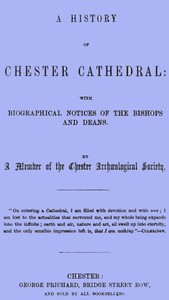
A History of Chester Cathedral with biographical notices of the Bishops and Deans — Context and Discussion
(0 User reviews)
3025
Project Gutenberg
2020
Not confirmed
Chester Cathedral; Chester (England) -- Antiquities
Readers of public-domain and historical texts
Project Gutenberg digital edition
en
Edition facts
Words
26,331
Reading time
115 min
Text sections
3
For A History of Chester Cathedral with biographical notices of the Bishops and Deans — Context and Discussion, the stored edition analysis reports 26,331 words, 1 hr 55 min estimated reading time, and 3 detected text sections.
The text analysis averages about 24.5 words per sentence, while the detected sections provide another way to judge how the source is divided.
Project Gutenberg metadata also associates the work with “Chester Cathedral,” connecting these edition facts with the source record’s subject description.
Source:
Project Gutenberg record #62240
John Hicklin's 1852 history of Chester Cathedral combines architectural description with biographical sketches of bishops and deans, drawing on antiquarian sources and a Coleridge epigraph to frame the cathedral as a site of moral and historical reflection.
Editorial Edition Score
4.6/5
★★★★★
★★★★★
Calculated from edition completeness, EPUB availability, text structure and catalogue metadata. Not a user rating.
How this score is calculated
- Description quality20 pts
- Title & short description10 pts
- Source metadata20 pts
- Text length15 pts
- Chapters / structure15 pts
- EPUB file integrity20 pts
Total of 100 points, scaled to a 2.5-5.0 range. Editions with an empty description or a missing EPUB file are not scored.
Edition quality
Read the Text
nd churches wantonly destroyed.
Under the empire of his successor, Constantine Chlorus, persecution was extinguished; churches were re-built, the offices of religion generally resumed, and the people enjoyed a long tranquillity.
The recall of the Romans to the defence of the integral parts of their empire, in conjunction with the laborious teaching of the early Christians, led to the speedy decline of their mythology in Britain, where indeed it appears never to have taken any deep root. The growing power of truth supplanted Pagan superstition, and the zeal of the Christian converts, speedily destroyed the statues and altars of its deities, which yet existed in this Island as memorials of its conquest by Roman arms. “Here had been within the bounds of Britain, saith our stories, before the time of King Lucius, whose reign began about the year 179, flamines and arch-flamines, who were governors over others, the priests of that religion, which the people in their Paganism did profess, as idolatry hath ever made a counterfeit show of the true service of God; and when Lucius was converted to the Christian faith, to enlarge the power of Christian knowledge and settle a government in the Church of Christ, abolishing those seats of heathenish idolators, he took advantage of the temples and other conveniences, wickedly used by them, to turn them to the true service of God and Christ; and therefore ordained in England three Archbishops and twenty-eight Bishops; one of which Archbishops he placed at London, to whom was subject Cornwall, &c., &c., and the third was the Archbishop Caerleon, that is Chester. Thus far I note only to show that when Lucius began the Christian religion, it may appear that both Chester had been a place for the Arch-flamines in the time of Paganism, and was also an Archbishop’s see at the first plantation of the truth.”
John Hicklin's A History of Chester Cathedral opens with a Coleridge epigraph that sets a devotional tone: 'On entering a Cathedral, I am filled with devotion and with awe; I am lost to the actualities that surround me.' The author, identified only as a member of the Chester Archæological Society, immediately broadens this personal sentiment into a claim about national character, arguing that England's 'proud position' stems from its Christian faith. This rhetorical move—from individual awe to collective history—shapes the entire work.
From Devotional Opening to Documentary Biography
The book's first chapter, 'A Visit to the Cathedral,' is a sustained argument for the moral and social importance of religious history. Hicklin writes in a formal, periodic style, with sentences that accumulate clauses: 'When we reflect upon the momentous and happy results which have always followed the introduction of Christianity amongst a people;—how it has ever proved an up-lifting and progressive power...' This elevated register contrasts sharply with the biographical notices that follow. The transition is abrupt: after several pages of general reflection, the narrative shifts to a series of bishop-by-bishop accounts, each compressed into a few paragraphs. The language becomes more concrete, citing specific benefactions, publications, and controversies. For example, Bishop Cartwright is described as 'a ready and expert agent' for James II, and his death is recorded with clinical precision: 'seized with a dysentery, he died on the 15th April, 1689, aged 54.' The change in pace—from expansive meditation to terse chronicle—suggests two distinct purposes: to inspire and to document.
Moral Judgment Woven into Factual Record
Hicklin does not merely list events; he evaluates character. Bishop Nicholas Stratford is praised for never admonishing 'others, but in the spirit of meekness and conciliation,' and his Dissuasion against Revenge is cited as evidence. In contrast, Bishop Cartwright's 'vacillating principles' are scrutinized through conflicting sources: Burnet called him 'one of the worst of men,' yet Antony à Wood 'rescues him from a similar charge.' Hicklin weighs these testimonies without resolving the ambiguity, noting that 'there still appears to be insufficient evidence to conclude' whether Cartwright died Protestant or Catholic. This careful hedging—using phrases like 'seems to point' and 'appears sufficiently confirmed'—reveals a writer attentive to the limits of his sources. The biographical notices thus function as miniature moral essays, where each prelate's legacy is assessed through his actions and the judgments of contemporaries.
Antiquarian Detail and Institutional Legacy
Hicklin grounds his narrative in specific institutional facts. Bishop Stratford founded Chester Blue Coat Hospital; his son endowed the Infirmary. Bishop Gastrell compiled the Notitia Cestriensis, described as 'the noblest document extant on the subject of the ecclesiastical antiquities of the diocese.' These details anchor the abstract claims of the opening in tangible outcomes. The author also notes the physical fabric of the cathedral only obliquely—through dedications, burials, and the building's role as a setting for episcopal acts. The pace here is steady, each bishop receiving a similar treatment: consecration, key works, death, and burial place. This uniformity gives the book a reference-like quality, suitable for a reader seeking specific information about Chester's ecclesiastical figures rather than a continuous narrative.
Hicklin's work rewards readers who move between its two modes: the sweeping religious history of the opening and the compressed biographies that follow. The book's value lies less in architectural description than in its compilation of episcopal lives, each judged with a blend of antiquarian caution and moral clarity. For those interested in Victorian ecclesiastical historiography or the local history of Chester, this edition offers a primary source that reveals how a mid-nineteenth-century antiquarian balanced piety with scholarly restraint.
I have spent many afternoons between those stone walls, and Hicklin’s words still carry their hush. He found quiet meaning in ancient arches, much as another hand found it in feather and hook. That careful patience lives on in Blacker's art of fly making, &c. — Key Ideas to Explore, a different sort of devotion, yet the same gentle diligence.
There are no reviews for this eBook.
There are no comments for this eBook.
Reader reflection
Take a moment to reflect on this book
Create a short personal record of your experience with this book.
Your progress
0
/
10
2
Was reading this book enjoyable?
3
How likely are you to recommend this book?
4
What was the reading difficulty like?
5
Did the book offer a fresh perspective?
6
What was the strongest part of the book?
7
Did any part of the book stay with you emotionally?
8
Did the story or argument move comfortably?
9
What changed or sharpened your thinking?
10