1

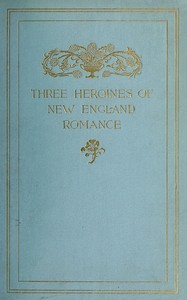
Three Heroines of New England Romance Their true stories herein set forth by Mrs Harriet Spoffard, Miss Louise Imogen Guiney, and Miss Alice Brown — Story, Setting & Ideas
(0 User reviews)
689
Project Gutenberg
2017
Not confirmed
Alden, Priscilla; Surriage, Agnes, 1726-1783; Wentworth, Martha Hilton
Readers of public-domain and historical texts
Project Gutenberg digital edition
en
Edition facts
Words
16,967
Reading time
74 min
Text sections
9
This digital edition of Three Heroines of New England Romance Their true stories herein set forth by Mrs Harriet Spoffard, Miss Louise Imogen Guiney, and Miss Alice Brown — Story, Setting & Ideas is described by source-level measurements including 16,967 words, 1 hr 14 min estimated reading time, and 9 detected text sections.
The text analysis averages about 28.0 words per sentence, while the detected sections provide another way to judge how the source is divided.
Project Gutenberg metadata also associates the work with “Alden, Priscilla,” connecting these edition facts with the source record’s subject description.
Source:
Project Gutenberg record #54028
Three biographical sketches by Spofford, Brown, and Guiney recount the lives of Priscilla Alden, Agnes Surriage, and Martha Hilton, using period detail and romanticized narration to explore class, marriage, and legend in colonial New England.
Editorial Edition Score
4.6/5
★★★★★
★★★★★
Calculated from edition completeness, EPUB availability, text structure and catalogue metadata. Not a user rating.
How this score is calculated
- Description quality20 pts
- Title & short description10 pts
- Source metadata20 pts
- Text length15 pts
- Chapters / structure15 pts
- EPUB file integrity20 pts
Total of 100 points, scaled to a 2.5-5.0 range. Editions with an empty description or a missing EPUB file are not scored.
Edition quality
Read the Text
“A fishmonger in London” 115
“He had the mortification to see her prefer one Shortridge, a mechanic” 117
“His snuff-boxes and his bowls” 118
Governor Benning Wentworth 119
Wentworth house at Little Harbor 121
“Her strategic eye upon master’s deciduous charms” 123
“The great buck of his day” 127
“Fiddling at Stoodley’s far into the morning” 131
“Wharves now rotting along the harbor-borders” 133
An old English church 139
Picturesque barns 140
The Weston flag-staff 141
“Houses sheltered by great elms” 142
“Past fertile farms” 142
“Over picturesque stone bridges” 143
“Here is a noble elm” 144
The Wayside Inn, Sudbury 145
Great elms at Hopkinton 149
The Royall House, Medford 153
Street leading to Moll Pitcher’s 156
Moll Pitcher’s house and the graveyard 157
Some fishermen’s hats 159
Circle Street and Floyd Ireson’s house 161
“This is where the sailors in pigtails and petticoats used to be” 165
St. John’s, Portsmouth 168
The Gardiner House and the linden 169
Plymouth, the home of Priscilla 172
Decorative designs Title, 7, 8, 9, 12, 105, 106, 134, 175
Initials 15, 63, 109, 137
“The swallow with summer Will wing o’er the seas, The wind that I sigh to Will visit thy trees. The ship that it hastens Thy ports will contain, But me—I shall never See England again!”
I OFTEN fancy John Alden, and others, too, among his companions of kindly fame, wandering down the long Plymouth beach and murmuring to themselves thoughts like these. And I like to look in the annals of the gentle Pilgrims and the sterner Puritans for any pages where one may find muffled for a moment the strain of high emprise which wins our awe and our praise, but not so surely our love, and gain access on their more human side to the men and women who lived the noblest romance in all history.
So one comes on the story of the Lady Arbella, and her love and death, with the sweet surprise one has in finding a fragile flower among granite ledges. So the Baby Peregrine’s velvet cheek has the unconscious caress of every mother who thinks of him rocked to sleep in his rough cradle by the sounding sea. So the thought deals tenderly with Dorothy Bradford, who crossed the mighty darkness of the deep only to fall overboard from the “Mayflower,” and be drowned in harbor, and would fain reap some harvest of romance in the coming over sea, three years afterward, of Mrs. Southworth, with her young sons, Constant and Thomas, to marry the Governor, who had loved her as Alice Carpenter lang syne. And so the story of John Alden’s courtship is read as if we had found some human beings camped in the midst of demigods.
The three biographies in this volume share a common strategy: each author treats her subject as a figure of romance rather than a subject for strict historical inquiry. Harriet Prescott Spofford opens with Priscilla Alden at her spinning wheel, weaving a scene that blends domestic tranquility with the "sounding sea" of the Plymouth settlement. The prose leans into sensory detail—the whir of the wheel, the salt air—to establish an intimate, almost legendary atmosphere. This approach signals that the book prioritizes narrative charm over archival rigor, a choice that shapes how a reader should engage with the text.
Priscilla: The Spinning Wheel and the Sea
Spofford’s account of Priscilla Alden draws heavily on the well-known story of John Alden’s courtship on behalf of Miles Standish, but she frames it through the lens of domestic craft. The spinning wheel becomes a symbol of patient industry, while the nearby ocean—described in the list of drawings as "his rough cradle by the sounding sea"—anchors the narrative in the Plymouth setting. Spofford emphasizes Priscilla’s quiet agency: she is not merely a romantic prize but a woman who "in calmer moments" reads scripture and manages her household. The author’s voice is warm and approving, treating Priscilla as an exemplar of Puritan virtue without delving into the harsher realities of colonial life. Readers should note how Spofford uses physical objects—the wheel, the Bible, the sea—to create a sense of place and character, even as she glosses over historical gaps.
Agnes Surriage: From Scrub to Lady
Alice Brown’s biography of Agnes Surriage, the Marblehead girl who married Sir Harry Frankland, is the most dramatic of the three. Brown leans into the Cinderella arc, describing Agnes as a "sweet scrub" who captures a baronet after a "moving third act." The prose is lively, peppered with references to "gold-laced dandies" and "pirate Blackbeards" that evoke a colorful colonial world. Brown is candid about the social dynamics: Agnes’s rise is a "nine-days’ wonder" because it defies class boundaries. The author also addresses the aftermath—Agnes’s remarriage after Sir Harry’s death—with a wry twist, suggesting that her transformation into "another person" is itself romantic. Readers should watch how Brown balances admiration for Agnes’s fidelity with a knowing nod to the compromises of widowhood. The narrative is less concerned with factual precision than with the emotional arc of a "humble princess."
Martha Hilton: The Kitchen-Wench as Lady
Louise Imogen Guiney’s portrait of Martha Hilton, who married Governor Benning Wentworth, is the most skeptical of the three. Guiney opens by noting that Martha is a "heroine of the letter, rather than of the spirit," and that we hear "nothing of her deserts; we hear merely of her success." This ironic distance sets her apart from Spofford and Brown. Guiney traces Martha’s lineage to a London fishmonger and the Governor’s to a brewer, undercutting any notion of a vast social gulf. The tone is arch: she describes the Governor as "inconsolable, to the minuet in Ariadne" after his first wife’s death, and she treats the marriage as a transaction rather than a romance. Readers should attend to Guiney’s use of dry humor and her focus on the material details of class—the "sly damsels in Puritan caps" and the "gold-laced dandies"—to see how she resists the sentimental pull of the other two biographies.
The Illustrations as a Parallel Narrative
Edmund H. Garrett’s illustrations, listed in the front matter, form a visual counterpoint to the texts. The drawings are described as "authentic and fanciful," and the captions—such as "With her sweeping brocades and a cushion towering upon her powdered head" for Martha Hilton—suggest a focus on costume and gesture. The list includes images of Priscilla at the spinning wheel, Rose Standish, Miles Standish, and scenes of Marblehead and Portsmouth. These illustrations likely reinforce the romanticized, picturesque quality of the biographies, offering readers a visual shorthand for the heroines’ settings and social positions. The notes section, also by Garrett, may provide additional context or commentary. Readers should consider how the images interact with the text: do they amplify the authors’ tones, or do they introduce a more sentimental or antiquarian perspective?
Reading these three biographies in sequence reveals a spectrum of authorial attitudes toward their subjects—from Spofford’s earnest reverence to Guiney’s wry detachment. The book’s value lies not in its historical accuracy but in its demonstration of how late-nineteenth-century writers shaped colonial women into romantic icons. A reader attentive to each author’s voice and narrative choices will find a richer experience than one seeking straightforward biography. The illustrations and notes by Garrett add another layer, inviting reflection on how visual and verbal storytelling collaborate.
I finished the Alden sketch last night, and it stayed with me—that quiet ache of a life built mostly from what others chose to record. It made me think of something else I stumbled on, Shelters, Shacks and Shanties — A Reader’s Guide, which lingers in a similar way, all about the makeshift homes we leave behind. Funny how old structures hold so much unspoken tenderness.
There are no reviews for this eBook.
There are no comments for this eBook.
Reader reflection
Take a moment to reflect on this book
Create a short personal record of your experience with this book.
Your progress
0
/
10
2
Did this book hold your interest?
3
Is this a title you would suggest to others?
4
Did the language feel accessible?
5
Did any part of the book stay with you emotionally?
6
How understandable was the text?
7
Was the book what you thought it would be?
8
Did you relate to its people, ideas, or situations?
9
What is the main idea you are taking away?
10