1

The art of home furnishing and decoration — Themes and Context
(0 User reviews)
26
Project Gutenberg
2022
Not confirmed
Interior decoration; Furniture; Linoleum
Readers of public-domain and historical texts
Project Gutenberg digital edition
en
Edition facts
Words
19,587
Reading time
86 min
Text sections
18
Before opening The art of home furnishing and decoration — Themes and Context, the edition data offers a quick orientation: 19,587 words, 1 hr 26 min estimated reading time, and 18 detected text sections.
The text analysis averages about 22.8 words per sentence, while the detected sections provide another way to judge how the source is divided.
Project Gutenberg metadata also associates the work with “Interior decoration,” connecting these edition facts with the source record’s subject description.
Source:
Project Gutenberg record #67518
An editorial note on the language, voice, and pacing of Frank Alvah Parsons' 1921 guide to home decoration, which blends aesthetic principles with a commercial pitch for linoleum, shifting from philosophical opening to practical room-by-room advice.
Editorial Edition Score
4.7/5
★★★★★
★★★★★
Calculated from edition completeness, EPUB availability, text structure and catalogue metadata. Not a user rating.
How this score is calculated
- Description quality20 pts
- Title & short description10 pts
- Source metadata20 pts
- Text length15 pts
- Chapters / structure15 pts
- EPUB file integrity20 pts
Total of 100 points, scaled to a 2.5-5.0 range. Editions with an empty description or a missing EPUB file are not scored.
Edition quality
Read the Text
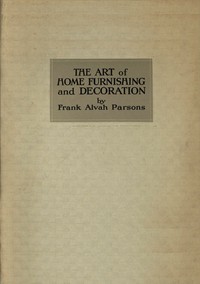
_THE ART OF HOME FURNISHING AND DECORATION_
_By_ FRANK ALVAH PARSONS
President, New York School of Fine and Applied Art Author of “Interior Decoration--Its Principles and Practice,” Etc.
PUBLISHED BY Armstrong Cork Company _Linoleum Department_ LANCASTER, PENNA., U. S. A.
Copyright 1921 by ARMSTRONG CORK COMPANY _Linoleum Department_ LANCASTER, PENNSYLVANIA
Frank Alvah Parsons, President of the New York School of Fine and Applied Art, is a leading American authority on interior decoration. He long since has amply demonstrated his wonderful faculty for turning his knowledge to the common good. We know of no man who, with voice and pen, has fought harder or more unceasingly for better taste, for richer, fuller home life.
Mr. Parsons hardly can seem a stranger to the average reader of this book. Indeed, through his writings and lectures, he has become guide and counsellor and the personal friend of thousands of refined men and women, who have accepted the idea so well developed by Mr. Parsons in the following pages, that “Man is what he lives in;” that, generally speaking, man can be no greater or no less than the daily environment in which he works, thinks, and lives.
We take great satisfaction and pleasure in announcing Mr. Parsons as the author of that section of this book which is entitled “The Art of Home Furnishing and Decoration.” It is written in Mr. Parson’s typically intimate and forceful style, and every paragraph is replete with information and suggestions of great value. We are sure that this book will hold your interest from the first to the last word, and that in the end you will look on the possibilities of your home and your life within it in a fresh and considerably enlarged perspective.
After you have spent an hour with Mr. Parsons on the general theme of home furnishing and decoration, we believe that it will profit you to read what is written by ourselves in the latter part of the book on the specific subject of linoleum and its relation to the principles that Mr. Parsons has laid down.
ARMSTRONG CORK COMPANY
_The Art of Home Furnishing and Decoration_
Man is exactly what he lives in, for environment is the strongest possible factor in man’s development. One may be so long among loud noises, bad odors, inharmonious colors and wrong arrangements of things that one doesn’t mind them, because one has let them become an integral part of one’s self. They are there, and they are as bad as they were at first, but one has become immune to them. This being admitted, it follows, of course, that concordant sounds, agreeable odors, harmonious colors and pleasing arrangements have their immediate effects, but their tendency is toward refinement, culture and artistic appreciation instead of toward brutality, ignorance and indifference. It is certainly not hard to see what effect is produced by living in any wrong environment. As a person accustoms himself to it, he becomes like it. When he is like it, he will admire only its kind, and whatever he does will be as nearly like his environment as he himself is.
The importance of thoroughly comprehending this truth cannot be overstated. The mental and artistic quality of the nation and even its physical comfort depend upon it. This viewpoint, being somewhat new to us, accounts for the upheaval in our ideas of what a home really is. Looking a little into this matter may perhaps stimulate us still further in our thinking, which will affect our way of doing whatever we attempt in the future.
[Sidenote: The Home Molds Our Tastes and Lives]
In the first place the home is the center of all life’s activities. We are born there, and long before we have seen the shop, the office, the church or even the school, our first impressions of the fundamentals of life have become fixed. These are exceedingly hard to efface.
Frank Alvah Parsons opens The Art of Home Furnishing and Decoration with a declarative claim: “Man is exactly what he lives in.” This sentence sets a philosophical tone that quickly gives way to a more instructional voice. The book, published by the Armstrong Cork Company’s Linoleum Department, is a hybrid: part interior-design treatise, part product catalog. Parsons, president of the New York School of Fine and Applied Art, writes with an authoritative yet intimate style, addressing the reader as a personal friend. The foreword by Armstrong Cork Company emphasizes his “wonderful faculty for turning his knowledge to the common good,” framing the book as a public service. Yet the text’s structure reveals a careful rhetorical arc, moving from general principles of harmony and color to specific room-by-room recommendations, culminating in a detailed defense of linoleum as a flooring material.
Philosophical Opening and Shifting Register
Parsons begins with a bold environmental determinism: “Man is exactly what he lives in.” This opening paragraph uses parallel structure and sensory language—loud noises, bad odors, inharmonious colors—to argue that environment shapes character. The tone is elevated, almost moralistic. But within a few pages, the register shifts. The author adopts a more conversational, persuasive style, using rhetorical questions and direct address: “Would you believe it?” he asks, describing a linoleum-paved courtyard. This shift from abstract principle to concrete example is a deliberate pacing technique. The philosophical framework lends authority to the commercial argument that follows. The reader is led from high-minded ideals to practical applications, with the linoleum pitch emerging as a natural solution to the problems of modern housekeeping.
Voice and the Use of Anecdotal Evidence
Parsons frequently employs anecdotal evidence to build credibility. He recounts visiting a home with a “very beautiful, little court” paved in linoleum that resembled marble tiles. The anecdote is told in first person, with an exclamation of surprise: “And, would you believe it?” This personal touch humanizes the author and makes the product endorsement feel like a discovery. The voice is that of a knowledgeable guide who has seen what works. He also cites “leading architects and interior decorators” who use linoleum, appealing to authority. The language is consistently positive and solution-oriented: linoleum is “so very much easier to take care of,” especially for the housewife doing her own work. The tone balances expertise with empathy, acknowledging the “almost universal household problem” of cleaning. This blend of personal testimony and professional endorsement creates a persuasive, trustworthy narrative voice.
Pacing and the Room-by-Room Structure
The book’s pacing accelerates as it moves from general principles to specific rooms. After the philosophical opening, Parsons devotes sections to the hall, living-room, dining-room, and other spaces. Each section follows a pattern: state the room’s function, describe the desired effect, then recommend linoleum as the ideal floor covering. For example, the hall “must be kept speckless and spotless,” and linoleum “proclaims the neatness of the housewife.” The living-room section emphasizes that linoleum serves as a “background” for rugs and furnishings, just as walls do for pictures. This repetitive structure reinforces the central message while varying the details. The prose becomes more list-like and instructional, with references to specific patterns (e.g., Pattern 350, a black-and-white block design). The final sections, written by Armstrong Cork Company, shift to a direct sales pitch, completing the arc from theory to product. The overall pacing moves from slow, reflective exposition to brisk, practical advice, ending with a clear call to action.
Readers should note that this book is a collaboration between an academic authority and a commercial manufacturer. The philosophical opening establishes Parsons’s credibility, but the later sections are unabashedly promotional. Pay attention to how the language shifts from abstract ideals to concrete product benefits. The book is best read as a period piece that reveals early 20th-century attitudes toward domesticity, design, and marketing. The excerpts suggest a work that is more about persuasion than pure instruction, and the pacing reflects that dual purpose.
Flipping through The Art of Home Furnishing and Decoration, I was struck by how its grand pronouncements soon give way to practical room-by-room advice, a shift from philosophy to the everyday. It reminded me of how the Memoirs of Madame la Marquise de Montespan — Volume 7 — Context and Discussion moves between courtly ideals and the most concrete, personal details of daily life. Both feel like voices negotiating two worlds at once.
There are no reviews for this eBook.
There are no comments for this eBook.
Reader reflection
Record your reading impressions
A brief reflection can help important ideas stay with you longer.
Your progress
0
/
10
2
How did the book work for you overall?
3
How likely are you to recommend this book?
4
How demanding did the text feel?
5
Did the book offer a fresh perspective?
6
How did the reading compare with what you expected?
7
How clearly were the main ideas presented?
8
How much did the book move you?
9
What did this book teach you most?
10