1

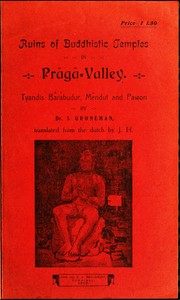
Ruins of Buddhistic Temples in Prågå Valley—Tyandis Båråbudur, Mendut and Pawon — A Closer Reading
(0 User reviews)
195
Project Gutenberg
2020
Not confirmed
Buddhist temples; Temples -- Indonesia -- Java
Readers of public-domain and historical texts
Project Gutenberg digital edition
en
Edition facts
Words
35,382
Reading time
154 min
Text sections
5
For Ruins of Buddhistic Temples in Prågå Valley—Tyandis Båråbudur, Mendut and Pawon — A Closer Reading, the stored edition analysis reports 35,382 words, 2 hr 34 min estimated reading time, and 5 detected text sections.
The text analysis averages about 25.6 words per sentence, while the detected sections provide another way to judge how the source is divided.
Project Gutenberg metadata also associates the work with “Buddhist temples,” connecting these edition facts with the source record’s subject description.
Source:
Project Gutenberg record #63057
Groneman's 1912 guide to three Javanese Buddhist temples—Båråbudur, Mendut, and Pawon—combines architectural description with detailed analysis of bas-reliefs, referencing jātaka stories and scholarly sources like Kern and Foucher.
Editorial Edition Score
4.7/5
★★★★★
★★★★★
Calculated from edition completeness, EPUB availability, text structure and catalogue metadata. Not a user rating.
How this score is calculated
- Description quality20 pts
- Title & short description10 pts
- Source metadata20 pts
- Text length15 pts
- Chapters / structure15 pts
- EPUB file integrity20 pts
Total of 100 points, scaled to a 2.5-5.0 range. Editions with an empty description or a missing EPUB file are not scored.
Edition quality
Read the Text
d of senses; the decline of a civilisation lost for ever, and of a highly developed art whose products, by time’s tooth changed into ruins, still testify to her lost greatness.
This Mahâyânism only acknowledged Buddha the redeemer of _this_ world, next to him were honoured the Buddhas of _three_ former worlds, and even a _fifth_ Buddha, the redeemer of a future world, which is to exist in the darkness of ages after the crack of this doom. These are the five _Dhyâni-Buddhas_: _Wairotyana_, _Akshobya_, _Ratnasambhava_, _Amitâbha_ and _Amoghasiddha_. And with the exception of these five Buddhas they also honoured the five _Dhyâni-Bodhisattvas_ or Buddha’s sons or Buddhas in a state of being, that is, in a state of self-exercise or self-denial which precedes the Buddhaship. They are in the same order of succession: _Samantabhadra_, _Wadyrapâni_, _Ratnapâni_, _Padmapâni_ and _Wishvapâni_. The southern church doesn’t know these Dhyâni-Buddhas and Bodhisattvas, so their images on the Båråbudur and on other tyanḍis in Java prove to us that the Buddhists of those temples belonged to the _northern_ church.
Proofs of the existence of Hînayânism in Java, there were none as yet. But the Chinese Buddhist _J Tsing_, who visited India and the Dutch Indonésian countries in the seventh century of our era, wrote us that at that period of time Hînayânism must have ruled here in Java[4].
It goes without saying that even the Mahâyânists honoured, among others, the Buddha of _this their_ world, _Amitâbha_, as their Lord and Redeemer, putting faith in his life on earth as man and prince’s son, as ascetic and preacher, just as the Israelites do believe in the personage of their _Jahvé_, their Lord God of Hosts, their god of battle and revenge, and just like our German ancestors trusted in _Odhin_, and _Thor_, and in the dying sun-god _Baldur_.
And when we wish to judge and understand the temples built by these Buddhists, we also ought to start from that point of view, and accept the hero of the legend as if he should have really lived, and suffered in order to redeem the world from the burden of the sin of life, and from the curse of death, and infinite regenerations.
The Buddhists assert the ashes of their Buddha to have been divided after his cremation into eight towns, and buried there. King _Ashoka_ is said to have seven of these graves re-opened again so as to distribute the holy ashes among some 84000 metal, crystal or stone vases or urns to cause them to be spread throughout his empire and without, and kept under barrows or _stûpas_.
We know the proper history of Buddhism to begin with this king in the _third_ century _before_ our era, and in several parts of Hindustan are found still undamaged inscriptions chiselled at his order upon rocks as so many unobjectionable evidences of this fact. I willingly allow this number of 84000 to be very exaggerated—yet, it is a fact proved by many an existing and opened grave, that the Buddhists of that or later date, and wherever they might have settled, always kept small quantities of ashes or bones they considered the remains of their Buddha’s corpse, in order to be buried under earthen or stone barrows to honour them as the relics of the great Master himself.[5]
There where the Buddhists founded a community, there, under such a hill or _stûpa_ they also buried an urn of ashes whereas the hill itself was honoured as the Master’s grave.[6]
Those hills however, were badly protected from the influences of temperature and time, and not proof against the profaning hand of man, and therefore built of stone, the _dâgaba_ or _dagob_, generally placed on a pedestal of composed leaves of the lotus, the _padmâsana_, hardly dispensible to Indian images.[7]
Many temples’ ornaments have been copied after these dagobs, among others, the shape of the small-sized prayer-bell which is still rung by the _visju_ in chinese temples even at this day. These are facts proving this tomb-stone’s having been highly honoured.
Not anything do we know about the Buddhists of eleven centuries ago who once populated these regions where afterwards arose the Mohammedan empire of _Mataram_. We only know that there formerly must have existed a _Hindu_ empire of this name because of a found copper engraving all covered with ancient-javanese writing which contained in a oath-formula the words: “_Sri mahârâja i Mataram_.”
We understand them to have come from India, probably from the North, but we don’t know when this happened, and when they first began to deposit their Buddha ashes worthily.
Groneman’s study of the Prågå Valley temples is neither a detached survey nor a travelogue. Written after his retirement to Jogyåkartå in 1896, the book emerges from a specific personal and scholarly context: the author’s desire to “devote myself to the antiquarian and ethnological studies dear to me” while residing near the ruins. The preface frames the work as a response to both his own intellectual needs and the wishes of other visitors, offering a “simple description” of Mendut and Pawon alongside a more extensive treatment of Båråbudur. The resulting text is a hybrid—part guidebook, part scholarly commentary—that reflects the author’s engagement with contemporary Orientalist debates.
A Guidebook with Scholarly Ambitions
The book’s structure follows the order of the temples: Mendut, Pawon, then Båråbudur. But Groneman does not merely describe what a visitor would see. He repeatedly interrupts the descriptive flow to cite European scholars—Kern, Speyer, Oldenburg, Foucher—and to weigh their interpretations of the reliefs. For instance, when discussing the fifth gallery of Båråbudur, he notes that Oldenburg identified a panel as “the Lord as the horse Balâha,” but Groneman presents this as one possibility among several. The text thus functions as a record of ongoing scholarly conversation, not a definitive guide.
Reading the Reliefs as Narrative Sequences
Groneman’s most distinctive contribution is his attempt to reconstruct the narrative logic of the Båråbudur reliefs. He traces the sequence of panels along the galleries, linking them to jātaka stories and avadānas. For example, he describes a series of reliefs showing a tortoise rescuing shipwrecked men, then sacrificing its body—a story he connects to the Lord’s former life. He also follows Foucher’s account of the Sudhana Kumārāvadāna, identifying panels that depict the nāga Jammatyitraka, the hunter Halaka, and the kinnarī Manoharā. These readings are tentative; Groneman often hedges with phrases like “probably” and “may have been hewn here.”
The Limits of the Evidence
Groneman is candid about what remains unexplained. He notes that “many a sculpture and symbolical ornament of building has not yet been explained or, so to say, insufficiently interpreted.” The excerpts show him grappling with incomplete series: he speculates that missing sculptures “have had some connection with other former lives” and that a gallery “may have been a continuous series.” This caution is a strength. The book does not pretend to have solved all puzzles; instead, it invites readers to see the ruins as a site of ongoing inquiry, where each relief raises questions about Buddhist narrative and iconography.
Groneman’s book is best approached as a period document—a snapshot of early twentieth-century Javanese archaeology. Readers interested in the temples themselves will find useful descriptions, but the real value lies in observing how a scholar of the time pieced together fragmentary evidence. The text rewards those who read it alongside the reliefs, checking Groneman’s identifications against the actual stones.
That grey afternoon, the rain blurred the window as I traced Groneman’s descriptions of Båråbudur’s stone narratives, each panel a frozen jātaka. The quiet patience of those carvings lingered oddly. Later, warm and dry, I picked up a different shelf’s remnant—Rossetti — Text and Context. Its careful attention to painted, tangled stories felt like the same slow looking, just another kind of ruin.
There are no reviews for this eBook.
There are no comments for this eBook.
Reader reflection
What was your reading experience?
Capture what you thought, learned, and would like to remember.
Your progress
0
/
10
2
Was reading this book enjoyable?
3
Would you encourage someone else to read it?
4
What was the reading difficulty like?
5
How understandable was the text?
6
How valuable was this book for your own interests?
7
How personally connected did you feel to the book?
8
Did the story or argument move comfortably?
9
What did this book teach you most?
10