1

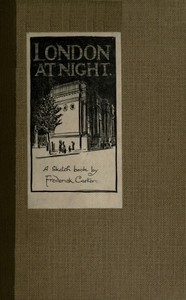
London at Night: A sketch-book — Text and Context
(0 User reviews)
970
Project Gutenberg
2017
Not confirmed
London (England) -- Pictorial works
Readers of public-domain and historical texts
Project Gutenberg digital edition
en
Edition facts
Words
3,572
Reading time
16 min
Text sections
1
The source record for London at Night: A sketch-book — Text and Context measures this digital text at 3,572 words, 16 min estimated reading time, and 1 detected text section.
The text analysis averages about 17.4 words per sentence, while the detected sections provide another way to judge how the source is divided.
Project Gutenberg metadata also associates the work with “London (England) -- Pictorial works,” connecting these edition facts with the source record’s subject description.
Source:
Project Gutenberg record #54166
Frederick Carter's 1914 sketchbook captures London after dark through 24 pencil drawings, from Piccadilly Circus to Hampstead Heath. This edition reproduces the original plates with titles and artist's signatures, offering a silent, atmospheric tour of Edwardian night scenes.
Editorial Edition Score
4.4/5
★★★★★
★★★★★
Calculated from edition completeness, EPUB availability, text structure and catalogue metadata. Not a user rating.
How this score is calculated
- Description quality20 pts
- Title & short description10 pts
- Source metadata20 pts
- Text length15 pts
- Chapters / structure15 pts
- EPUB file integrity20 pts
Total of 100 points, scaled to a 2.5-5.0 range. Editions with an empty description or a missing EPUB file are not scored.
Edition quality
Read the Text
A SKETCH-BOOK. by Frederick Carter.
ADAM & CHARLES BLACK, LONDON, W. 1914.
i PICCADILLY CIRCUS. (Title page)
ii THE CURVE OF THE QUADRANT, REGENT STREET
iii CLEOPATRA’S NEEDLE.
v THE SCAFFOLD: BUILDING AT NIGHT IN OXFORD STREET.
vi KENSINGTON PALACE GARDENS.
vii HANWAY STREET. TOTTENHAM COURT ROAD.
viii HAMPSTEAD HEATH ON BANK HOLIDAY.
ix AIR STREET. FROM REGENT STREET.
x ELECTRIC LIGHT IN THE TREES ON THE EMBANKMENT.
xi LIBERTY’S CORNER. REGENT STREET.
xii SAINT PAUL’S CATHEDRAL. SOUTH SIDE.
xiii THE ARCHES. UNDER CHARING CROSS.
xiv THE SPHINX ON THE EMBANKMENT.
xv A CHURCH IN REGENT SQUARE.
xvi SAINT MARTIN’S IN THE FIELDS.
xvii MARKET STREET, S^{T} JAMES’.
xviii HUNGERFORD BRIDGE.
xix AFTER THE THEATRE: S^{T.} MARTIN’S IN THE FIELDS.
xxi THE CABRANK ADELAIDE STREET.
xxiii THE NATIONAL GALLERY, FROM TRAFALGAR SQUARE.
xxiv A GARDEN IN THE MALL.
THE ARTIST’S SKETCH BOOK SERIES
_Each containing 24 page Reproductions in facsimile from pencil drawings._
_Large Square Demy 8vo with artistic cover._
CAMBRIDGE by Walter M. Keesey CANTERBURY . Walter M. Keesey EDINBURGH . Lester G. Hornby ETON . Fred Richards GLASGOW . John Nisbet HARROW . Walter M. Keesey LONDON . Lester G. Hornby LONDON AT NIGHT . Frederick Carter OXFORD . Fred Richards ROCHESTER . K. Kimball STRATFORD-ON-AVON . Gordon Home WINCHESTER . Gordon Home
FLORENCE . Fred Richards PARIS . Eugène Béjot ROME . Fred Richards VENICE . Fred Richards
A. & C. BLACK · Soho Square · LONDON W.
End of the Project Gutenberg EBook of London at Night, by Frederick Carter
Frederick Carter's London at Night: A sketch-book (1914) presents twenty-four pencil drawings of the city after dark, from the bustle of Piccadilly Circus to the quiet of a garden in the Mall. The book belongs to the Artist's Sketch Book Series, which also included volumes on Cambridge, Paris, and Venice. Carter's subjects range from famous landmarks—Saint Paul's Cathedral, the National Gallery—to more obscure corners like Hanway Street and the cab rank on Adelaide Street. The drawings are reproduced in facsimile, each with a title and often the artist's signature and year (1913 or 1914). This digital edition preserves the original sequence, allowing readers to follow Carter's nocturnal itinerary.
A Night-Time Geography of Edwardian London
The list of titles functions as a route map through London's nocturnal landscape. Carter begins at Piccadilly Circus, then moves along Regent Street's curved quadrant, past Cleopatra's Needle on the Embankment, and up to the Marble Arch. He includes both grand thoroughfares and intimate settings: Kensington Palace Gardens, a church in Regent Square, and the arches under Charing Cross. The selection balances iconic sites with everyday scenes—a scaffold on Oxford Street, market stalls in St James's, and the aftermath of theatre crowds at St Martin's in the Fields. This mix suggests Carter was interested not only in monumental architecture but also in the transient life of the streets after hours.
The Artist's Hand: Signatures and Dates
Several plates bear Carter's signature and the year, such as "Air Street from Regent Street. 1913" and "Electric Light in the Trees on the Embankment f carter. 1913." These details anchor the drawings to specific moments, hinting at the artist's working process. The signatures vary in placement and style—sometimes "F Carter" appears at the bottom of the plate, other times "f. carter 1914" is tucked into the image. This inconsistency suggests the drawings were produced over at least two years, perhaps compiled from sketches made on different nights. The facsimile reproduction preserves these handwritten elements, giving the reader a sense of the original sketchbook's materiality.
The Series Context: A Broader Sketchbook Tradition
London at Night was part of the Artist's Sketch Book Series published by Adam & Charles Black. The back matter lists other titles in the series, including volumes on Cambridge, Edinburgh, Oxford, Florence, Paris, and Venice, each by a different artist. The series format was consistent: each book contained twenty-four page reproductions in facsimile from pencil drawings, in large square demy octavo with an artistic cover. Carter's contribution stands out for its nocturnal focus, while other volumes like Lester G. Hornby's London presumably depicted the city by day. This series context underscores the book's purpose as a visual travelogue rather than a practical guide.
Reading the Plates: What the Titles Reveal
The titles are terse and descriptive: "Cleopatra's Needle," "The Marble Arch," "The Sphinx on the Embankment." Some include time or activity: "Clearing Away the Flower Baskets in Piccadilly Circus 11pm" appears on the title page, and "After the Theatre: St Martin's in the Fields" suggests a specific hour. Others name streets or districts—"Hanway Street, Tottenham Court Road," "Market Street, St James'"—indicating Carter's interest in less monumental locales. The repetition of Regent Street (the Quadrant, Liberty's Corner, Air Street) implies a particular fascination with that area. Together, the titles form a lexicon of Edwardian London's night-time geography, inviting the reader to compare Carter's vision with their own knowledge of the city.
Because the excerpts consist only of the title page, list of plates, and some repeated headers, the reader encounters the book primarily as a sequence of captioned images. The absence of descriptive text or commentary means the drawings themselves must carry the atmosphere. Pay attention to the order of plates: Carter's route moves from central landmarks to quieter streets, then to the Embankment and back to theatre districts. This progression may reflect a single night's walk or a curated selection of scenes. The sketchbook format rewards slow, sequential viewing.
I came back to Carter's drawings like you’d return to a familiar street at dusk—each pencil line holding its own quiet hush. It made me think of how illustrators across eras capture not just places, but the feeling of being alone inside them. That’s what Children's Books and Their Illustrators — Inside the Classic keeps whispering to me about, the gentleness behind those images we once trusted.
There are no reviews for this eBook.
There are no comments for this eBook.
Reader reflection
Before you leave, reflect on the book
Use these questions to collect your thoughts before moving on.
Your progress
0
/
10
2
How much did you enjoy the reading experience?
3
Would you recommend this book to another reader?
4
How demanding did the text feel?
5
How useful did the reading feel?
6
How strong was your personal connection to the text?
7
Did the book meet your expectations?
8
How distinctive were its ideas or approach?
9
What did this book teach you most?
10