1

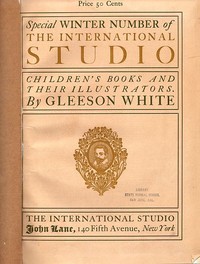
Children's Books and Their Illustrators — Inside the Classic
(0 User reviews)
179
Project Gutenberg
2008
Not confirmed
Children's literature; Illustration of books; Illustrators; Illustrated books
Readers of public-domain and historical texts
Project Gutenberg digital edition
en
Edition facts
Words
31,506
Reading time
137 min
Text sections
5
The catalog record for Children's Books and Their Illustrators — Inside the Classic provides practical reading context through 31,506 words, 2 hr 17 min estimated reading time, and 5 detected text sections.
The text analysis averages about 20.3 words per sentence, while the detected sections provide another way to judge how the source is divided.
Project Gutenberg metadata also associates the work with “Children's literature,” connecting these edition facts with the source record’s subject description.
Source:
Project Gutenberg record #27112
Gleeson White's 1898 study examines the craft of children's book illustration through detailed analysis of artists like Randolph Caldecott, Walter Crane, and Kate Greenaway, focusing on how illustrations interpret and expand text.
Editorial Edition Score
4.7/5
★★★★★
★★★★★
Calculated from edition completeness, EPUB availability, text structure and catalogue metadata. Not a user rating.
How this score is calculated
- Description quality20 pts
- Title & short description10 pts
- Source metadata20 pts
- Text length15 pts
- Chapters / structure15 pts
- EPUB file integrity20 pts
Total of 100 points, scaled to a 2.5-5.0 range. Editions with an empty description or a missing EPUB file are not scored.
Edition quality
Read the Text
Dobson was able to add graceful wreaths even to the fan of the Pompadour, and that another writer is able to impart to the misty twilight not only the eerie fantasies it shows the careless observer, but also a host of others that only a poet feels, and that only a poet knows how to prison within his cage of printed syllables. Indeed, of the theme of the present discourse has not the wonder-working Robert Louis Stevenson sung of "Picture Books in Winter" and "The Land of Story Books," so truly and clearly that it is dangerous for lesser folk to attempt essays in their praise? All that artists have done to amuse the august monarch "King Baby" (who, pictured by Mr. Robert Halls, is fitly enthroned here by way of frontispiece) during the playtime of his immaturity is too big a subject for our space, and can but be indicated in rough outline here.
Luckily, a serious study of the evolution of the child's book already exists. Since the bulk of this number was in type, I lighted by chance upon "The Child and his Book," by Mrs. E. M. Field, a most admirable volume which traces its subject from times before the Norman conquest to this century. Therein we find full accounts of MSS. designed for teaching purposes, of early printed manuals, and of the mass of literature intended to impress "the Fear of the Lord and of the Broomstick." Did space allow, the present chronicle might be enlivened with many an excerpt which she has culled from out-of-the-way sources. But the temptation to quote must be controlled. It is only fair to add that in that work there is a very excellent chapter to "Some Illustrators of Children's Books," although its main purpose is the text of the books. One branch has found its specialist and its exhaustive monograph, in Mr. Andrew Tuer's sumptuous volumes devoted to "The Horn Book."
Perhaps there is no pleasure the modern "grown-up" person envies the youngsters of the hour as he envies them the shoals of delightful books which publishers prepare for the Christmas tables of lucky children. If he be old enough to remember Mrs. Trimmer's "History of the Robins," "The Fairchild Family," or that Poly-technically inspired romance, the "Swiss Family Robinson," he feels that a certain half-hearted approval of more dreary volumes is possibly due to the glamour which middle age casts upon the past. It is said that even Barbauld's "Evenings at Home" and "Sandford and Merton" (the anecdotes only, I imagine) have been found toothsome dainties by unjaded youthful appetites; but when he compares these with the books of the last twenty years, he wishes he could become a child again to enjoy their sweets to the full.
Now nine-tenths of this improvement is due to artist and publisher; although it is obvious that illustrations imply something to illustrate, and, as a rule (not by any means without exception), the better the text the better the pictures. Years before good picture-books there were good stories, and these, whether they be the classics of the nursery, the laureates of its rhyme, the unknown author of its sagas, the born story-tellers--whether they date from prehistoric cave-dwellers, or are of our own age, like Charles Kingsley or Lewis Carroll--supply the text to spur on the artist to his best achievements.
Gleeson White's Children's Books and Their Illustrators opens not with a general history but with a close look at how illustrators translate words into images. White devotes particular attention to Randolph Caldecott's method, noting that in The House that Jack Built the artist expands a single line of text—'This is the Rat that Ate the Malt'—into five distinct pictures, each capturing a moment before, during, or after the reported incident. This 'literary expression,' White argues, is Caldecott's hallmark: he 'studied his subject as no one else ever studied it,' playing with the text until he knew it 'ten times better than its author.'
Caldecott's Narrative Expansion
White's analysis of Randolph Caldecott reveals a methodical approach to picture-making. In The House that Jack Built, the phrase 'This is the Rat that Ate the Malt' generates five images: the owner carrying malt, the rat driven away, the rat peeping into the room, the rat studying a placard upside down, and the gorged animal on an empty measure. Similarly, 'This is the Cat that Killed the Rat' yields five pictures; the dog receives four, the cat three. White emphasizes Caldecott's 'fine economy of line and colour' and his ability to depict not just the scene described but 'each successive step before and after the reported incident.' This technique, White suggests, makes Caldecott's illustrations a kind of commentary on the text, revealing a deeper engagement than mere decoration.
Walter Crane's Prolific Output
White catalogues Walter Crane's extensive contributions to children's literature, listing dozens of titles from the 1860s through the 1890s. Among them are the Routledge series 'The Baby's Opera,' 'The Baby's Bouquet,' and 'The Baby's Own Æsop,' all printed in colours by Edmund Evans. White also notes Crane's illustrations for Mrs. Molesworth's novels—sixteen titles including Carrots (1876), The Cuckoo Clock (1877), and The Tapestry Room (1879). Two works White singles out as 'perhaps two of the most important illustrated books noted in these pages' are the Macmillan editions of Grimm's Household Stories (1882) and The Necklace of Princess Fiorimonde (1880). The sheer volume of Crane's work, White implies, established a standard for illustrated children's books in the late Victorian period.
The Role of Publishers and Series
White's text frequently notes the publishers behind illustrated books, revealing a network of commercial and artistic collaboration. Routledge issued the small quarto series at five shillings; Cassells published Flora's Feast (1889) and Queen Summer (1891); Marcus Ward produced Slate and Pencilvania and Pothooks and Perseverance. White also mentions American editions, such as Hawthorne's A Wonder Book 'first published in America' as a quarto with elaborate colour designs. The listing of titles and prices—'Each 12mo $1.50'—suggests a market where illustration quality was tied to format and cost. White's attention to these details frames the illustrated book as both an artistic and commercial object, shaped by the demands of publishers and the tastes of the buying public.
White's Critical Voice and Method
White does not merely list illustrators; he evaluates them with a critic's eye. Of Caldecott, he writes that 'no successor has equalled the master in the peculiar subtlety of his pictured comment upon the bare text.' He praises the artist's ability to 'portray simply and with irresistible vigour' while maintaining 'a fine economy of line and colour.' White's own prose is precise and concrete, avoiding vague praise. He describes Caldecott's process as one of immersion: 'he must have played with it, dreamed of it, worried it night and day.' This language gives the reader a sense of the illustrator's craft as a form of intense study. White's method—combining close reading of images with biographical and publishing context—makes his work a model of early art criticism focused on children's books.
White's study is best read as a series of case studies rather than a comprehensive history. His focus on individual artists and their techniques—Caldecott's narrative expansion, Crane's prolific output, the commercial contexts of publishing—offers a grounded entry into late Victorian children's book illustration. Readers interested in the interplay between text and image will find White's observations on Caldecott especially valuable, as they demonstrate how a single line of verse can inspire a sequence of pictures that enrich the story.
Leafing through Gleeson White’s study, I kept pausing on the quiet way Kate Greenaway’s figures breathe on the page, their stillness more eloquent than any flourish. It brought back an afternoon spent with Choffard — Reading Notes, where ornament feels equally unhurried—not decoration, but a kind of patient attention. Two voices, different centuries, both whispering the same secret.
There are no reviews for this eBook.
There are no comments for this eBook.
Reader reflection
How will you remember this book?
Save your reaction, strongest insight, and memorable passage.
Your progress
0
/
10
2
Did this book hold your interest?
3
Would you pass this book on to a friend?
4
How demanding did the text feel?
5
Would a second reading be valuable?
6
How much did the book move you?
7
Did it raise ideas you would like to talk about?
8
Could you apply anything you learned?
9
Which lesson or insight stayed with you?
10