1

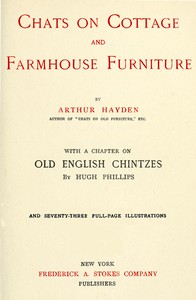
Chats on Cottage and Farmhouse Furniture — A Closer Reading
(0 User reviews)
2744
Project Gutenberg
2014
Not confirmed
Furniture -- England; Country furniture -- England; Textile fabrics -- England
Readers of public-domain and historical texts
Project Gutenberg digital edition
en
Edition facts
Words
46,716
Reading time
204 min
Text sections
9
The catalog record for Chats on Cottage and Farmhouse Furniture — A Closer Reading provides practical reading context through 46,716 words, 3 hr 24 min estimated reading time, and 9 detected text sections.
The text analysis averages about 18.9 words per sentence, while the detected sections provide another way to judge how the source is divided.
Project Gutenberg metadata also associates the work with “Furniture -- England,” connecting these edition facts with the source record’s subject description.
Source:
Project Gutenberg record #44603
An editorial note on Arthur Hayden's study of English cottage and farmhouse furniture, focusing on its structural organization, recurring motifs in oak carving, and the movement between historical periods and domestic settings.
Editorial Edition Score
4.7/5
★★★★★
★★★★★
Calculated from edition completeness, EPUB availability, text structure and catalogue metadata. Not a user rating.
How this score is calculated
- Description quality20 pts
- Title & short description10 pts
- Source metadata20 pts
- Text length15 pts
- Chapters / structure15 pts
- EPUB file integrity20 pts
Total of 100 points, scaled to a 2.5-5.0 range. Editions with an empty description or a missing EPUB file are not scored.
Edition quality
Read the Text
CHAPTER I. THE RENAISSANCE ON THE CONTINENT II. THE ENGLISH RENAISSANCE III. STUART OR JACOBEAN (Early Seventeenth Century) IV. STUART OR JACOBEAN (Late Seventeenth Century) V. QUEEN ANNE AND EARLY GEORGIAN STYLES VI. FRENCH FURNITURE: THE PERIOD OF LOUIS XIV. VII. FRENCH FURNITURE: THE PERIOD OF LOUIS XV. VIII. FRENCH FURNITURE: THE PERIOD OF LOUIS XVI. IX. FRENCH FURNITURE: THE FIRST EMPIRE STYLE X. CHIPPENDALE AND HIS STYLE XI. ADAM, HEPPLEWHITE, AND SHERATON STYLES XII. HINTS TO COLLECTORS
CHATS ON COTTAGE AND FARMHOUSE FURNITURE
_With Coloured Frontispieces and many Illustrations._
_Large Crown 8vo, cloth._
CHATS ON ENGLISH CHINA.
CHATS ON OLD FURNITURE.
By G. WOOLLISCROFT RHEAD.
CHATS ON OLD LACE AND NEEDLEWORK.
CHATS ON ORIENTAL CHINA.
CHATS ON ENGLISH EARTHENWARE.
(Companion Volume to "Chats on English China.")
By H. J. L. J. MASSÉ, M.A.
CHATS ON POSTAGE STAMPS.
CHATS ON OLD JEWELLERY AND TRINKETS.
CHATS ON COTTAGE AND FARMHOUSE FURNITURE.
(Companion Volume to "Chats on Old Furniture.")
LONDON: T. FISHER UNWIN. NEW YORK: F. A. STOKES COMPANY.
AUTHOR OF "CHATS ON OLD FURNITURE," ETC.
AND SEVENTY-THREE FULL-PAGE ILLUSTRATIONS
FREDERICK A. STOKES COMPANY
(_All rights reserved._)
TO MY OLD FRIEND FREDERIC ARUP I DEDICATE THIS VOLUME IN MEMORY OF A HAPPY LABOUR OF LOVE COMPLETED
The number of works dealing with old English furniture has grown rapidly during the last ten years. Not only has the subject been broadly treated from the historic or from the collector's point of view, but latterly everything has been scientifically reduced into departments of knowledge, and individual periods have received detailed treatment at the hands of specialists.
Museums and well-known collections, noblemen's seats and country houses have furnished photographs of the finest examples, and these, now well-known, pieces have appeared again and again as illustrations to volumes by various hands.
It is obviously essential in the study of the history and evolution of furniture-making in this country that superlative specimens be selected as ideal types for the student of design or for the collector, but such pieces must always be beyond the means of the average collector.
The present volume has been written for that large class of collectors, who, while appreciating the beauty and the subtlety of great masterpieces of English furniture, have not long enough purses to pay the prices such examples bring after fierce competition in the auction-room.
The field of minor work affords peculiar pleasure and demands especial study. The character of the cottage and farmhouse furniture is as sturdy and independent as that of the persons for whom it was made. For three centuries unknown cabinet-makers in towns and in villages produced work unaffected by any foreign influences. Linen-chests, bacon-cupboards, Bible-boxes, gate tables, and other tables, dressers, and chairs possess particular styles of treatment in different districts. The eighteenth-century cabinet-makers scattered up and down the three kingdoms and in America found in Chippendale's "Director" a design-book which stimulated them to produce furniture of compelling interest to the collector.
The examples of such work illustrated in this volume have been taken from a wide area and are such as may come under the hand of the diligent collector in various parts of the country.
In view of the increased love of collecting homely furniture suitable for modern use, it is my hope that this book may find a ready welcome, especially nowadays, when so many of the picturesque architectural details of old homesteads are being reproduced in the garden suburbs of great cities.
It is possible that the authorities of local museums may find in this class of furniture a field for special research, as undoubtedly specimens of local work should be secured for permanent exhibition before they are dispersed far and wide and their identity with particular districts lost for ever.
Arthur Hayden's Chats on Cottage and Farmhouse Furniture opens with a preface that situates the work within a decade of growing specialization in furniture history, yet the book itself resists narrow period boundaries. The table of contents reveals a structure that moves from continental Renaissance to English styles, then to French periods and named cabinetmakers, before a final chapter of collector's hints. This arrangement suggests a deliberate arc from broad historical context to practical connoisseurship, with the cottage and farmhouse pieces treated as a distinct category within that sweep.
Structure as a Dialogue Between Eras
The book's chapter sequence is not merely chronological. After covering the English Renaissance and Stuart periods, Hayden inserts three chapters on French furniture of Louis XV and XVI, then returns to English makers like Chippendale and Sheraton. This interleaving of national traditions creates a comparative framework: the reader moves from English oak to French courtly styles and back to English craftsmanship. The effect is to position cottage furniture not as isolated rustic work but as part of a wider European conversation about form and ornament. The final chapter, 'Hints to Collectors,' shifts tone abruptly, offering practical advice that grounds the historical survey in the act of acquisition.
Recurring Images of Carving and Restraint
Throughout the excerpts, a tension emerges between ornament and simplicity. Hayden notes that early farmhouse chairs show 'ornament is reduced to a minimum,' standing as 'rude monuments' to tradition. Yet he also describes a 'superior farmhouse chair' with a 'carved top with scroll cresting.' The carved motifs—'scrollwork or in conventional lozenge design'—recur across generations, creating a visual continuity that Hayden calls a 'strong family resemblance.' This repetition of patterns, even as styles evolve, becomes a leitmotif: the same traditional designs 'retained their hold for many generations,' making dating difficult without inscribed dates.
Movement Between Domestic Spaces and Historical Shifts
Hayden frequently moves from broad economic change to the intimate details of household objects. In one passage, he traces the shift from wooden trenchers to pewter, from rushes to carpets, and from straw pillows to feather ones, linking these material changes to the 'rise of the middle classes' and the 'advance of the yeomen.' The chimney-corner, he notes, came into use with Elizabethan chimneys. This movement between macro and micro scales—from the wool trade spreading across eastern counties to a farmer's wife spinning her own sheep's wool—gives the book a layered texture, where furniture becomes evidence of social transformation.
The Collector's Gaze and the Problem of Age
Hayden injects a note of skepticism about the attribution of age to furniture. He observes a 'marked leaning towards generosity in imparting age to old furniture,' noting that pieces 'grow in antiquity according to the fancy of the owner or the imagination of the collector.' This remark, placed within a discussion of seventeenth-century chairs, signals a critical awareness that the collector's desire can distort historical judgment. The book thus oscillates between descriptive cataloging and a more reflexive commentary on the practices of collecting itself, a tension that enriches its reading as both a guide and a cultural document.
Readers approaching this work will find it rewards attention to its structural choices—the juxtaposition of English and French chapters, the movement from historical narrative to collector's advice. The recurring images of carved oak and the repeated caution about dating pieces offer a thread that ties the book together. Hayden's voice, at once scholarly and conversational, invites the reader to see these objects not as static artifacts but as evidence of changing lives and enduring craft traditions.
I’ve often thought how the quiet patience of oak, carved and turned in Arthur Hayden’s pages, shares something with the slow gaze of a child tracing a picture. Both hold time still. That same found intimacy sits in Children's Books and Their Illustrators — Inside the Classic, where every line waits for a hand to turn the page. A gentle kinship, truly.
There are no reviews for this eBook.
There are no comments for this eBook.
Reader reflection
Before you leave, reflect on the book
Use these questions to collect your thoughts before moving on.
Your progress
0
/
10
2
How much did you enjoy the reading experience?
3
Would you encourage someone else to read it?
4
Did the language feel accessible?
5
Did the book give you something worth debating?
6
How original did the book feel?
7
Did the story or argument move comfortably?
8
Was the book what you thought it would be?
9
What changed or sharpened your thinking?
10