1

Horse Laughs — A Closer Reading
(0 User reviews)
1216
Project Gutenberg
2013
Not confirmed
English wit and humor, Pictorial; Horses; Horses -- Caricatures and cartoons; Horsemanship -- Caricatures and cartoons
Readers of public-domain and historical texts
Project Gutenberg digital edition
en
Edition facts
Words
4,278
Reading time
19 min
Text sections
1
For Horse Laughs — A Closer Reading, the stored edition analysis reports 4,278 words, 19 min estimated reading time, and 1 detected text section.
The text analysis averages about 18.7 words per sentence, while the detected sections provide another way to judge how the source is divided.
Project Gutenberg metadata also associates the work with “English wit and humor, Pictorial,” connecting these edition facts with the source record’s subject description.
Source:
Project Gutenberg record #42402
A collection of Victorian hunting and horse-riding cartoons by Charles Hunt Marshall, pairing satirical captions with illustrations. The humor relies on dialect, social class clashes, and equestrian mishaps, offering a glimpse into 19th-century British sporting culture.
Editorial Edition Score
4.4/5
★★★★★
★★★★★
Calculated from edition completeness, EPUB availability, text structure and catalogue metadata. Not a user rating.
How this score is calculated
- Description quality20 pts
- Title & short description10 pts
- Source metadata20 pts
- Text length15 pts
- Chapters / structure15 pts
- EPUB file integrity20 pts
Total of 100 points, scaled to a 2.5-5.0 range. Editions with an empty description or a missing EPUB file are not scored.
Edition quality
Read the Text
To Gilbert Dalziel, Esq.,
THE EDITOR OF “JUDY,”
THIS LITTLE BOOK OF SKETCHES IS GRATEFULLY DEDICATED,
ACKNOWLEDGMENT OF HIS KIND PERMISSION FOR ITS PUBLICATION,
RECOGNITION OF NUMEROUS FAVOURS RECEIVED FROM HIM ON VARIOUS OCCASIONS.
WITH THE MOST LIVELY SENTIMENTS OF RESPECT,
BY HIS MOST OBEDIENT SERVANT,
THE AUTHOR AND ARTIST.
End of the Project Gutenberg EBook of Horse Laughs, by Chas. H. Marshall
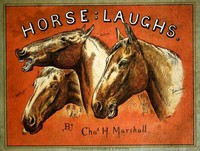
Charles Hunt Marshall's Horse Laughs opens with a dedication to Gilbert Dalziel, editor of the comic periodical Judy, signaling the book's origin in the world of Victorian illustrated humor. The first sketch, “Advice Gratis,” immediately establishes the collection's formula: a brief caption in dialect—here a boy tells a preacher to “lengthen yer stirrups an’ shorten yer face”—paired with a single illustration. The humor is situational, rooted in the incongruities of horse culture, and the language is deliberately rustic or pompous, depending on the speaker.
Dialect and Social Caricature
The excerpts are dense with phonetic spelling meant to convey regional or class speech. A “Jovial Huntsman” slurs his words after drinking: “Fine huntinsh mornin’, shurr. ’Oundish fine condishun—thirstin’ for bloodsh.” The effect is comic but also pointed—the huntsman's drunkenness undercuts his authority. Elsewhere, a “Small Boy” calls an “Awful County Magnate” an “old Chawbacon,” reversing the expected power dynamic. Marshall uses dialect not merely for color but to dramatize social friction: tenants, boys, and tradespeople talk back to their betters, and the jokes often land at the expense of the upper classes.
The Horse as Straight Man
Horses themselves rarely speak; they are the silent partners in these scenes, their behavior—or the rider's misreading of it—generating the punchline. In “A Musical Horse,” an officious bystander claims the horse “tootles a bit on the flute” and will soon play the trombone, a metaphor for flatulence that the oblivious “Swell” fails to grasp. The horse's body becomes a source of low comedy, but the joke is on the rider's pretension. Similarly, “A Choppy Sea” compares a rough ride to a seascape, with a “Seafaring Gent” slurring about an “awful shoppy shee.” The horse is a prop for human folly.
Structure and Pacing
Each sketch is self-contained, typically one or two sentences of dialogue beneath a title. The collection moves briskly from one scenario to the next: a curate tempted by hounds, a whip who falls and curses, a noble lord whose wife is compared to prize livestock. There is no narrative arc, but a cumulative effect emerges. The repetition of character types—the pompous swell, the cheeky boy, the drunken huntsman—creates a small world of equestrian absurdity. Readers can dip in anywhere, but the sequence from dedication to final sketch suggests a deliberate arrangement, perhaps alternating between rural and urban settings or between verbal and physical comedy.
Visual Humor Beyond the Text
Though the excerpts provide only captions and titles, the catalog metadata and the dedication confirm that Marshall was both author and artist. The phrase “this little book of sketches” indicates that the humor is incomplete without the illustrations. The captions often describe a visual situation—a rider falling, a horse misbehaving—that the drawing would make concrete. For instance, “Dignity and Impudence” pits a mounted magnate against a boy on foot; the caption alone conveys the impudence, but the drawing likely shows the spatial comedy of the boy refusing to move. Readers should imagine the pictures as essential to the punchlines.
Horse Laughs rewards a slow reading that savors the dialect and the implied illustrations. The brevity of each sketch makes it ideal for browsing, but the recurring social tensions—between classes, between pretension and reality—give the collection a coherent satirical edge. Approach it as a period artifact: the humor is specific to Victorian hunting culture, yet the deflation of authority remains recognizable.
The rain blurred the windows while I lingered over Marshall’s cartoons, their clipped Victorian voices almost audible between the thud of hooves and the creak of saddles. That same afternoon, idly drifting, I pulled down Furnishing the Home of Good Taste A Brief Sketch of the Period Styles in Interior Decoration with Suggestions as to Their Employment in the Homes of Today — Inside the Classic, curious how those same drawing-room walls framed so much unspoken laughter.
There are no reviews for this eBook.
There are no comments for this eBook.
Reader reflection
Record your reading impressions
A brief reflection can help important ideas stay with you longer.
Your progress
0
/
10
2
Was reading this book enjoyable?
3
Would you recommend this book to another reader?
4
Did the language feel accessible?
5
Did it raise ideas you would like to talk about?
6
Did the book deliver what you hoped for?
7
Would a second reading be valuable?
8
Did anything about the book feel genuinely new?
9
Which lesson or insight stayed with you?
10