1

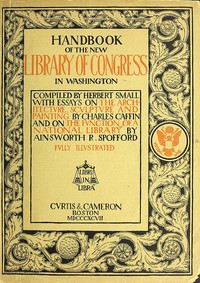
Handbook of the new Library of Congress — Inside the Classic
(0 User reviews)
330
Project Gutenberg
2019
Not confirmed
Library of Congress -- Handbooks, manuals, etc.
Readers of public-domain and historical texts
Project Gutenberg digital edition
en
Edition facts
Words
63,120
Reading time
275 min
Text sections
9
The catalog record for Handbook of the new Library of Congress — Inside the Classic provides practical reading context through 63,120 words, 4 hr 35 min estimated reading time, and 9 detected text sections.
The text analysis averages about 22.9 words per sentence, while the detected sections provide another way to judge how the source is divided.
Project Gutenberg metadata also associates the work with “Library of Congress -- Handbooks, manuals, etc.,” connecting these edition facts with the source record’s subject description.
Source:
Project Gutenberg record #59821
This 1897 handbook, compiled by Herbert Small, offers a detailed room-by-room tour of the new Library of Congress building, with supplementary essays on its architecture, sculpture, and painting by Charles Caffin and on the function of a national library by Ainsworth R. Spofford.
Editorial Edition Score
4.7/5
★★★★★
★★★★★
Calculated from edition completeness, EPUB availability, text structure and catalogue metadata. Not a user rating.
How this score is calculated
- Description quality20 pts
- Title & short description10 pts
- Source metadata20 pts
- Text length15 pts
- Chapters / structure15 pts
- EPUB file integrity20 pts
Total of 100 points, scaled to a 2.5-5.0 range. Editions with an empty description or a missing EPUB file are not scored.
Edition quality
Read the Text
s required of the fountain, the ethnological heads, the series of busts in the portico of the Entrance Pavilion, and the spandrel figures ornamenting the Entrance Porch.
=Mr. Hinton Perry’s Fountain.=--Of Mr. Perry’s fountain, it may be said at once that it is the most lavishly ornamental of any in the country. It occupies a semicircular basin fifty feet broad, containing a dozen bronze figures disposed to represent a scene--so one may take it--in the court of Neptune, the classic god of the sea. The granite wall of the terrace against which the fountain is placed contains three deep niches, in the spandrels of which are four dolphins sculptured in relief from models by Mr. Albert Weinert. The niches themselves are treated with an evident suggestion of a grotto worn by the sea, with a hint, also, at the formation of stalactites by the constant dripping of water. In front of the central niche Neptune is seated in a majestic attitude on a bank of rocks. He is represented as an old man with a long flowing beard, but the lines of his naked figure indicate the energy and great muscular strength befitting the Ruler of the Deep. The figure is of colossal size; it would be, that is, if standing, about twelve feet in height. On either side of the bank lolls a figure of Triton, one of the minor sea-gods, blowing a conch shell to summon the water-deities to the throne of their sovereign. In front of each of the niches at the side is a sea-nymph triumphantly bestriding an infuriated sea-horse, his ears laid back and his fish’s tail writhing with anger on account of a jet of water constantly thrown against his head. The basin is crossed and re-crossed by similar jets, which furnish the whole flow of water, and proceed from the mouths of sea-monsters in various places throughout the fountain. There are seven of them in all. The first is a serpent just showing itself above the water in front of the bank on which Neptune is seated. Higher up, to the right and left, two gigantic frogs lurk in crevices of the rocks; and floating along the outer edge of the basin are four huge Florida turtles, their heads raised a little above the water and their long fins making as if swimming.
=The Ethnological Heads.=--The ethnological heads ornamenting the keystones of the first-story pavilion windows offer as interesting material for study as any of the decorations of the Library. The series is unique in that it is the first instance of a comprehensive attempt to make ethnological science contribute to the architectural decoration of an important public building. It was at first proposed to employ a more conventional kind of ornament, such as the familiar Gorgons’ heads so often found in connection with Renaissance architecture. The present idea was carried out with the assistance of Professor Otis T. Mason, the Curator of the Department of Ethnology in the National Museum for the last twelve years. The heads, thirty-three in number, are about a foot and a half in height, and were modelled, some by Mr. Boyd and others by Mr. Henry J. Ellicott, after data accumulated by Professor Mason as the result of some six months’ special study of the ethnological collections in the possession of the National Museum--which contains, indeed, practically all the material (books, photographs, carefully verified measurements) necessary for such an undertaking. The large collection of authentic, life-size models, chiefly of savage and barbarous peoples, which the visitor may see in its exhibition halls, is the most extensive in the country, and many of the heads on the Library keystones are taken directly from these.
The handbook opens with a clear statement of its dual purpose: to interest the general reader and to serve as a guide for visitors. The compiler, Herbert Small, explains that the building is described in the order a visitor might naturally walk through it, and that criticism is reserved for a separate essay. This practical orientation shapes the entire work, making it both a descriptive catalog and a navigational aid.
Small notes that he originally intended to include fuller accounts of the library's collections, copyright operations, and administration, but decided to omit these because the new building would change them. This decision gives the handbook a deliberate, self-imposed limitation: it focuses on the physical structure and its decoration, not on the institution's daily workings.
A Tour Ordered by the Visitor's Path
The handbook's structure is explicitly tied to a walking route. Small writes that the building is described "in the order in which a visitor might naturally walk through it." This means the text follows a logical progression through spaces, from entrance to interior rooms, and likely includes directions for moving from one area to the next. The headings and subheadings are designed to help a reader on site locate themselves. This approach transforms the book into a practical tool rather than a purely descriptive account.
The excerpts show that the description of the dome's decoration, for instance, is part of a larger sequence that includes the collar, the twelve figures, and the axial points. The reader is guided to notice how the four cardinal directions govern the building's axial lines and how the decorative scheme responds to them. The handbook thus trains the eye to see the building as an integrated whole, with each part related to the visitor's position and movement.
The Decorative Program as a Narrative of Civilization
The excerpts reveal a detailed account of the dome's painted decoration, which represents twelve countries or epochs that contributed to American civilization. The figures are arranged chronologically, beginning with Egypt at the east, and each is associated with a specific contribution: Egypt with Written Records, Judea with Religion, Greece with Philosophy, and so on. The painter, Mr. Blashfield, is noted to have had limited control over the order, as it had to be chronological.
The description emphasizes that the figures are winged, representing ideals, and that the wings serve to unite the composition. Four figures—Egypt, Rome, Italy, and England—are painted with lighter drapery to mark the cardinal points, but the text explicitly states this is for decorative purposes only, not to magnify their importance. The handbook thus provides a careful reading of the artist's intentions and the constraints under which he worked.
The Handbook's Self-Acknowledged Gaps
Small openly acknowledges what the handbook does not cover. He had planned to describe the library's collections, the Smithsonian exchange system, copyright law, and general administration, but decided to pass over these topics because the new building would change them. He expresses hope that a future edition might supply this omission. This candor gives the work a provisional quality: it is a snapshot of the building at its opening, not a comprehensive guide to the institution.
The supplementary essay by Ainsworth R. Spofford on the function of a national library is intended to indicate the general scope of the institution, but the handbook itself remains focused on the physical plant. Readers interested in how the library actually operates will need to look elsewhere. This limitation is not a flaw but a deliberate choice that makes the handbook a precise document of the building's architecture and decoration in 1897.
This handbook is best used as a companion for a physical visit or as a detailed record of the building's original decorative scheme. Its value lies in its specificity: the descriptions of the dome's figures, the axial points, and the artist's intentions are grounded in the actual building. Readers should supplement it with later sources for information on the library's collections and administration, which the compiler deliberately omitted.
I keep thinking about the guided rooms in the 1897 Library handbook—how someone once mapped every mosaic and reading table for strangers. It’s the same quiet intimacy I felt with the court memoirs, that archive of whispers. Memoirs of Madame la Marquise de Montespan — Volume 5 — Context and Discussion holds its own corridors of grace and gossip, patinaed by time. Some buildings, some lives, just ask to be walked through slowly.
There are no reviews for this eBook.
There are no comments for this eBook.
Reader reflection
Record your reading impressions
A brief reflection can help important ideas stay with you longer.
Your progress
0
/
10
2
What was your overall reaction to the book?
3
How likely are you to recommend this book?
4
How demanding did the text feel?
5
How clear did the writing feel?
6
Is this a title worth rereading?
7
How would you rate its originality?
8
Did the book deliver what you hoped for?
9
What did this book teach you most?
10