1

Famous Houses and Literary Shrines of London — Reading Companion
(0 User reviews)
647
Project Gutenberg
2013
Not confirmed
Literary landmarks -- England -- London; London (England) -- Intellectual life; Authors, English -- Homes and haunts -- England -- London; Artists -- Homes and haunts -- England -- London
Readers of public-domain and historical texts
Project Gutenberg digital edition
en
Edition facts
Words
73,461
Reading time
320 min
Text sections
13
This digital edition of Famous Houses and Literary Shrines of London — Reading Companion is described by source-level measurements including 73,461 words, 5 hr 20 min estimated reading time, and 13 detected text sections.
The text analysis averages about 27.9 words per sentence, while the detected sections provide another way to judge how the source is divided.
Project Gutenberg metadata also associates the work with “Literary landmarks -- England -- London,” connecting these edition facts with the source record’s subject description.
Source:
Project Gutenberg record #44269
Adcock's 1912 literary pilgrimage uses contemporary diaries, letters, and memoirs to reconstruct the domestic lives of London's famous writers and artists, prioritizing their own words over modern commentary.
Editorial Edition Score
4.8/5
★★★★★
★★★★★
Calculated from edition completeness, EPUB availability, text structure and catalogue metadata. Not a user rating.
How this score is calculated
- Description quality20 pts
- Title & short description10 pts
- Source metadata20 pts
- Text length15 pts
- Chapters / structure15 pts
- EPUB file integrity20 pts
Total of 100 points, scaled to a 2.5-5.0 range. Editions with an empty description or a missing EPUB file are not scored.
Edition quality
Read the Text
Milton had his birth there.
Dr. Donne, the son of a London merchant, was also born within a stone's throw of Cheapside; and his disciple, Cowley, came into the world in Fleet Street, at the corner of Chancery Lane. But Cowley was a renegade; he acquired an unnatural preference for the country, and not only held that "God the first garden made, and the first city Cain," but ended a poem in praise of nature and a quiet life with--
"Methinks I see The monster London laugh at me; I should at thee too, foolish city, If it were fit to laugh at misery; But thy estate I pity. Let but thy wicked men from out thee go, And all the fools that crowd thee so, Even thou, who dost thy millions boast, A village less than Islington wilt grow, A solitude almost."
The daintiest of our lyrists, Herrick, was born over his father's shop in Cheapside, and you may take it he was only playing with poetical fancies when, in some lines to his friend Endymion Porter, he praised the country with its "nut-brown mirth and russet wit," and again when, in a set of verses on "The Country Life," he assured his brother he was "thrice and above blest," because he could--
"Leave the city, for exchange, to see The country's sweet simplicity."
If you want to find him in earnest, turn to that enraptured outburst of his on "His Return to London"--
"Ravished in spirit I come, nay more I fly To thee, blessed place of my nativity!... O place! O people! manners framed to please All nations, customs, kindreds, languages! I am a free-born Roman; suffer then That I amongst you live a citizen. London my home is, though by hard fate sent Into a long and irksome banishment; Yet since called back, henceforward let me be, O native country! repossessed by thee; For rather than I'll to the West return, I'll beg of thee first here to have mine urn."
There speaks the true Cockney; he would sooner be dead in London than alive in the West of England. Even Lamb's love of London was scarcely greater than that.
It was fitting that Pope, essentially a town poet, should be born in Lombard Street. In the next thoroughfare, Cornhill, Gray was born; and, son of a butcher, Defoe began life in the parish of St. Giles's, Cripplegate. Shakespeare was an alien, but Bacon was born at York House, in the Strand; which, to my thinking, is the strongest argument in favour of the theory that he wrote the plays. Churchill was born at Vine Street, Westminster; Keats in Moorfields; and, staunchest and one of the most incorrigible Londoners of them all, Charles Lamb in Crown Office Row, Temple. He refers, in one of his essays, to Hare Court, in the Temple, and says: "It was a gloomy, churchyard-like court, with three trees and a pump in it. I was born near it, and used to drink at that pump when I was a Rechabite of six years old." The pump is no longer there, only one half of Hare Court remains as it was in Lamb's day, and Crown Office Row has been rebuilt. His homes in Mitre Court Buildings and Inner Temple Lane have vanished also; but the Temple is still rich in reminiscences of him. Paper Buildings, King's Bench Walk, Harcourt Buildings, the fountain near Garden Court, the old Elizabethan Hall, in which tradition says Shakespeare read one of his plays to Queen Elizabeth--these and the church, the gardens, the winding lanes and quaint byways of the Temple, made up, as he said, his earliest recollections. "I repeat to this day," he writes, "no verses to myself more frequently, or with kindlier emotion, than those of Spenser, where he speaks of this spot--
'There when they came whereas those bricky towers The which on Themmes broad aged back doth ride, Where now the studious lawyers have their bowers, There whylome wont the Templar knights to bide, Till they decayed through pride.'"
And, "indeed," he adds, "it is the most elegant spot in the metropolis."
Adcock opens his prefatory note with a striking claim: an unoccupied house whose former inhabitants are unknown is 'deader or emptier' than a grave. This conviction drives the method of Famous Houses and Literary Shrines of London. Rather than offering his own descriptions, Adcock assembles a collage of contemporary voices—diaries, letters, and memoirs written in or about these houses—to 'recreate the life and recapture the atmosphere' of each address. The result is a work that functions as a curated anthology of domestic testimony, where the walls speak through the words of those who once lived within them.
A Method of Quotation and Collage
Adcock's prefatory note makes his editorial strategy explicit: he is 'less concerned to give my own descriptions and opinions than to bring together opinions and descriptions that were written by such famous residents themselves or by guests and visitors.' This is not a conventional guidebook but a mosaic of primary sources. He draws heavily on Boswell's Johnson, Forster's lives of Goldsmith and Dickens, Gilchrist's Life of Blake, and Leigh Hunt's Autobiography, among others. The effect is that the reader encounters the houses through the eyes of their inhabitants and contemporaries, not through a modern intermediary. Adcock's own voice recedes, surfacing only to stitch together these fragments with brief narrative context.
The Peculiar Case of Thomas Day
One of the most extended passages in the excerpts concerns the eccentric philosopher Thomas Day, author of Sandford and Merton. Adcock recounts Day's experiment in raising two orphan girls according to his principles: he isolated them in France, taught them himself, and attempted to instill 'a deep hatred for dress, for luxury, for fine people, for fashion and titles.' The narrative is built from Day's own letters and from contemporary accounts, including the detail that he 'dropped melting sealing-wax on her arms' and 'fired pistols at her petticoats' to test her fortitude. Adcock's tone is wry but not judgmental, concluding that Day 'must have been a man worth knowing' despite his 'peculiarities and his oppressive earnestness.' This blend of anecdote and measured assessment typifies the book's approach.
The Role of the Illustrator
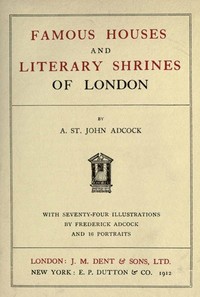
The book is a collaboration between Arthur St. John Adcock and his brother Frederick Adcock, who provided seventy-four illustrations and sixteen portraits. The prefatory note frames the text as 'the complement of my brother's drawings,' suggesting that the visual and verbal elements are intended to work in tandem. While the excerpts do not describe the illustrations in detail, the partnership implies a deliberate interplay between image and word: the drawings presumably depict the houses as they stood in 1912, while the text populates them with the voices of their former residents. This dual perspective—the physical building and the remembered life—is central to the book's design.
A Personal Plea for Preservation
Adcock's account of Thomas Day ends with a pointed remark: 'I think the County Council should put a tablet on the face of his birthplace at once, for the encouragement of all men who think for themselves and are not afraid to act upon their opinions.' This is one of the few moments where the author steps out from behind his sources to advocate directly. It reveals a subtext running through the book: the houses are not merely historical curiosities but living monuments whose preservation matters. The plea is specific—a tablet for Day's birthplace—and reflects a broader anxiety that London's literary heritage might be lost if not actively commemorated.
Adcock's method—letting the dead speak through their own letters, diaries, and the recollections of their friends—gives Famous Houses and Literary Shrines of London an intimacy that a conventional guidebook lacks. Readers should approach it not as a systematic history but as a series of domestic vignettes, each anchored to a specific address. The houses themselves are the stage; the words of their former occupants are the performance.
Reading Adcock’s careful stitching of old letters makes me miss my grandmother’s marginalia—she underlined the same Keats line for fifty years. That intimate layering of voices reminded me of Rossetti — Text and Context, where the poems feel like rooms you’re allowed to enter unseen. Both books whisper, not preach. They let the dead keep their quiet.
There are no reviews for this eBook.
There are no comments for this eBook.
Reader reflection
Take a moment to reflect on this book
Create a short personal record of your experience with this book.
Your progress
0
/
10
2
What was your overall reaction to the book?
3
Would you pass this book on to a friend?
4
How much effort did this book require?
5
How personally connected did you feel to the book?
6
How strongly did the book affect you emotionally?
7
Did the book offer a fresh perspective?
8
How valuable was this book for your own interests?
9
What did this book teach you most?
10