1

Armor and Arms An elementary handbook and guide to the collection in the City Art Museum of St. Louis, Missouri, U.S.A. — Themes and Context
(0 User reviews)
1334
Project Gutenberg
2020
Not confirmed
Weapons -- Catalogs; Armor -- Catalogs
Readers of public-domain and historical texts
Project Gutenberg digital edition
en
Edition facts
Words
16,650
Reading time
73 min
Text sections
3
The source record for Armor and Arms An elementary handbook and guide to the collection in the City Art Museum of St. Louis, Missouri, U.S.A. — Themes and Context measures this digital text at 16,650 words, 1 hr 13 min estimated reading time, and 3 detected text sections.
The text analysis averages about 20.2 words per sentence, while the detected sections provide another way to judge how the source is divided.
Project Gutenberg metadata also associates the work with “Weapons -- Catalogs,” connecting these edition facts with the source record’s subject description.
Source:
Project Gutenberg record #62818
Curator Thomas T. Hoopes guides readers through the City Art Museum of St. Louis's armor and arms collection, tracing technical evolution from Greek bronze helmets to Renaissance rapiers, with a focus on design, function, and the museum's curatorial choices.
Editorial Edition Score
4.5/5
★★★★★
★★★★★
Calculated from edition completeness, EPUB availability, text structure and catalogue metadata. Not a user rating.
How this score is calculated
- Description quality20 pts
- Title & short description10 pts
- Source metadata20 pts
- Text length15 pts
- Chapters / structure15 pts
- EPUB file integrity20 pts
Total of 100 points, scaled to a 2.5-5.0 range. Editions with an empty description or a missing EPUB file are not scored.
Edition quality
Read the Text
for wild animals or other men with stones or sticks in their hands killed them and ate them up. The first men about whom we know anything definite already had weapons of stone. Arms and, later, armor have accompanied man throughout his history.
The first obvious weapons were stones, roughly shaped to make them more effective. Such are not to be found in the City Art Museum, but we do have examples of the next type to develop, the weapons of the bronze age.
Bronze is a mixture of copper and tin, and it was invented a very long time ago, and in many different places. It was known in ancient Egypt, in the Far East and in Europe. Two thousand years before Christ the Chinese were making bronze arms and domestic and ceremonial objects of all sorts, and were making them so beautiful that such objects are considered proper exhibits for an art museum. We have a very fine collection of ancient Chinese bronzes, exhibited in the Museum’s Chinese galleries, and among them are numerous weapons. The earliest include axes and dagger-axes (Fig. 1). These date from the Shang Dynasty, (ca. 1523-ca. 1028 B.C.) This too is the period of a bronze helmet (Fig. 2) in the form of a hood with smooth sides which come down well over the cheeks, while leaving the front of the face exposed. Helmets of almost precisely this form, but made of steel, were worn in Italy in the fifteenth century, more than two thousand years later! This helmet has a small plume-holder at its very top, and is peculiar in having, as its only decoration, a pair of eyes embossed in relief on the forehead.
From the Ordos region of Siberia, where a primitive culture lasted for a very long time, comes a particularly fine ceremonial dagger (Fig. 3) of bronze with inlays of turquoise. From China again, dating throughout the thousand years before Christ, come numerous bronze weapons now in the Museum’s Study Collection, including swords, daggers, and, from about the beginning of the Christian Era, most ingenious mechanisms for the crossbow (Fig. 4) a weapon which was not known in Europe until many centuries later.
An Etruscan grave has yielded the large bronze disk of Fig. 5. On stylistic grounds it is believed that this originated not in Etruria, but on the other, Eastern, shore of Italy in Picenum, in the second half of the seventh century before Christ. It was probably the central reinforcement of a large leather shield.
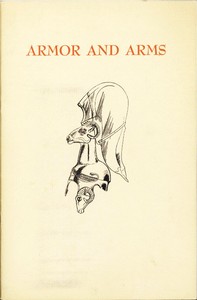
But of all the specimens of antique armor and arms in this (and possibly in any other) museum, none surpasses the helmet shown in our frontispiece. This helmet, together with fragments of armor, a shield rim and a spear point, all now in the Museum, was found in a tomb near Metaponto, in Southern Italy, where once there was a Greek colony. It is believed to date from about the middle of the sixth century B.C. The helmet is of bronze, the upper part of the bowl formed as the neck and head of a ram. This is surmounted by a great crest of silver, resting on a support of ivory. The cheek pieces of the helmet have rams’ heads in profile embossed in relief. The eyes, the horns of the main ram’s head, the ivory crest holder and part of the silver crest are restorations, but enough original fragments of the crest were found with the helmet to indicate exactly how the crest was shaped. Moreover the existence of such metallic crests is verified by a bronze statuette of similar origin (Fig. 6).
At first glance, the helmet proclaims itself a great work of sculpture, and proves that arms and armor can properly belong in a museum of art. How very well this piece deserves its place here is still more apparent on close examination. It seems incredible that so long ago a craftsman could, without any of our modern tools, have formed from a single plate of bronze such a deep and difficult forging as this helmet bowl. It is equally amazing that, in a period still considered as archaic, his artistic imagination could have produced so naturalistic yet so noble a rendition of an animal form. The technical skill and taste of the engraving and embossing are also noteworthy: the suggestion of locks of hair around the forehead, the eyebrows which terminate as snakes’ heads, the suggestions of skin texture on the rams’ heads. It is indeed one of the world’s masterpieces of armor.
Thomas T. Hoopes, curator of the City Art Museum of St. Louis, opens this handbook with a clear distinction: the museum collects armor and arms as objects of art, not mere tools. The preface notes that purely utilitarian pieces are relegated to a study collection, accessible by request, while the gallery displays items judged beautiful by their makers. This curatorial lens shapes the entire guide, which traces the interplay of form and function across centuries and cultures.
From Bronze to Steel: Material Constraints and Design
Hoopes grounds his discussion in the physical properties of materials. Stone Age man, he explains, could not make true swords because flint and obsidian were too brittle for large blades. Bronze, by contrast, could be cast into effective and beautiful forms, as seen in Chinese Han Dynasty swords (206 B.C.–220 A.D.) in the study collection. These short, double-edged blades were adapted primarily for thrusting, though they retained cutting ability.
The author traces a clear technical lineage: Viking swords of laminated metal, reminiscent of Damascus steel, were powerful in a downward slash but too heavy for quick thrusts. By the fifteenth century, longer hilts allowed two-handed use, increasing power. This culminated in the enormous two-handed swords of the landesknechts, over five feet long with immense drooping guards. Hoopes emphasizes how material innovation—from bronze to laminated steel—directly influenced weapon design and combat technique.
The Rapier Revolution: Thrust Over Slash
As the sixteenth century advanced, Hoopes notes a decisive shift: sword blades became narrower, lighter, and more adapted for thrusting. Guards developed rings and curved knuckle-guards to protect the out-thrust hand. The new method of fighting, he argues, had advantages over the old slashing system, which required raising the sword high and exposing the body before a blow could be struck.
The rapier emerged as the dominant weapon, its guard growing more complicated until it coalesced into a solid metal cup completely shielding the hand. Some fencers carried a dagger in the left hand to parry, but eventually this was abandoned as fighters learned to parry with the rear portion of their own blades before making a second thrust, or riposte. Action grew faster, and swords lighter, until the seventeenth-century court sword—with a short hilt, small flat guard often magnificently decorated in chiselled steel, and a needle-like point—often had no sharp cutting edge at all.
Museum as Arbiter: Art Versus Utility
Hoopes repeatedly returns to the museum's defining criterion: objects must be beautiful by the intention of their makers. This principle governs what is exhibited and what is stored. The preface explicitly states that numerous items in the vast range of armor and arms are purely utilitarian and therefore not on display, but assembled in a study collection available on application.
This curatorial stance shapes the guide's selections. A steel club is described as a "beautiful implement for smashing heads," while a Chinese bronze sword from about the time of Christ is noted as "not very sharp, but it could still do quite a lot of damage." The author's dry humor underscores the tension between aesthetic appreciation and lethal function. Readers are invited to see these objects as the museum does: as art first, weapons second.
Hoopes offers a practical orientation for visitors: each illustrated specimen carries a museum serial number, and readers can request to see any item not on display by citing that number at the information desk. The guide is explicitly an outline, not a comprehensive study, and directs curious readers to a short bibliography and to correspondence with the curator. It is a handbook for looking, not a substitute for the gallery itself.
Flipping through Hoopes’s quiet guide to the St. Louis armor, I paused at a gauntlet’s delicate articulation, and somehow remembered the way porcelain handles were discussed in Chats on English China — Context and Discussion. Both books treat everyday objects as hushed witnesses—each curve and glaze a small conversation with hands long gone. The warmth of that thought lingered over tea.
There are no reviews for this eBook.
There are no comments for this eBook.
Reader reflection
Before you leave, reflect on the book
Use these questions to collect your thoughts before moving on.
Your progress
0
/
10
2
How did the book work for you overall?
3
Would you pass this book on to a friend?
4
Did the language feel accessible?
5
Which part made the strongest impression?
6
Did anything about the book feel genuinely new?
7
Would you read this book again?
8
Would this book work well in a reading group?
9
What is the main idea you are taking away?
10