1

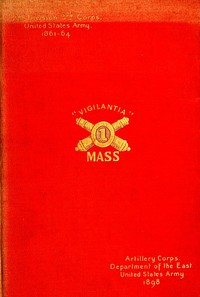
The First regiment Massachusetts heavy artillery, United States volunteers, in the Spanish-American war of 1898 — A Reader’s Guide
(0 User reviews)
2652
Project Gutenberg
2016
Not confirmed
Spanish-American War, 1898 -- Regimental histories; Massachusetts Artillery. 1st Regiment, 1861-1905
Readers of public-domain and historical texts
Project Gutenberg digital edition
en
Edition facts
Words
31,580
Reading time
138 min
Text sections
23
The source record for The First regiment Massachusetts heavy artillery, United States volunteers, in the Spanish-American war of 1898 — A Reader’s Guide measures this digital text at 31,580 words, 2 hr 18 min estimated reading time, and 23 detected text sections.
The text analysis averages about 16.1 words per sentence, while the detected sections provide another way to judge how the source is divided.
Project Gutenberg metadata also associates the work with “Spanish-American War, 1898 -- Regimental histories,” connecting these edition facts with the source record’s subject description.
Source:
Project Gutenberg record #51510
Colonel James A. Frye's regimental history of the First Massachusetts Heavy Artillery in the Spanish-American War, structured around the coast-defense problem, the regiment's dispersal to multiple forts, and the mundane reality of garrison duty, with recurring emphasis on inadequate armament and decaying fortifications.
Editorial Edition Score
4.8/5
★★★★★
★★★★★
Calculated from edition completeness, EPUB availability, text structure and catalogue metadata. Not a user rating.
How this score is calculated
- Description quality20 pts
- Title & short description10 pts
- Source metadata20 pts
- Text length15 pts
- Chapters / structure15 pts
- EPUB file integrity20 pts
Total of 100 points, scaled to a 2.5-5.0 range. Editions with an empty description or a missing EPUB file are not scored.
Edition quality
Read the Text
eeling of alarm entirely without foundation, or due to unreasoning fear. More than one foreign service journal had reckoned the opposing fleets as nearly of equal strength, and even our own Captain Mahan now writes: "The force of the Spanish navy on paper, as the expression goes, was so nearly equal to our own, that it was well within the limits of possibility that an unlucky incident, the loss, for example, of a battleship, might make the Spaniard superior in nominal, or even in actual, available force. Where so much is at stake as the result of a war, or even the unnecessary prolongation of war, with its sufferings and anxieties, the only safe rule is to regard the apparent as the actual, until its reality has been tested." We are looking backward now; then we were looking forward. We now know, through the supreme tests of May 1st and July 3d, that the paper strength and the fighting strength of the Spanish navy were two widely differing qualities; but late in April, 1898, all this yet remained to be determined, and the memorable rush of the _Oregon_ from the far Pacific bears witness that the Navy Department recognized the preponderance that might be given by the addition of even a single fighting-ship to our force on the threatened Atlantic sea-board.
Of the result of a general fleet action the country had small doubt; it was the possibility of sudden and unexpected naval raids that caused concern. The words of the English naval critic, Steevens, applied with tenfold force to our own case: "It is tolerably obvious that no superiority in the world could guarantee our whole empire against raids by hostile cruisers. A fast cruiser could break the closest blockade possible in the days of torpedo boats, and though she would stand to meet and be engaged by a cruiser or cruisers of our own, yet she would also stand to elude them. She might then shell or lay under contribution unprotected coast towns, destroy shipping lying in their harbors, or making for or from them, besides landing small forces to do serious, if not vital damage." And this fact was recognized no better by any one than by Admiral Cervera himself, who, in a letter written in February, 1898, after deploring the lack of Spanish naval preparation, said: "Under such conditions, a campaign would be disastrous, if not an offensive one, and all that could be done in an offensive war would be to make some raids with a few fast vessels."
Reduced to its lowest terms, the situation confronting the authorities was this: the Spanish naval list showed—either in commission or building—nine 20-knot cruisers,[1] heavily armed and armored, and theoretically able to run away easily from any armored ships in our establishment save the _Brooklyn_ and _New York_, while (still theoretically) capable of whipping without effort these two latter cruisers, if brought to bay. Furthermore, the operations of the army and navy, in the West Indies and the Philippines, imperatively required the services of every modern fighting-ship at our disposal, and thus the long stretch of Atlantic coast, with its teeming harbors and populous cities, practically was left at the mercy of any chance squadron of swift cruisers, or even—at least in the earlier days of the war—of possible raids by privateers or wandering torpedo-gunboats. There was, it is true, the hastily improvised and costly coast-patrol fleet, of something over forty vessels—monitor relics of the '60's, armed yachts, ferry-boats, and tugs—distributed along the coast at stations from Eastport to New Orleans, but this heterogeneous outfit was brought into existence rather for scouting than for fighting. As a factor in actual resistance to determined naval attack it called for no serious consideration, and as a matter of record its organization was not complete until the 16th of June, when the dreaded _Vizcaya_, with her sister ships, finally had been marked down and safely penned in the harbor of Santiago.
_Almirante Oquendo_, _Cardenal Cisneros_, _Cataluna_, _Cristobal Colon_, _Emperador Carlos V._, _Infanta Maria Teresa_, _Pedro d'Aragon_, _Princesa de Asturias_, _Vizcaya_.—"Brassey's Naval Annual," 1897.
Colonel James A. Frye's history of the First Massachusetts Heavy Artillery is organized not as a continuous narrative but as a series of discrete chapters that shift between administrative overviews and localized garrison accounts. The table of contents reveals a deliberate structure: after an introductory chapter and a discussion of the coast-defense problem, the book moves through mobilization, station assignments, and finally a regimental record. This compartmentalized approach mirrors the regiment's own fragmentation, as companies were scattered among Fort Warren, Fort Pickering, Fort Rodman, and other posts.
Frye repeatedly emphasizes the physical decay of the forts. Fort Pickering, for instance, is described as "but a ruin," having "crumble into decay" since the Civil War. The text dwells on the lack of heavy guns, the need for improvised earthworks, and the reliance on local civilian assistance for tools and derricks. These recurring details ground the work in material conditions rather than battle action.
From Mobilization to Dispersal
The book's early chapters trace the regiment's journey from peacetime militia to federal service. Chapter III, "Marching-Orders," and Chapter IV, "Off for Active Service," cover the initial call and assembly at Framingham. But the narrative quickly fragments. By Chapter X, "Assignment to Stations," the regiment splits into three divisions: Colonel Pfaff's headquarters at Salem, Lieutenant-Colonel Woodman's garrison at New Bedford, and Major Frye's battalion at Fort Warren. This tripartite structure forces Frye to adopt a parallel reporting style, treating each division's record in turn.
The movement between scenes is abrupt. One chapter focuses on the bureaucratic shift from "M.V.M." to "U.S.V." (Chapter VII), while the next discusses the personnel of the regiment (Chapter VIII). The reader is shuttled between administrative details and localized descriptions of fort life, with little connective tissue. This structural choice reflects the reality of a regiment that never fought as a unified body but instead manned scattered coastal defenses.
Fort Pickering: A Study in Decay and Improvisation
Chapter XI, "Fort Pickering and the 'North-Shore' Defenses," offers the most detailed portrait of a single post. Frye describes the fort as occupying a site "since the earliest colonial days" but now reduced to a ruin. The garrison pitched tents on the glacis outside the wet ditch, while headquarters were located inside the parapet of an outwork. The armament was nonexistent: "there was no armament of heavy guns."
Frye records the specific defensive measures taken. Under Major Dyar, Captains Frothingham and Nutter set men to work "with shovel, pick, and barrow" constructing an earthen parapet with stone revetment, designed by Lieutenant Francis, a civil engineer. The city of Salem supplied working tools and derricks. Colonel Pfaff's request for six 8-inch converted rifles was denied, even though such guns lay idle at Fort Warren. This episode recurs as a motif: the gap between available resources and actual needs.
Recurring Images: Idle Guns and Feeble Defenses
Throughout the excerpts, certain images recur. The phrase "feeble defenses" appears in the Fort Pickering chapter, and the text repeatedly notes that serious resistance to a resolute fleet attack could not be made. The author concedes that the fort's location made bombardment under modern long-range conditions unavoidable. Yet the narrative does not dwell on defeatism; instead, it catalogs the specific threats the garrison prepared for: sudden descents by Spanish auxiliary cruisers, dashes by torpedo-boats, and landing parties.
Another recurring image is that of idle or inadequate artillery. At Fort Warren, 8-inch rifles lay "dismounted and removed from the casemates" while Fort Pickering lacked any heavy guns. The contrast between the theoretical firepower of the coast-defense system and the actual state of the forts is a quiet but persistent theme. Frye's language is precise: he writes of "the material available" and "all possible protection" within those limits.
The Rhythm of Garrison Duty
Frye explicitly characterizes the regimental history after dispersal as "a dull story of garrison duty, faithfully performed in the face of every discouragement." This acknowledgment shapes the book's tone. The chapters on Fort Rodman and the Third Battalion at Fort Warren likely continue this pattern, though the excerpts do not include them. The final chapters, "Final Days in the Service" and "An Honorable Regimental Record," suggest a return to administrative closure.
The movement between scenes is not dramatic but logistical: from Salem to New Bedford to Boston Harbor. Frye's prose mirrors this rhythm, shifting between third-person regimental perspective and localized detail. The book includes a chronology of the war and muster rolls, reinforcing its documentary purpose. The reader is left with the impression of a unit that served not through combat but through presence and preparation, in forts that were already obsolete.
Frye's history is best approached as a documentary record rather than a narrative. Readers interested in the material conditions of coastal defense, the administrative challenges of a dispersed regiment, or the specific geography of Massachusetts forts will find precise detail. The book's structure—moving from problem to mobilization to station reports—rewards those who read with attention to the recurring motifs of decay, improvisation, and the gap between strategic need and available means. The muster rolls and chronology provide useful reference points.
The rain blurred the window while I traced the First Massachusetts’ frustrating patrols—young men waiting out a war in fortifications that were already relics. That patient, hollow vigilance stayed with me. Later, I opened Harriet Martineau — A Reader’s Guide for no clear reason, finding the same quiet attention turned inward, to a mind studying its own confines. Two centuries, one stillness.
There are no reviews for this eBook.
There are no comments for this eBook.
Reader reflection
Record your reading impressions
A brief reflection can help important ideas stay with you longer.
Your progress
0
/
10
2
Did this book hold your interest?
3
Is this a title you would suggest to others?
4
How easy was the book to follow?
5
What was the strongest part of the book?
6
How strongly did the book affect you emotionally?
7
How clearly were the main ideas presented?
8
Did the book give you something worth debating?
9
Which lesson or insight stayed with you?
10