
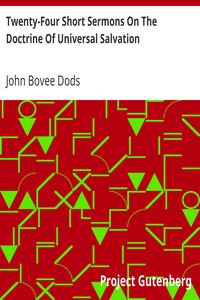
Twenty-Four Short Sermons On The Doctrine Of Universal Salvation by John Bovee Dods
This isn't a novel with a plot, but the journey of an idea. In Twenty-Four Short Sermons, John Bovee Dods, a preacher from the 1800s, lays out a radical argument piece by piece. He claims the ultimate destination for every human soul isn't heaven for some and hell for others, but universal reconciliation with God.
The Story
Think of it as a 24-chapter manifesto. Dods starts by tackling the big objections head-on. What about all those Bible verses about punishment? He goes through them, one by one, arguing they describe corrective, not endless, suffering. He asks questions like: How can finite sins deserve infinite punishment? How does eternal torment fit with a God whose defining characteristic is love? Each sermon builds on the last, using scripture, reason, and appeals to God's character to dismantle the traditional view of hell. The 'story' is the logical construction of a hopeful alternative, where divine justice is about restoration, not retribution.
Why You Should Read It
I was fascinated by the sheer nerve of it. This was written in an era known for its stern religiosity, yet here's Dods preaching a message of ultimate hope. It's not fluffy or vague; it's a rigorous, scriptural argument. Reading it, you feel the weight of his conviction. You also get a raw look at a theological debate that's still alive today. It challenged my own preconceptions about what people 'back then' believed. More than a historical artifact, it's a passionate plea for a kinder theology. The writing is direct and clear, meant for everyday people in his congregation, which makes its revolutionary core even more powerful.
Final Verdict
Perfect for the spiritually curious, the history nerd, or anyone who's ever questioned the concept of eternal damnation. If you enjoy exploring different religious ideas, even if you don't agree with them, this is a compelling snapshot of a minority voice in American religious history. It's also surprisingly quick and accessible for a 19th-century theological work. Don't read it for narrative thrills; read it to engage with a bold, hopeful, and logically argued vision of faith that dares to imagine a truly happy ending for all.
Legal analysis indicates this work is in the public domain. Feel free to use it for personal or commercial purposes.




Nancy Rodriguez
2 years agoClear, concise, and incredibly informative.