
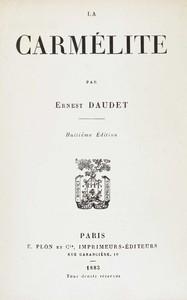
La Carmélite by Ernest Daudet
Ernest Daudet's La Carmélite takes us behind the high walls of a Carmelite convent in 19th-century France. We meet Sister Thérèse, a young woman who has chosen a life of silence, prayer, and strict seclusion from the world. Her days follow a sacred rhythm, marked by bells and ritual. This quiet existence is upended when a visitor arrives—a man named Henri, who knew her before she took her vows. Old feelings, long buried under layers of devotion, begin to surface.
The Story
The plot unfolds like a quiet storm. Henri's presence is a pebble dropped into the still pond of convent life. Through secret letters and brief, charged encounters during visiting hours, a connection is rekindled. Thérèse is thrown into a crisis of conscience. Every stolen glance is a betrayal of her promise to God, yet the pull of a human love she thought she'd sacrificed feels overwhelming. Daudet masterfully shows the external rules of the convent—the locked gates, the Mother Superior's watchful eye—clashing with the internal chaos in Thérèse's heart. The story builds to a point where she must make an impossible choice: the divine love she pledged her life to, or the earthly love that has reignited her soul.
Why You Should Read It
This book got under my skin because it treats its characters with such honesty. Thérèse isn't a saintly ideal; she's a real, conflicted woman. Her struggle isn't painted as simple rebellion, but as a genuine, painful tearing of the self. Daudet doesn't judge her. Instead, he asks us to sit with her in that difficult space. The atmosphere is incredible—you can feel the chill of the stone floors and the heavy weight of silence. It's a fascinating look at a world most of us will never see, but the central conflict is universal. Who hasn't felt torn between what they should do and what they want to do? It’s a deep, quiet character study that asks big questions about faith, freedom, and where true fulfillment lies.
Final Verdict
La Carmélite is perfect for readers who love immersive historical settings and intense psychological drama. If you enjoyed the internal conflicts in novels like Jane Eyre or the cloistered tension of movies like Doubt, you'll find a lot to love here. It's not a fast-paced adventure; it's a slow, thoughtful burn. You read it for the exquisite tension, the moral complexity, and the chance to live inside a character's most private dilemma for a few hundred pages. A hidden gem for anyone who believes the most epic battles are often fought in silence.
Legal analysis indicates this work is in the public domain. Access is open to everyone around the world.
Thomas Wilson
3 months agoI found the data interpretation to be highly professional and unbiased.
Kevin Clark
1 year agoThe layout is very easy on the eyes.
Joseph Lewis
1 year agoA must-have for anyone studying this subject.
Deborah Scott
1 year agoGood quality content.






Paul Harris
1 year agoExceptional clarity on a very complex subject.