
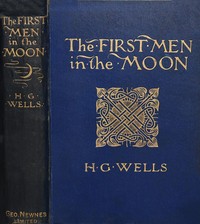
The First Men in the Moon by H. G. Wells
Let's set the scene: Bedford, a man down on his luck, rents a cottage in the English countryside to write a play. His peace is shattered by his neighbor, the brilliant and utterly single-minded physicist Mr. Cavor, whose experiments keep causing explosions. Cavor isn't making fireworks; he's discovered "Cavorite," a substance that blocks gravity. Soon, the pair have a wild idea: build a spherical spaceship, coat it in this paint, and shoot for the moon.
The Story
The journey itself is a bizarre and wonderful piece of early sci-fi. They simply roll their sphere into space once gravity lets go. When they arrive, they find a dead world on the surface, but beneath the crust is a vast, cavernous ecosystem. Giant mushrooms grow in the airless caves, and the moon is inhabited by the Selenites—a society of insect-like beings with specialized roles, from warriors to thinkers, all ruled by a giant, bulbous brain. What starts as exploration quickly turns to panic when the Selenites capture Cavor. Bedford, driven by pure survival instinct, manages a desperate escape back to Earth, but Cavor is left behind. The story then shifts to radio messages from Cavor, describing the Selenite society in detail, before his transmissions end ominously.
Why You Should Read It
This book is so much more than its fantastic premise. Wells uses the moon as a blank slate to explore ideas about society, intelligence, and imperialism. Cavor is the wide-eyed scientist, thrilled by discovery. Bedford is the everyman, representing human fear and aggression. Their dynamic is brilliant. The Selenite civilization is a chilling mirror—hyper-efficient, logical, and utterly devoid of what we'd call humanity. It makes you question what "progress" really means. The ending, with Cavor's final messages, has a haunting quality that sticks with you. It’s not a neat, happy adventure. It's messy, frightening, and deeply thoughtful.
Final Verdict
This is a must-read for anyone who loves classic science fiction that's heavy on ideas. It's perfect for fans of Jules Verne who want something with a sharper social edge, or for modern readers who enjoy first-contact stories like Arrival. You have to embrace the old-fashioned language and the Victorian sensibilities, but if you do, you'll find a story that's incredibly inventive, surprisingly tense, and packed with big questions that are still relevant today. It's a short, punchy trip to a very strange moon.
This is a copyright-free edition. Use this text in your own projects freely.
Michael Thompson
7 months agoThis was exactly the kind of deep dive I was searching for, the breakdown of complex theories into digestible segments is masterfully done. I'm genuinely impressed by the quality of this digital edition.
Emily Thomas
4 months agoBefore I started my latest project, I read this and the insights into future trends are particularly thought-provoking. I'm genuinely impressed by the quality of this digital edition.
William Perez
1 month agoI started reading this with a critical mind, the emphasis on ethics and sustainability within the topic is commendable. A perfect balance of theory and practical advice.






Elizabeth Wilson
2 months agoMy first impression was quite positive because the evidence-based approach makes it a very credible source of information. Highly recommended for those seeking credible information.