
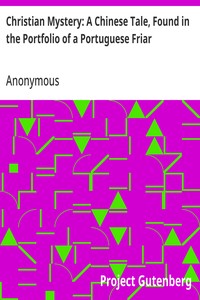
Christian Mystery: A Chinese Tale, Found in the Portfolio of a Portuguese Friar
Let's talk about this wonderfully odd book. First, the title itself is a story: Christian Mystery: A Chinese Tale, Found in the Portfolio of a Portuguese Friar. We have an anonymous author, a Portuguese friar as the discoverer (or maybe the subject?), and China as the setting. It feels like a literary artifact before you even open it.
The Story
The narrative is framed as a discovered document. A Portuguese friar, living in or traveling through China, stumbles upon a hidden community. This isn't your typical village; its members use symbols that look familiar to him—crosses, references to a single god—but in ways that feel completely foreign, mixed with Chinese philosophy and local ritual. The friar becomes an investigator, drawn into their world. He's trying to decode their beliefs: Is this a surviving, isolated Christian sect that arrived centuries ago and evolved on its own? Or is it something indigenous that simply mirrors Christian ideas by accident? The plot follows his quest for answers, which is as much about his own shaken faith as it is about uncovering facts. He faces suspicion, grapples with language barriers, and constantly questions what he's seeing.
Why You Should Read It
What grabbed me wasn't a fast-paced thriller plot, but the thick, immersive atmosphere of confusion and wonder. You feel the friar's disorientation right alongside him. The book brilliantly avoids easy answers. It's less about proving one religion right or wrong and more about exploring how ideas travel, change, and get reinterpreted across vast distances. The characters in the secret society aren't villains or saints; they're just people guarding a tradition they believe is sacred. Their calm certainty contrasts with the friar's increasingly frantic need to categorize them. It makes you think about how much of our own belief is about the story we tell, not just the symbols we use.
Final Verdict
This book is perfect for readers who love historical fiction that feels genuinely mysterious, not just costume drama. It's for anyone fascinated by the early, messy encounters between East and West, long before globalization smoothed the edges. If you enjoyed the philosophical puzzles in Umberto Eco's The Name of the Rose or the cultural exploration in James Clavell's Shōgun, but wished they were quieter and more focused on faith, you'll find a lot to love here. It's a slow-burn, thoughtful mystery that stays with you, mainly because it's brave enough to leave some questions beautifully, frustratingly open.
The copyright for this book has expired, making it public property. Use this text in your own projects freely.
Jennifer Harris
4 months agoExtremely helpful for my current research project.
Jessica Lopez
6 months agoThe layout is perfect for tablet and e-reader devices.
Charles Gonzalez
1 year agoThe layout of the digital version made it easy to start immediately, the data points used to support the main thesis are quite robust. Highly recommended for those seeking credible information.
Thomas Martinez
5 months agoA brilliant read that I finished in one sitting.





Karen Miller
2 months agoI was particularly interested in the case studies mentioned here, the critical analysis of current industry standards is very timely. It’s a comprehensive resource that doesn't feel bloated.