
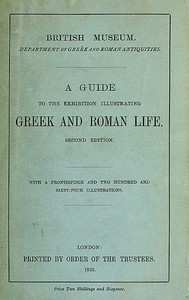
A Guide to the Exhibition Illustrating Greek and Roman Life
Let's be clear: this isn't a novel. There's no protagonist named Marcus going on a quest. Instead, the 'story' here is the reconstruction of a lost world. The book is organized like a walk through a hypothetical exhibition, with each section focusing on a different slice of life. It starts with the fundamentals—where people lived, what their homes looked like, and how they fed themselves. From there, it moves through the rhythms of daily existence: going to school, working a job, enjoying games and theatre, practicing religion, and finally, confronting illness and death.
The Story
The narrative is built by the objects themselves. A simple clay lamp tells a story about dark nights and indoor life. A set of dice and a game board reveal how people relaxed. A stylus and wax tablet show us the act of learning. By grouping these everyday items together, the book builds a coherent picture. It shows the connections between a farmer's tool, the food in a market, and the recipe used to cook it. The 'plot' is the journey from waking up to going to sleep in the ancient Mediterranean, with all the mundane and fascinating details in between.
Why You Should Read It
I love this because it makes history human-sized. It's easy to feel distant from people we see as 'ancient,' but this book breaks that down. When you see a child's rattle or a well-used piece of kitchenware, the gap of centuries suddenly shrinks. You realize these were people with the same basic needs and joys. The writing is straightforward and focuses on explaining what things are and why they mattered. It doesn't get lost in academic jargon. Instead, it feels like having a knowledgeable friend point things out in a gallery, saying, 'Look at this—isn't it cool?'
Final Verdict
This is a perfect pick for anyone who finds skeletons of history—the wars, dates, and kings—a bit dry but is endlessly curious about how people actually lived. It's fantastic for museum-goers who want to get more out of their visits, for writers or game designers looking for authentic details, or for anyone who's ever wondered about the smell of a Roman street or the sound of a Greek workshop. It turns artifacts from 'old things in glass cases' into pieces of a relatable, lived experience.
No rights are reserved for this publication. Distribute this work to help spread literacy.
Linda Martin
1 year agoThis is now a staple reference in my professional collection.
John Thomas
2 years agoThought-provoking and well-organized content.
Logan Brown
1 year agoAfter finishing this book, the clarity of the writing makes this accessible. I will read more from this author.
Mason Moore
1 year agoFive stars!








John Harris
10 months agoHaving followed this topic for years, I can say that the author’s unique perspective adds a fresh layer to the discussion. This adds significant depth to my understanding of the field.