
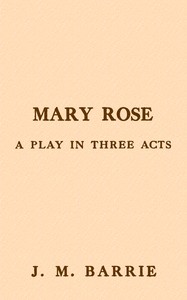
Mary Rose : A play in three acts by J. M. Barrie
Most of us know J.M. Barrie as the man who gave us Peter Pan and Neverland. But Mary Rose is a different kind of magic—darker, quieter, and meant for adults. It shows Barrie wrestling with themes far removed from flying children: loss, the fragility of memory, and the ghosts that aren't always supernatural.
The Story
The play follows Mary Rose, a cheerful young woman. During a trip to a remote Scottish island with her parents, she vanishes without a trace. A massive search finds nothing. Then, years later, she reappears just as suddenly. The impossible part? She hasn't aged, and she has no memory of the missing years. She returns to her husband, Simon, and tries to pick up her life. But the world has moved on. Her son, Harry, is now a young man she doesn't recognize. The play becomes a heartbreaking look at a woman trapped out of time, a living ghost in her own home, while those around her are haunted by the person she was and confused by the person she has become.
Why You Should Read It
This isn't a plot-heavy adventure. Its power is in the atmosphere and the aching questions it leaves you with. Barrie writes about loss in a way that feels deeply personal. Mary Rose isn't just lost on an island; she's lost to herself. The real horror isn't the vanishing act, but the return. How do you love someone who is physically present but emotionally absent? How do you grieve for someone who is standing right in front of you? The characters around Mary Rose—her devoted but bewildered husband, her practical mother—are just as compelling as she is. They represent all of us trying to hold on to things and people that slip through our fingers.
Final Verdict
Perfect for readers who love atmospheric, character-driven stories with a touch of the uncanny. If you enjoyed the melancholy of Kazuo Ishiguro's Never Let Me Go or the quiet hauntings in Shirley Jackson's work, you'll find a kindred spirit here. It's also a must-read for anyone interested in seeing the darker, more complex side of J.M. Barrie. Be prepared for a slow, sad, and beautifully unsettling experience that focuses more on emotional resonance than easy answers.
This content is free to share and distribute. Thank you for supporting open literature.
William Lopez
1 year agoThis book was worth my time since the arguments are well-supported by credible references. Truly inspiring.
Karen Martinez
9 months agoSurprisingly enough, the flow of the text seems very fluid. Definitely a 5-star read.


Carol Lee
1 year agoVery interesting perspective.