
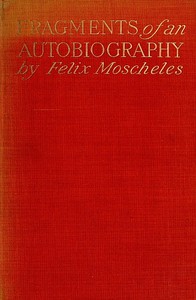
Fragments of an Autobiography by Felix Moscheles
Felix Moscheles had a life that’s hard to summarize. Born into a musical family (his father was a famous composer), he chose painting. He traveled across Europe, became a vocal advocate for peace, and somehow always found himself in the same room as legendary artists, musicians, and thinkers. His "autobiography" is less a chronological story and more a collection of vivid memories and encounters. He doesn't give us a dry list of events; he hands us snapshots—of a lively debate, a quiet moment in a studio, or a grand concert.
The Story
There isn't a single plot driving this book forward. Instead, it’s built around people and moments. Moscheles takes us from his childhood, surrounded by music, to his life as an artist in London and on the continent. The real narrative thread is his relationships. We see his deep friendship with the composer Franz Liszt, his interactions with peace societies, and his observations on the Franco-Prussian War. He writes about these events not as a historian, but as a person who was there, feeling the tension and hearing the arguments. It’s the story of a life spent connecting dots between art, politics, and friendship.
Why You Should Read It
You should read this for the atmosphere. Moscheles has a warm, conversational way of writing that makes you feel like you're listening to stories over tea. He doesn't put these famous people on pedestals; he shows them as human. You get the sense of Liszt's incredible energy, the intellectual climate of the peace movement, and the daily life of an artist. It removes the dust from history. For me, the best parts were the small, unexpected details—the description of a room, a passing comment someone made, the way a piece of music sounded in a particular moment. It brings a whole era into sharp, personal focus.
Final Verdict
This book is perfect for anyone who finds history books a bit too sterile. If you love biographies, memoirs, or just great storytelling about real people, you’ll enjoy this. It’s especially rewarding for readers interested in 19th-century European art and music scenes. Don't go in looking for a dramatic, novel-like plot. Go in ready to meet a charming guide and let him show you around his extraordinary world. It’s a quiet, thoughtful, and deeply human look at the past.
This content is free to share and distribute. Use this text in your own projects freely.
Elizabeth Smith
7 months agoUnlike many other resources I've purchased before, the argument presented in the middle section is particularly compelling. Thanks for making such a high-quality version available.
Mason Sanchez
5 months agoI didn't expect much, but the author's voice is distinct and makes complex topics easy to digest. Thanks for sharing this review.
George Miller
1 year agoA sophisticated analysis that fills a gap in the literature.