
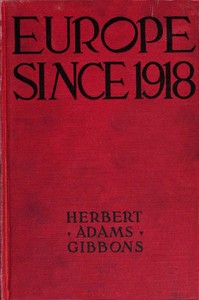
Europe Since 1918 by Herbert Adams Gibbons
Published in 1923, Herbert Adams Gibbons's Europe Since 1918 is a history book that reads like urgent journalism. Gibbons was a reporter and scholar who witnessed the cataclysm of World War I and its messy aftermath firsthand. His book isn't a distant academic summary; it's a dispatch from the front lines of a fragile peace.
The Story
Gibbons picks up the story right at the Armistice in 1918. He walks us through the monumental task the victors faced at the Paris Peace Conference: how do you rebuild a continent shattered by four years of total war? The book maps out the new political landscape, from the creation of shaky new nations like Czechoslovakia and Yugoslavia to the punitive terms imposed on Germany. But Gibbons goes deeper than politics. He looks at the human cost—the refugees, the economic collapse, the deep-seated bitterness—and argues that simply drawing new borders on a map wouldn't heal the real wounds. He tracks the rise of new political forces, including the early rumblings of fascism in Italy and the solidification of communist rule in Russia, showing how the war's unresolved tensions were already setting the stage for the next crisis.
Why You Should Read It
What makes this book so compelling is its perspective. Reading a history written during the events it describes is a completely different experience. There's no foresight, no knowing how it all turns out. You feel the uncertainty, the hope, and the dread of the moment. Gibbons isn't just telling us what happened; he's trying to make sense of it as it happens. His analysis of the Treaty of Versailles is particularly sharp—he saw clearly how its harsh terms planted seeds of future conflict. It's like watching a slow-motion car crash with a narrator who can see the skid marks forming but can't stop the vehicles.
Final Verdict
This book is perfect for anyone who loves history that feels alive and immediate. It's for the reader who enjoyed the big-picture drama of books like The Guns of August but wants to understand what came after the fighting stopped. It's also a fantastic read for modern politics buffs, as it's a masterclass in how the trauma of war and a bad peace can reshape the world for generations. Don't come looking for a simple textbook timeline. Come for a passionate, insightful, and worryingly prescient tour of a continent trying—and, as Gibbons feared, failing—to put itself back together.
This text is dedicated to the public domain. It serves as a testament to our shared literary heritage.

Donald Gonzalez
2 months agoRight from the opening paragraph, the way it handles controversial points with balance is quite professional. I'm genuinely impressed by the quality of this digital edition.