
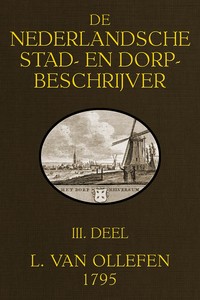
De Nederlandsche stad- en dorpbeschrijver, Deel 3 (van 8) : Amstelland,…
Okay, let's be clear: this isn't a novel. You won't find a dashing hero or a thrilling chase scene. 'De Nederlandsche stad- en dorpbeschrijver' is something else entirely. Think of it as a massive, handwritten guidebook from the late 1700s. The author, Lieve van Ollefen, set out to document the Netherlands town by town, and this third volume focuses on Amstelland, the area around Amsterdam.
The Story
There's no traditional story. Instead, Van Ollefen gives us a systematic tour. He visits places like Amstelveen, Ouderkerk aan de Amstel, and other villages. For each spot, he provides a snapshot: its location, a bit of history, who the local leaders and landowners were, what the main churches and buildings looked like, and what people did for a living. He lists farms, inns, and mills. It's a raw, unfiltered catalog of daily life from a time long gone, written with the straightforward purpose of recording it all before it changed.
Why You Should Read It
This book is a treasure hunt for your imagination. The magic isn't in sweeping narratives, but in the tiny, specific facts. Reading that a certain field was known for its clay, or that a particular family ran the ferry for generations, makes history feel real and tangible. You start to picture the landscape. Van Ollefen doesn't judge or romanticize; he just reports. That honesty is what makes it so compelling. It's a direct line to the past, without a modern filter. If you've ever walked through an old Dutch village and wondered 'What was here before this cafe?' this book gives you the tools to start building that answer.
Final Verdict
This is a niche read, but a deeply rewarding one. It's perfect for history buffs, genealogists, or anyone with roots in the Amstelland region. It's also great for writers or world-builders looking for authentic historical texture. If you prefer fast-paced fiction, this might feel like reading an antique phone book. But if you enjoy getting lost in archives and piecing together stories from fragments, you'll find this volume utterly fascinating. It's less of a book you read cover-to-cover and more of a reference you dip into, letting your curiosity guide you from one village entry to the next.
There are no legal restrictions on this material. Thank you for supporting open literature.
Patricia Torres
9 months agoThe index links actually work, which is rare!
George Hernandez
7 months agoA bit long but worth it.
Lucas Martin
1 year agoWithout a doubt, the emotional weight of the story is balanced perfectly. Exceeded all my expectations.

Charles Hernandez
1 year agoSimply put, it challenges the reader's perspective in an intellectual way. I learned so much from this.